
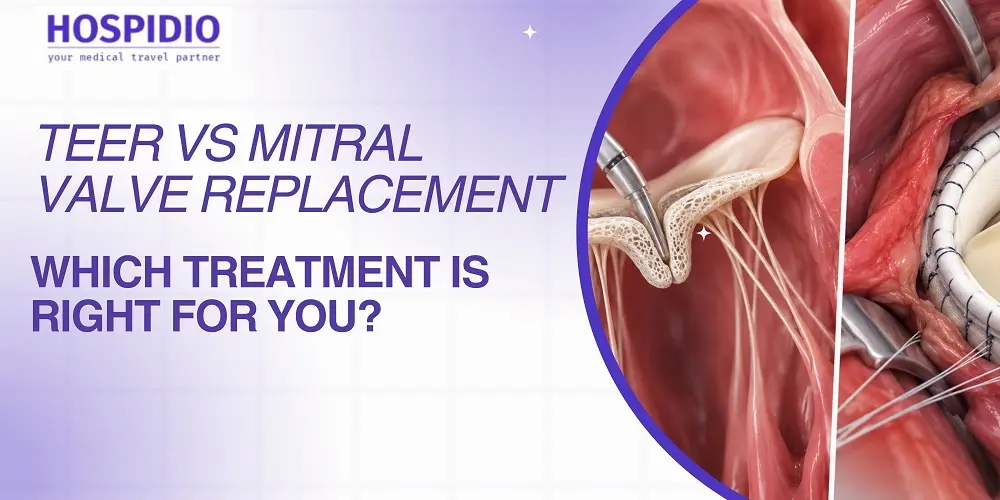
Si votre cardiologue vous a parlé d'une insuffisance mitrale, vous avez probablement entendu parler de deux options très différentes : la réparation mitrale par voie transcathéter (TEER, souvent réalisée avec un dispositif appelé MitraClip) et le remplacement valvulaire mitral. En résumé, la TEER consiste à réparer votre valve existante à l'aide d'un clip inséré par cathéter, sans chirurgie à cœur ouvert, tandis que le remplacement consiste à retirer la valve endommagée et à la remplacer par une nouvelle, généralement par chirurgie à cœur ouvert, bien que des options de remplacement par cathéter soient également en développement. Le choix le plus approprié dépend de votre risque chirurgical, de l'anatomie de votre valve et de la comparaison des deux options en termes de temps de récupération et de durabilité à long terme. C'est précisément ce que ce guide explique en détail.
Qu’est-ce que la TEER ? Comment se déroule concrètement la procédure ?
La technique TEER traite une insuffisance valvulaire mitrale (ou tricuspide) sans retirer la valve. L'équipe de cardiologie insère un cathéter par une veine de l'aine, le guide jusqu'au cœur grâce à l'imagerie en temps réel (échocardiographie transœsophagienne, ou ETO, associée à une radiographie), et fixe un ou plusieurs petits clips sur les bords défectueux des feuillets valvulaires. Ces clips rapprochent les feuillets, ce qui permet à la valve de se fermer plus complètement et de réduire ainsi le reflux sanguin.
L'intervention dure généralement de deux à quatre heures et se déroule sous anesthésie générale, bien qu'il n'y ait pas d'incision thoracique et que le cœur continue de battre. La plupart des patients restent hospitalisés une à trois nuits après l'opération, contre cinq à dix jours pour une chirurgie à cœur ouvert des valves cardiaques . Le MitraClip est le dispositif le plus éprouvé pour la réparation endovasculaire de la valve mitrale (TEER), avec une expérience clinique importante et croissante à travers le monde ; le TriClip est le dispositif équivalent utilisé pour la TEER de la valve tricuspide.
La technique TEER ne remplace rien. Votre valve native reste en place, c'est pourquoi les médecins parlent parfois de réparation plutôt que de remplacement.
Si votre essoufflement, vos œdèmes ou votre fatigue se sont aggravés ces dernières semaines, cette évolution est plus importante que votre état actuel. Demandez une consultation en cardiologie dès maintenant, et non lors de votre prochain rendez-vous de routine.
Qu’est-ce que le remplacement de la valvule mitrale ?
Le remplacement valvulaire consiste à retirer complètement la valve native endommagée et à la remplacer par une prothèse valvulaire mécanique ou biologique (tissulaire). Traditionnellement, cette intervention chirurgicale se pratique à cœur ouvert : le cœur est temporairement arrêté et le flux sanguin est dévié par une machine cœur-poumons. Les nouvelles techniques de remplacement par cathéter, telles que le TMVR (remplacement transcathéter de la valve mitrale) et le TAVR (remplacement transcathéter de la valve aortique), permettent d’insérer une valve de remplacement par cathéter, évitant ainsi une chirurgie à cœur ouvert. Cependant, ces nouvelles voies d’accès ne sont pas encore adaptées à tous les patients ni à toutes les valves.
La convalescence après un remplacement valvulaire chirurgical nécessite généralement cinq à dix jours d'hospitalisation et plusieurs semaines, voire quelques mois, avant de reprendre une activité normale. Cette période est souvent complétée par un programme de réadaptation cardiaque structuré . En contrepartie, le remplacement permet une correction plus complète et plus durable de la fuite, notamment chez les patients dont l'anatomie valvulaire est trop endommagée ou calcifiée pour qu'un clip soit efficace.
Quelle est la place de la réparation chirurgicale ?
La TEER et le remplacement ne sont pas les seules options. La réparation chirurgicale de la valve mitrale, réalisée à cœur ouvert, consiste à retirer le tissu endommagé des feuillets ou à renforcer la valve à l'aide d'un anneau de soutien, tout en conservant la valve native au lieu de la retirer. Lorsqu'une valve est réparable, les recommandations privilégient généralement la réparation au remplacement, car une valve bien réparée a tendance à durer plus longtemps qu'une prothèse. La TEER est souvent mieux comprise comme l'alternative par cathéter à la réparation chirurgicale, car les deux approches visent à préserver la valve native ; le remplacement devient le dernier recours lorsque la valve est trop endommagée, calcifiée ou déformée pour qu'une réparation par clip ou chirurgicale soit possible. Cet article se concentre sur la TEER par rapport au remplacement, car cette comparaison porte sur la décision la plus cruciale : conserver ou non sa valve native. Si une réparation chirurgicale est envisagée, une comparaison plus détaillée mérite une lecture séparée.
TEER vs Remplacement de la valve : Comparaison rapide
| Facteur | TEER (Réparation de clips) | Remplacement de la vanne |
| Que se passe-t-il avec votre vanne ? | Reste en place, les dépliants sont agrafés ensemble. | Retiré et remplacé par une prothèse |
| L’accès | Cathéter inséré par une veine de l'aine | Chirurgie à cœur ouvert (ou cathétérisme, pour TMVR/TAVR) |
| Anesthésie | Généralités, sans incision thoracique | En général, avec incision thoracique pour les voies d'abord chirurgicales |
| séjour hospitalier typique | Entre 1 et 3 jours | Entre 5 et 10 jours |
| Retour à une activité normale | Environ une semaine pour une activité légère | Plusieurs semaines à quelques mois |
| Risque de fuite résiduelle | Plus élevé ; la régurgitation mitrale modérée à sévère récidive plus fréquemment | Inférieur ; correction plus complète |
| taux de réopération | Légèrement plus élevé au fil du temps | Coût en adjuvantation plus élevé. |
| Idéal pour | Patients à haut risque chirurgical, âgés ou fragiles, présentant une anatomie valvulaire favorable | Les patients plus jeunes, à plus faible risque, ou présentant une anatomie trop endommagée pour une pince |
Durabilité : le compromis que personne n'omet.
Voici l'élément essentiel que les patients qui s'intéressent à la TEER doivent bien comprendre. Les données cliniques comparant le MitraClip à la réparation ou au remplacement chirurgical montrent systématiquement la même tendance : la TEER offre une procédure plus douce et une récupération beaucoup plus rapide, mais le remplacement (et la réparation chirurgicale) tendent à mieux résister à l'épreuve du temps.
En comparaison directe, les patients traités par MitraClip présentaient plus fréquemment une insuffisance mitrale résiduelle modérée à sévère à la sortie de l'hôpital que les patients opérés, et cet écart persistait après cinq ans de suivi. Les interventions chirurgicales présentent généralement des taux plus faibles de nécessité de réintervention. Rien de tout cela ne signifie que la TEER soit un moins bon choix ; cela signifie simplement que la TEER privilégie une durabilité à long terme moindre au profit d'une intervention beaucoup moins invasive, ce qui est un compromis idéal pour un patient qui ne pouvait pas supporter une chirurgie à cœur ouvert en toute sécurité.
Qui est un bon candidat pour le programme TEER ?
La TEER est envisagée lorsque la régurgitation mitrale est sévère, que les symptômes et la fonction cardiaque répondent aux critères de traitement, que l'anatomie de la valve se prête au clipping et que l'équipe de cardiologie détermine que la TEER offre un équilibre approprié entre les avantages et les risques liés à la procédure.
Les symptômes et la gravité correspondent au profil suivant : insuffisance mitrale modérée à sévère ou sévère (grade 3 ou plus), avec des symptômes d'insuffisance cardiaque de classe NYHA II, III ou de classe ambulatoire IV, et une fraction d'éjection ventriculaire gauche d'au moins 20 %.
L'anatomie valvulaire est favorable. Les résultats les plus fiables sont obtenus lorsque l'anatomie des feuillets permet une bonne fixation et une coaptation correcte, classiquement en cas de prolapsus isolé du feston moyen (P2) du feuillet postérieur. Les feuillets trop calcifiés, trop étroits ou présentant un écart trop important sont souvent mieux adaptés à un remplacement valvulaire.
Étant donné l'interaction de ces facteurs, la décision est prise par une équipe multidisciplinaire de cardiologie, et non par un simple chiffre ou examen d'imagerie. Les critères d'éligibilité varient également selon que votre régurgitation est primaire (un problème structurel au sein même de la valve, comme un prolapsus valvulaire) ou secondaire (causée par un cœur affaibli ou hypertrophié exerçant une déformation sur la valve) ; les données cliniques justifiant la TEER diffèrent dans les deux cas, il est donc important d'en discuter avec votre équipe de cardiologie plutôt que de se fier uniquement à des critères généraux.
Risques et complications de la TEER
La TEER est moins invasive qu'une intervention chirurgicale, mais elle n'est pas sans risque. Les problèmes les plus fréquents sont liés au point d'insertion du cathéter dans l'aine : ecchymoses, saignements ou lésions vasculaires. Des complications vasculaires majeures surviennent dans environ 1 à 4 % des cas. Plus rarement, les patients peuvent présenter un détachement total ou partiel du clip, des lésions des feuillets valvulaires, un AVC ou d'autres événements ischémiques, une insuffisance rénale due au produit de contraste utilisé pour l'imagerie, ou, exceptionnellement, la nécessité d'une intervention chirurgicale d'urgence si le clip ne parvient pas à réduire suffisamment la fuite. Le taux de complications est généralement inférieur à celui de la chirurgie à cœur ouvert, ce qui explique pourquoi la TEER est privilégiée chez les patients à haut risque. Cependant, « moins risqué qu'une intervention chirurgicale » ne signifie pas « sans risque ».
Une sensation d'oppression thoracique, des évanouissements ou une aggravation soudaine de l'essoufflement ne sont pas des symptômes à surveiller soi-même. Ils nécessitent une prise en charge médicale immédiate, quel que soit le traitement choisi.
TEER mitral vs TEER tricuspidien : Note rapide
Tout ce qui précède concerne la valve mitrale, mais la même approche par clip est utilisée pour la valve tricuspide, grâce à un dispositif appelé TriClip. La technique TEER tricuspidienne a ses propres critères d'éligibilité (les patients présentant un écart important entre les feuillets, une dilatation importante de l'orifice valvulaire ou des sondes de stimulateur cardiaque traversant la valve ont généralement un mauvais pronostic avec un clip et peuvent nécessiter un remplacement valvulaire tricuspidien par voie transcathéter). À ce jour, il n'existe pas de preuves solides permettant de conclure à la supériorité de la réparation ou du remplacement pour la valve tricuspide. Si vous souffrez d'insuffisance tricuspidienne, considérez cet article comme un guide général et demandez à votre équipe de cardiologie quel dispositif est le plus adapté à votre anatomie.
Faire le choix : qu’est-ce qui le détermine réellement ?
Il n'existe pas de solution « idéale » entre la TEER et le remplacement valvulaire ; il n'y a que l'option qui correspond à votre risque chirurgical, à l'anatomie de votre valve et à vos priorités concernant le temps de récupération et la durabilité à long terme. Une équipe multidisciplinaire, comprenant généralement un cardiologue interventionnel et un chirurgien cardiaque, examine votre échocardiographie, votre état de santé général et vos objectifs personnels avant de vous recommander une solution. Si vous êtes en cours d'évaluation pour l'une ou l'autre de ces options, la question la plus pertinente à poser lors de votre rendez-vous n'est pas « laquelle est la meilleure », mais « quelle est la plus adaptée à ma valve et à mon profil de risque ? »
Les options présentées sur cette page dépendent de la capacité de récupération de votre fonction cardiaque. Attendre un diagnostic déjà établi ne préserve pas ces options, mais les restreint.
Si vous ou un membre de votre famille venez de recevoir un diagnostic d'insuffisance mitrale ou tricuspidienne, la prochaine étape consiste à consulter un cardiologue spécialisé dans les pathologies structurelles. Il pourra vous expliquer en détail vos examens d'imagerie et les différentes options qui s'offrent à vous. À lire également : le parcours d'un patient opéré d'une valve aortique par voie mini-invasive.
Références
- Recommandations relatives au dépistage et à la procédure de réparation mitrale bord à bord par cathéter, Centre national d'information sur la biotechnologie
- MitraClip versus chirurgie pour l'insuffisance mitrale, Centre national d'information sur la biotechnologie
- Réparation bord à bord ou remplacement de la valve tricuspideAnalyse comparative et revue d'experts sur la thérapie cardiovasculaire
- TEER (réparation bord à bord par cathéter), Cleveland Clinic
- Complications après réparation bord à bord de la valve mitrale par voie transcathéter, Centre national d'information sur la biotechnologie
- Réparation mitrale bord à bord par voie transcathéter (TEER), UCSF Health
- Couverture de l'essai EVEREST II, Collège américain de cardiologie
Blogs récents




Questions fréquemment posées
Pas tout à fait interchangeables : le MitraClip laisse généralement une légère fuite résiduelle, plus souvent qu’une intervention chirurgicale, et cette fuite persiste même après plusieurs années de suivi. Le MitraClip n’a pas vocation à surpasser la chirurgie ; il vise à offrir une alternative beaucoup plus sûre aux patients ne pouvant pas subir une opération à cœur ouvert, en privilégiant une durabilité légèrement inférieure à long terme au détriment d’un risque opératoire considérablement réduit.
Il n'y a pas de date de péremption fixe pour le clip lui-même, mais sa « durabilité » fait référence à sa capacité à contrôler efficacement la fuite au fil du temps. Certains patients développent une régurgitation modérée ou sévère récidivante des années après l'intervention et peuvent nécessiter une nouvelle TEER ou un remplacement valvulaire ultérieur. Le suivi échocardiographique régulier permet à votre cardiologue de surveiller ces régurgitations.
La plupart des patients reçoivent un traitement antiplaquettaire de courte durée après une réparation endovasculaire de la valve mitrale (TEER), et non une anticoagulation complète à vie. Toutefois, ce traitement varie selon le dispositif, la valve et les facteurs de risque individuels, comme la fibrillation auriculaire. Les prothèses valvulaires tricuspidiennes présentent généralement une probabilité plus élevée de nécessiter une anticoagulation continue que les clips mitraux. Votre cardiologue établira le plan de traitement spécifique en fonction de votre cas.
Oui, un clip peut se détacher partiellement ou la fuite peut réapparaître malgré le clip. Dans ce cas, les options comprennent généralement une nouvelle intervention TEER, ou un remplacement valvulaire chirurgical ou par cathéter, selon votre anatomie et l'évolution de votre profil de risque depuis la première intervention. Un échec ne signifie pas que toutes les solutions existent.
La technique TEER est le plus souvent utilisée chez les patients âgés ou à haut risque, car c'est dans cette population que sa moindre lourdeur opératoire est la plus importante. Cependant, l'âge seul n'est pas le facteur déterminant. Un patient plus jeune présentant un risque chirurgical prohibitif lié à d'autres pathologies peut être candidat à la TEER, et un patient plus âgé avec une anatomie favorable et un faible risque chirurgical peut être orienté vers une réparation chirurgicale. L'équipe de cardiologie évalue conjointement les scores de risque et l'anatomie, et non l'âge seul.
La plupart des patients ayant subi une TEER passent un à trois jours à l'hôpital et reprennent leurs activités quotidiennes légères en une semaine environ, car cette intervention ne nécessite ni incision thoracique ni circulation extracorporelle. Le remplacement valvulaire chirurgical implique généralement cinq à dix jours d'hospitalisation et plusieurs semaines, voire quelques mois, de convalescence, avec notamment des restrictions concernant le port de charges lourdes et la conduite pendant la consolidation du sternum. Certains patients après une TEER suivent un court programme de réadaptation cardiaque pour améliorer leur endurance, même si l'intervention elle-même est beaucoup moins invasive.
Les médicaments (généralement des diurétiques et des traitements pour l'insuffisance cardiaque) permettent de soulager les symptômes et sont souvent prescrits en première intention, mais ils ne corrigent pas une fuite valvulaire structurelle. La réparation endovasculaire (TEER) ou le remplacement valvulaire sont généralement envisagés lorsque la régurgitation est modérée à sévère, voire sévère, que les symptômes sont importants et que les médicaments seuls ne permettent plus un contrôle efficace. Votre cardiologue suit l'évolution de la gravité de la régurgitation et de la fonction cardiaque afin de déterminer le moment opportun pour envisager un autre traitement.
Non, et c'est une confusion fréquente. Le TAVI (remplacement valvulaire aortique par voie transcathéter) consiste à remplacer la valve aortique par une nouvelle prothèse valvulaire introduite par cathéter ; la TEER répare la valve mitrale ou tricuspide en fixant les feuillets existants sans les retirer. Ces deux techniques traitent des valves différentes selon des approches fondamentalement différentes, bien qu'elles soient toutes deux réalisées par cathéter et évitent la chirurgie à cœur ouvert.
Dr. Basim Parvez est physiothérapeute agréé et consultant principal auprès des patients chez HOSPIDIO. Titulaire d'un MBA en gestion de la santé, il possède une vaste expérience clinique et une approche empreinte de compassion, et accompagne les patients tout au long de leurs traitements médicaux. Dr. Basim met également à profit son talent d'écriture pour simplifier des informations complexes en matière de santé, permettant ainsi aux patients de prendre des décisions éclairées et favorisant la clarté et la confiance dans leur parcours médical.
Sasmita Bal est spécialiste du marketing digital et du contenu chez HOSPIDIO, experte en SEO et en contenu relatif à la santé internationale. Elle vérifie les contenus publiés afin d'optimiser leur visibilité dans les moteurs de recherche et de garantir leur pertinence par rapport aux besoins des patients internationaux souhaitant se faire soigner en Inde. Tous les contenus qu'elle examine sont rédigés et validés cliniquement par le fondateur de HOSPIDIO et les spécialistes médicaux concernés avant leur publication.