
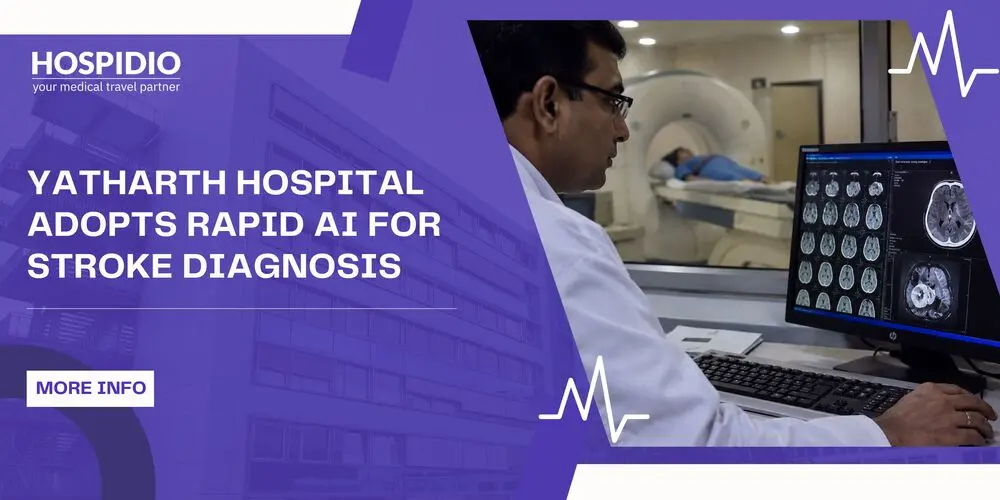
A major step forward in emergency neurology care has been announced in India. Yatharth Super Speciality Hospital, located at Omega-1 in Greater Noida, has officially integrated Rapid AI, an artificial intelligence driven imaging platform built to dramatically speed up the diagnosis of brain strokes and other critical neurovascular conditions. This adoption marks a turning point for stroke care in the region, and signals a broader shift in how Indian hospitals are harnessing AI to save lives in time-critical emergencies.
For anyone who has witnessed a loved one suffer a stroke, the phrase "time is brain" carries visceral weight. Every minute that a stroke goes undiagnosed, nearly two million neurons are lost. In that context, a technology that can deliver colour coded CT scan analysis in under three minutes is not merely a clinical upgrade, it is the difference between recovery and permanent disability.
What Is a Brain Stroke, And Why Speed Is Everything
A brain stroke is a life threatening medical emergency that occurs when the blood supply to part of the brain is suddenly interrupted. This can happen in two distinct ways: either a blood clot blocks a vessel (ischaemic stroke) or a vessel ruptures and bleeds into brain tissue (haemorrhagic stroke). In both scenarios, brain cells are deprived of oxygen and nutrients and begin to die within minutes.
The severity of a stroke depends on which area of the brain is affected and how long blood flow remains disrupted. Symptoms may include sudden numbness or weakness on one side of the body, difficulty speaking, confusion, vision disturbances, and loss of balance or coordination. Recognising these warning signs early and getting the patient to a capable facility can be the single most important factor in their survival and recovery.
To make recognition easier, neurologists use the BE FAST acronym: Balance, Eyes, Face, Arms, Speech, Time. Each letter corresponds to a warning sign. If any of these appear suddenly, it is time to call emergency services immediately and head to the nearest stroke-capable centre.
What Is Rapid AI, And How Does It Work?
Rapid AI is a clinically validated, AI-powered platform specifically designed for neurovascular imaging analysis. It uses advanced machine learning algorithms to automatically process brain CT scans and other neuroimaging data in real time, providing clinicians with fast, standardised, and actionable insights that would otherwise require significant manual review time.
The platform is capable of:
- Detecting large vessel occlusions (LVOs): blocked arteries that typically cause the most severe strokes
- Identifying haemorrhages and quantifying their extent
- Assessing the volume of salvageable brain tissue (the "penumbra") versus already damaged tissue (the "core")
- Generating colour coded imaging results in less than three minutes, regardless of time of day or staffing levels
Crucially, Rapid AI does not rely on the immediate availability of a specialist. It works around the clock and delivers consistent, globally standardised results, a vital capability in hospital settings where on call neurology coverage may be limited. The majority of international clinical stroke trials and evidence based treatment guidelines have been built on data collected using this platform.
The Announcement: Yatharth Hospital's Integration
Yatharth Super Speciality Hospital's decision to adopt Rapid AI represents a significant investment in its neurocritical care infrastructure. The hospital, serving the growing Greater Noida and NCR region, now has the ability to deploy AI-assisted stroke diagnostics for every patient presenting with acute neurological symptoms, day or night.
Dr Sumit Goyal, Director and Head of Department of Neurosurgery and Group Director of Neurointervention at Yatharth Hospital, highlighted the clinical urgency behind the adoption. He noted that stroke management is extremely time sensitive and that Rapid AI's capacity to rapidly analyse brain scans and highlight critical abnormalities empowers the neuro team to make immediate and well informed treatment decisions, with the goal of improving survival rates and reducing long term disability in patients.
Dr Sunil Baliyan, COO and Facility Director, echoed this sentiment, noting that the hospital continually strives to bring the latest healthcare technology to its patients. He described the introduction of Rapid AI as a significant milestone in their commitment to delivering faster, more precise, and life-saving interventions, especially in neurological emergencies where every second counts.
The Problem With Traditional Stroke Diagnosis
To appreciate why this development matters, it helps to understand the limitations of conventional diagnostic workflows. In most hospital settings, a suspected stroke patient arrives at the emergency department and undergoes a CT scan. That scan then needs to be reviewed, often by a radiologist or neurologist who may not be immediately on site. Manual review of complex imaging, especially for quantifying penumbra size or identifying subtle LVOs, is time consuming and subject to variability between reviewers.
In rural or semi-urban facilities, these delays can stretch from minutes to hours. Even in well staffed hospitals, after-hours coverage gaps can create life threatening bottlenecks. Rapid AI eliminates this by delivering standardised, repeatable, AI-generated analysis instantly, removing human availability as a variable in the diagnostic chain.
Why This Matters for Patients: In India and Beyond
India carries a significant stroke burden. Estimates suggest that stroke is among the leading causes of mortality and long term disability in the country, with urban and semi-urban populations showing rising incidence rates due to hypertension, diabetes, sedentary lifestyles, and pollution. Access to advanced stroke care, however, remains highly uneven, concentrated in major metros and premium hospitals.
Yatharth Hospital's adoption of Rapid AI in Greater Noida, a rapidly urbanising region with a dense and growing population, signals that AI-powered diagnostics are beginning to reach beyond Tier-1 cities. For the thousands of patients who arrive at secondary and tertiary hospitals outside Delhi or Mumbai, this kind of institutional investment could make a decisive difference in their outcomes.
Beyond India, this adoption also reflects a global trend. Rapid AI is already in use across hundreds of hospitals in Europe, North America, and Southeast Asia. Its integration into Indian hospitals not only raises the quality of local care but also places those facilities within an internationally benchmarked standard of stroke management.
Key Takeaways for Patients and Families
If you or someone near you experiences the following, act immediately:
- Sudden weakness or numbness in the face, arm, or leg especially on one side
- Sudden confusion, trouble speaking, or difficulty understanding speech
- Sudden trouble seeing in one or both eyes
- Sudden severe headache with no known cause
- Sudden dizziness, loss of balance, or loss of coordination
Head to the nearest stroke ready hospital as quickly as possible. Ask the emergency team whether the facility has AI-assisted imaging analysis, it could materially shorten the time from your arrival to treatment initiation.
Conclusion
The integration of Rapid AI at Yatharth Super Speciality Hospital, Greater Noida, is more than a technology headline, it is a meaningful advancement in accessible, timely, and high quality neurological emergency care. By automating the analysis of complex brain imaging and delivering results in under three minutes, the hospital is directly addressing one of the most persistent and costly problems in stroke management: diagnostic delay.
As AI-assisted diagnostics continue to move from leading academic centres into community hospitals across India, patients, families, and healthcare workers alike stand to benefit. In stroke care, where every minute matters, that transition cannot come fast enough.
References
- BW Healthcare World. (April 4, 2026). Yatharth Super Speciality Hospital Adopts Rapid AI For Faster Stroke Diagnosis. https://www.bwhealthcareworld.com/article/yatharth-super-speciality-hospital-adopts-rapid-ai-for-faster-stroke-diagnosis-600788
- Rapid AI (iSchemaView). Clinical Platform Overview. https://www.rapidai.comWorld Stroke Organization.
- Global Stroke Fact Sheet 2022. https://www.world-stroke.org
About Hospidio: This blog post is intended to provide factual, evidence based information to keep our community informed about healthcare developments in India and globally. Always consult with qualified healthcare professionals for medical advice and follow the guidance of your treating physician or local health authorities.
Recent Blogs
Frequently Asked Questions
Rapid AI is an artificial intelligence powered imaging platform that automatically analyses brain CT scans to detect strokes, large vessel occlusions, and haemorrhages. It delivers colour coded results in under three minutes, helping doctors make faster and more accurate treatment decisions without waiting for a specialist to be available onsite.
Yatharth Super Speciality Hospital, Omega-1, Greater Noida, has integrated Rapid AI into its neurology and emergency care workflow, making it one of the early adopters of this globally recognised stroke diagnostic technology in the NCR region.
By reducing diagnostic delays, Rapid AI enables doctors to initiate treatment, such as clot busting medication or surgical intervention much sooner. Since every minute of delay in stroke treatment results in the loss of nearly two million neurons, faster diagnosis directly translates to better survival rates and reduced long term disability.
recommend using the BE FAST framework, watch for sudden loss of Balance, changes in Eyes or vision, drooping Face, weakness in Arms, slurred Speech, and if any of these appear, Time to call emergency services immediately and reach the nearest stroke-ready hospital.
Yes. One of Rapid AI's key advantages is that it functions round the clock without requiring a neurologist or radiologist to be physically present. It automatically processes scans and flags critical findings, ensuring consistent diagnostic quality even during night hours or in facilities with limited specialist coverage.
Doctors recommend using the BE FAST framework, watch for sudden loss of Balance, changes in Eyes or vision, drooping Face, weakness in Arms, slurred Speech, and if any of these appear, Time to call emergency services immediately and reach the nearest stroke ready hospital.
Shruti Verma has completed her M.Tech in Biotechnology with experience in medical writing and scientific content development. She specializes in translating complex biomedical and healthcare information into clear, accurate, and reader-friendly content for diverse audiences. When she is not designing content, probably she is designing graphics.
Guneet Bhatia is the Founder of HOSPIDIO and an accomplished content reviewer with extensive experience in medical content development, instructional design, and blogging. Passionate about creating impactful content, she excels in ensuring accuracy and clarity in every piece. Guneet enjoys engaging in meaningful conversations with people from diverse ethnic and cultural backgrounds, enriching her perspective. When she's not working, she cherishes quality time with her family, enjoys good music, and loves brainstorming innovative ideas with her team.