
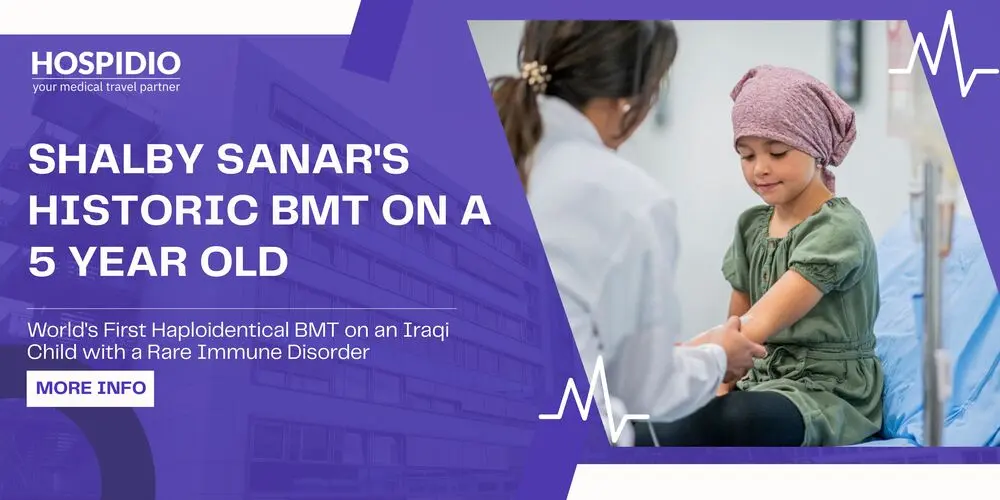
In a landmark moment for pediatric medicine, a team of doctors in India has successfully performed the world's first Haploidentical Bone Marrow Transplant (BMT) on a five-year-old child with an extraordinarily rare immune disorder, a procedure that, until now, had never been reported anywhere in global medical literature at this age. The patient, Master Abbas, a young boy from Waset, Iraq, is recovering well after the groundbreaking procedure carried out at SHALBY Sanar International Hospitals in Gurugram. For families around the world whose children face rare immunodeficiency disorders without a fully matched donor, this case marks a turning point in what is medically possible.
What Happened: The Case at a Glance
Master Abbas arrived at SHALBY Sanar International Hospitals with a diagnosis that stumped specialists: a Common Variable Immunodeficiency (CVID) like phenotype caused by an IKZF-1 gene mutation, a condition so rare it has almost no documented precedent in a child of his age anywhere in the world. As if the diagnosis alone were not complex enough, his clinical picture was further complicated by Chronic Liver Disease (CLD) and Leaky Gut Syndrome, conditions that had to be stabilized before any transplant could even be considered.
The biggest obstacle the medical team faced, however, was the absence of a 100% HLA matched donor. In standard bone marrow transplantation, a full match between donor and recipient tissue types is the preferred, safest route. Master Abbas had none. His medical team, led by Dr. Satyendra Katewa, Director and Head of the Department of Blood and Marrow Transplant and Cellular Therapies at SHALBY Sanar, made the decision to proceed with a 50% HLA matched, or Haploidentical, BMT. That decision, backed by rigorous preparation and clinical expertise, has now entered the history books.
Understanding the Condition: What Is CVID-like Phenotype with IKZF-1 Mutation?
To appreciate why this case is so significant, it helps to understand what Master Abbas was battling.Common Variable Immunodeficiency (CVID) is a primary immune disorder characterised by low levels of antibodies and a severely weakened ability to fight infections. However, Master Abbas's condition was caused by a mutation in the IKZF-1 gene, a gene that plays a critical role in the development of immune cells. This specific mutation creating a CVID-like phenotype in a five-year-old is, by all accounts, an extraordinarily rare occurrence. No case with a bone marrow transplant outcome has been reported in published world literature in a child this young.
Left untreated, this condition would leave a child perpetually vulnerable to life threatening infections, unable to build meaningful immunity. For Master Abbas, a bone marrow transplant was not optional, it was the only path toward a functional life.
What is a Haploidentical Bone Marrow Transplant?
A bone marrow transplant, also known as a stem cell transplant, works by replacing a patient's diseased or non-functioning bone marrow with healthy donor marrow that can produce normal blood cells and restore immune function. The procedure involves:
- Conditioning: High-dose chemotherapy (and sometimes radiation) to destroy the patient's existing diseased bone marrow and suppress the immune system.
- Infusion: Healthy donor stem cells are infused into the patient's bloodstream intravenously, similar to a blood transfusion.
- Engraftment: The donor stem cells travel to the bone marrow cavities, settle, and begin producing healthy blood cells.
In an ideal scenario, the donor and recipient share a 100% HLA (Human Leukocyte Antigen) match, a set of proteins on cells that help the immune system distinguish the body's own cells from foreign ones. When a perfect match is not available, a Haploidentical transplant uses a half matched (50% HLA matched) donor, typically a biological parent or sibling.
Haploidentical BMT has been used in adults and older children in specific contexts, but performing it on a five year old with a complex primary immunodeficiency, alongside active liver disease and gut involvement, had never been documented before. The immune and physiological stakes at this age are significantly higher, making the procedure technically demanding and clinically high risk.
How the Medical Team Prepared for the Procedure
Before the transplant could proceed, the team at SHALBY Sanar had to address Master Abbas's co-existing conditions. His Chronic Liver Disease and Leaky Gut Syndrome were managed through specialised treatments to stabilise his overall health, a necessary prerequisite to ensure his body could withstand the rigours of high-dose conditioning chemotherapy.
Dr. Satyendra Katewa, commenting on the case, acknowledged both the gravity and the significance of what the team undertook: "This was a very challenging case, but our team worked together to overcome the difficulties." The coordinated effort across haematology, immunology, gastroenterology, and transplant medicine reflects the kind of multidisciplinary approach that defines world class medical care.
Why India? The Rise of India as a Global Medical Destination
This milestone did not happen by chance. India's position as a leader in complex bone marrow and stem cell transplantation has been steadily growing over the past two decades.
Several factors have made India a compelling destination for international patients seeking advanced haematological care:
- Cost-effectiveness: BMT procedures in India cost a fraction of what similar treatment would in the United States, United Kingdom, or Western Europe, without compromising clinical outcomes.
- Specialised expertise: Indian transplant units have accumulated significant experience across allogeneic, autologous, and now haploidentical transplantation, backed by fellowship-trained specialists.
- Infrastructure: Hospitals like SHALBY Sanar in Gurugram operate dedicated BMT units with sterile environments, advanced apheresis, and cellular therapy capabilities that meet international standards.
- Medical tourism infrastructure: From medical visa facilitation to international patient services, India has built robust systems to receive and support patients from the Middle East, Africa, Southeast Asia, and beyond.
Master Abbas's journey from Iraq to Gurugram is part of a much larger pattern. Every year, hundreds of paediatric patients from across the world, particularly from Iraq, Egypt, Bangladesh, Nigeria, and Kenya, travel to India for bone marrow transplants that are either unavailable or unaffordable in their home countries.
What This Breakthrough Means for Future Patients
The successful outcome of Master Abbas's transplant carries profound implications:
- It establishes that Haploidentical BMT is technically feasible and potentially life saving in young children with rare primary immunodeficiencies, even in the absence of a fully matched donor.
- It expands the pool of candidates who can be considered for transplant, because a biological parent is almost always available as a 50% HLA matched donor, this approach dramatically reduces the barrier of finding suitable donors.
- It creates a documented precedent in world medical literature that could guide future protocols for CVID-like conditions caused by IKZF-1 mutations in paediatric patients.
For families who have been told their child has no matched donor and therefore no transplant option, this case offers a new and credible pathway forward.
Conclusion
The story of Master Abbas is more than a medical news headline, it is a testament to what happens when clinical expertise, institutional commitment, and cross border medical collaboration converge around a child who had nowhere else to turn. India's SHALBY Sanar International Hospitals has placed itself at the frontier of paediatric haematology with a procedure the world had not seen before.
For international patients and families navigating rare blood disorders or immunodeficiency conditions, this achievement underscores why India continues to be one of the most capable and accessible destinations for life-changing medical care. If your child or a family member is facing a haematological condition and you are looking for guidance on treatment options in India, reach out to HOSPIDIO. Our patient consultants can connect you with leading specialists and BMT centres, completely free of charge.
References
- Times of India. (March 2025). 5-year-old boy from Iraq undergoes world's first of its kind bone marrow transplantation in India. Retrieved from https://timesofindia.indiatimes.com/life-style/health-fitness/health-news/5-year-old-boy-from-iraq-undergoes-worlds-first-of-its-kind-bone-marrow-transplantation-in-india/articleshow/119760392.cms
- SHALBY Sanar International Hospitals. (April 2025). SHALBY Sanar Performs World's First Haploidentical Bone Marrow Transplant to Save Young Boy with Rare Immune Disorder. Retrieved from https://www.shalby.org/news-media/shalby-sanar-performs-worlds-first-haploidentical-bone-marrow-transplant-to-save-young-boy-with-rare-immune-disorder/
- Vibes of India. (March 2025). World's First Haploidentical Bone Marrow Transplant Saves Young Boy With Rare Immune Disorder. Retrieved from https://www.vibesofindia.com/worlds-first-haploidentical-bone-marrow-transplant-saves-young-boy-with-rare-immune-disorder/
About Hospidio: This blog post is intended to provide factual, evidence-based information to keep our community informed about global health developments and medical travel opportunities. Always consult with healthcare professionals for medical advice specific to your situation.
Recent Blogs
Shruti Verma has completed her M.Tech in Biotechnology with experience in medical writing and scientific content development. She specializes in translating complex biomedical and healthcare information into clear, accurate, and reader-friendly content for diverse audiences. When she is not designing content, probably she is designing graphics.
Guneet Bhatia is the Founder of HOSPIDIO and an accomplished content reviewer with extensive experience in medical content development, instructional design, and blogging. Passionate about creating impactful content, she excels in ensuring accuracy and clarity in every piece. Guneet enjoys engaging in meaningful conversations with people from diverse ethnic and cultural backgrounds, enriching her perspective. When she's not working, she cherishes quality time with her family, enjoys good music, and loves brainstorming innovative ideas with her team.