
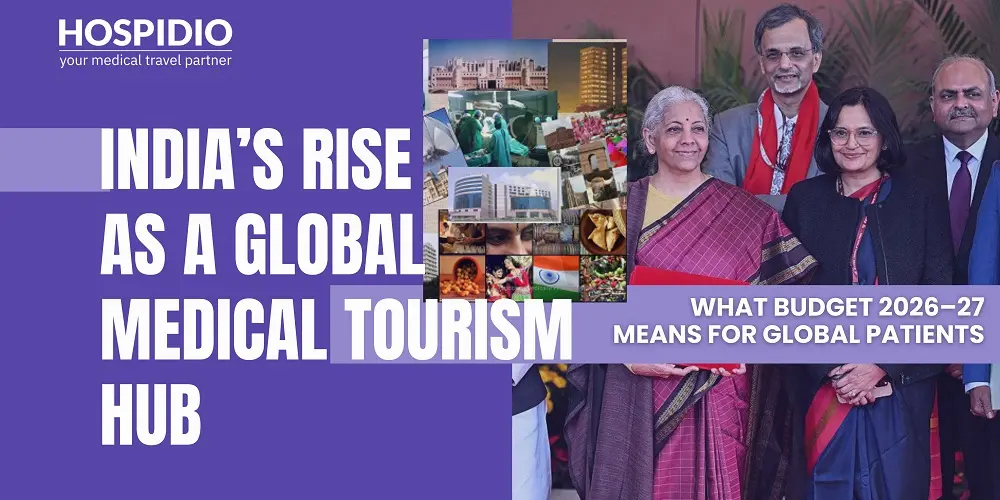
A Turning Point for Global Healthcare Seekers
For millions of patients across the world, access to timely, affordable, and high-quality medical care has become increasingly challenging. Rising treatment costs, long waiting periods, and limited access to advanced procedures in many countries are forcing patients to look beyond borders for healthcare solutions.
India has steadily emerged as one of the most trusted destinations for international patients — and the Union Budget 2026–27 has further strengthened this position.
We Handle the Planning
You Focus on Recovery
From Medical Visa assistance to airport pick-up and local stay, HOSPIDIO manages your entire medical trip.
Tell Us About Your Need
Free case review. Confidential. No obligation.Presented by Nirmala Sitharaman, the Union Budget 2026–27 clearly outlines India’s long-term vision to position the country as a global healthcare and medical tourism hub, backed by infrastructure investment, workforce development, regulatory strengthening, and dedicated Medical Value Tourism (MVT) initiatives.
For international patients considering treatment abroad, this Budget is more than an economic document — it is a policy-backed signal of trust, quality, and preparedness.
What the Union Budget 2026–27 Says About Healthcare
Healthcare has been placed at the core of India’s development agenda under the broader vision of Viksit Bharat. The Budget recognizes that a strong healthcare ecosystem is essential not only for domestic well-being but also for positioning India as a global services leader.
Key Healthcare-Focused Announcements from the Budget
According to the official Budget Speech 2026–27, the government has announced:
- Expansion and upgrading of healthcare infrastructure, especially in Tier-II and Tier-III cities
- Strengthening of medical education and allied health professionals, with a target of adding over 100,000 trained Allied Health Professionals (AHPs) in the next five years
- Creation of a robust care ecosystem, including geriatric care, rehabilitation, and post-treatment support
- Enhanced focus on quality standards, accreditation, and global best practices in healthcare delivery
This approach directly addresses two critical concerns of international patients:
- Quality and safety of treatment
- Availability of skilled medical professionals across specialties
As highlighted in national media discussions, senior healthcare leaders have welcomed this structured and long-term push. Speaking on Aaj Tak after the Budget, Naresh Trehan emphasized that India’s focus on integrated healthcare infrastructure and skilled workforce development will significantly enhance global confidence in Indian medical services.
Budget 2026–27 Strengthens India’s Advantage in Cancer & Advanced Treatments
One of the most impactful yet less discussed outcomes of Budget 2026–27 is its direct benefit to patients undergoing cancer and complex medical treatments in India.
To reduce the financial burden on patients, the government has removed basic customs duty on 17 essential medicines, many of which are widely used in oncology, immunotherapy, and advanced treatments. In addition, seven more rare diseases have been included under duty-free personal imports of medicines.
For international patients, this means that treatment in India is not only affordable at the procedure level but remains cost-effective throughout long-term therapy and recovery. Expensive cancer drugs and post-treatment medications, which often make treatment unaffordable in many countries, become significantly more accessible when patients choose India.
This move reinforces India’s position as a destination where quality care does not come with lifelong financial stress.
Biopharma SHAKTI: Advancing Access to Modern Cancer & Biologic Medicines
Budget 2026–27 also marks a strategic shift in strengthening India’s pharmaceutical and biopharma ecosystem through the launch of Biopharma SHAKTI, a dedicated initiative aimed at developing India as a global hub for advanced medicines.
With a focus on biologics and biosimilars, this initiative supports treatments for cancer, autoimmune disorders, and chronic diseases that are increasingly sought by international patients. The program includes investments in pharmaceutical research institutes, expansion of accredited clinical trial centres, and improvements in regulatory systems to meet global standards.
For medical tourists, this translates into faster availability of next-generation therapies, reliable quality benchmarks, and reduced dependency on imported high-cost drugs. Patients travelling to India benefit from modern treatments that combine innovation with affordability—an advantage that few global healthcare destinations can currently offer.
Medical Tourism as a Strategic National Priority
One of the most important — and globally relevant — aspects of the Union Budget 2026–27 is the explicit recognition of Medical Value Tourism (MVT) as a strategic growth sector.
Dedicated Push for Medical Value Tourism
The Budget proposes the establishment of five Regional Medical Value Tourism Hubs across India, developed in partnership with the private sector. These hubs are designed as integrated healthcare ecosystems, combining:
- World-class hospitals
- Medical education and research institutions
- Diagnostic and rehabilitation facilities
- AYUSH and wellness centres
- Dedicated Medical Tourism Facilitation Centres
These hubs are intended to serve international patients end-to-end — from arrival and diagnosis to treatment, recovery, and follow-up care.
Why This Matters to International Patients
For patients travelling abroad for treatment, fragmentation is often the biggest challenge. The government’s hub-based approach ensures:
- Seamless coordination of care
- Standardized quality across facilities
- Improved post-treatment and rehabilitation services
- A patient-friendly ecosystem designed specifically for global visitors
This policy-backed structure significantly reduces uncertainty and risk — two major barriers that international patients typically face when choosing a treatment destination.
How Budget 2026–27 Directly Benefits International Patients
For international patients, government policy only matters if it translates into real, on-ground advantages. The Union Budget 2026–27 does exactly that by addressing the most important decision factors for patients seeking treatment abroad.
Better Infrastructure Beyond Metro Cities
One of the most impactful aspects of the Budget is the continued expansion of healthcare infrastructure beyond traditional metro hubs. With increased capital expenditure and focused development of Tier-II and Tier-III cities, India is creating distributed centres of medical excellence.
For international patients, this means:
- Reduced congestion at top hospitals
- Faster appointment and surgery timelines
- More personalized care environments
- Availability of advanced treatments across multiple regions
This also lowers overall treatment and stay costs without compromising clinical outcomes — a major advantage for long-duration treatments such as oncology, orthopaedics, and transplants.
Skilled Medical Workforce at Global Scale
A frequent concern among international patients is continuity of care — from diagnosis to recovery. The Budget directly addresses this by investing heavily in human capital.
Key initiatives include:
- Addition of 100,000+ Allied Health Professionals over five years
- Specialized training across radiology, anaesthesia, OT technology, behavioural health, and rehabilitation
- Development of a strong caregiver and post-care ecosystem, including wellness and rehabilitation services
This ensures that international patients are supported not only by expert doctors, but also by highly trained multidisciplinary teams — a critical requirement for complex and long-stay treatments.
Integrated Medical Value Tourism Hubs
The proposed Regional Medical Value Tourism Hubs represent a structural shift in how India serves global patients.
Unlike fragmented treatment journeys seen in many countries, these hubs are designed to offer:
- Diagnosis, treatment, recovery, and rehabilitation under one ecosystem
- Dedicated facilitation centres for international patients
- AYUSH and wellness integration for holistic recovery
- Infrastructure aligned with global expectations of comfort and care
For international patients, this reduces uncertainty, improves coordination, and enhances overall experience — a key differentiator when choosing a destination for medical travel.
Why India Already Leads in Medical Tourism — Even Before the Budget
While the Union Budget 2026–27 accelerates India’s journey, the country already holds a strong position in global medical tourism. The Budget builds on these existing strengths rather than starting from scratch.
World-Class Clinical Outcomes at Affordable Costs
India consistently delivers outcomes comparable to developed countries — often at 30–70% lower costs. This cost advantage is not driven by compromised quality, but by:
- Efficient hospital operations
- Large talent pool of highly experienced doctors
- Competitive medical education ecosystem
Many Indian hospitals follow international treatment protocols aligned with global standards recommended by bodies such as the World Health Organization.
Globally Accredited Hospitals and Safety Standards
India is home to a large number of internationally accredited hospitals, including those certified by:
- National Accreditation Board for Hospitals & Healthcare Providers
- Joint Commission International (JCI)
These accreditations assure international patients of:
- Patient safety protocols
- Infection control standards
- Ethical clinical practices
- Transparent treatment processes
The Budget’s emphasis on strengthening regulatory bodies and approval systems further reinforces global trust in India’s healthcare ecosystem.
Minimal Waiting Time Compared to Western Healthcare Systems
In many developed countries, patients face waiting periods of months — sometimes years — for surgeries such as joint replacements, cardiac procedures, or advanced diagnostics.
India offers:
- Faster consultations
- Quick diagnostic turnaround
- Timely surgical scheduling
This time advantage is often the deciding factor for international patients with urgent or quality-of-life-impacting conditions.
Treatments That Attract International Patients to India
India’s medical tourism growth is not generic — it is driven by specific high-demand treatments where the country has built deep expertise.
Cardiac Care
India is globally recognized for:
- Bypass surgery
- Valve replacements
- Minimally invasive cardiac procedures
High volumes and experienced cardiac surgeons allow for excellent outcomes at a fraction of the cost seen in Western countries.
Orthopedics and Joint Replacement
International patients frequently travel to India for:
- Knee replacement
- Hip replacement
- Spine surgeries
Advanced implants, robotic surgery options, and structured rehabilitation programs make India a preferred destination for mobility-restoring procedures.
Oncology (Cancer Care)
India offers comprehensive cancer treatment including:
- Surgical oncology
- Medical oncology
- Radiation therapy
- Targeted and immunotherapy
The Budget’s focus on diagnostics, workforce training, and infrastructure expansion further strengthens India’s oncology capabilities.
Organ Transplants and Complex Surgeries
India has developed strong expertise in:
- Liver transplants
- Kidney transplants
- Bone marrow transplants
Combined with improved post-operative care and ethical regulatory oversight, this makes India a trusted option for complex procedures.
Wellness, AYUSH, and Rehabilitation
With global interest rising in holistic recovery, India’s integration of AYUSH, yoga, and wellness therapies — supported by the Budget — adds a unique dimension to medical tourism.
For international patients, this means:
- Faster recovery
- Better post-treatment quality of life
- Comprehensive mind–body care
India vs Other Medical Tourism Destinations: A Global Comparison
When international patients evaluate treatment abroad, they typically compare multiple destinations such as Southeast Asia, Eastern Europe, and parts of the Middle East. The Union Budget 2026–27 further strengthens India’s comparative advantage across the most critical decision parameters.
Cost vs Quality Balance
While countries like Thailand, Turkey, or parts of Eastern Europe offer lower-cost treatments, India consistently delivers:
- Greater depth of clinical expertise
- Higher volumes of complex procedures
- Access to advanced technology at scale
Unlike destinations that specialize in limited procedures, India offers a full-spectrum healthcare ecosystem — from primary diagnostics to highly complex surgeries — under one system.
Workforce Depth and Continuity of Care
Many medical tourism destinations depend heavily on a small pool of specialists. India, by contrast, benefits from:
- Large numbers of experienced senior doctors
- A rapidly expanding pipeline of trained allied health professionals
- Structured post-operative and rehabilitation support
The Budget’s targeted investment in healthcare workforce development ensures long-term continuity and reliability — a key reassurance for international patients planning complex or multi-stage treatments.
Policy Stability and Long-Term Vision
One of India’s strongest differentiators post-Budget 2026–27 is policy continuity. Rather than short-term incentives, the government has articulated a long-term vision linking healthcare, education, tourism, and global services.
For international patients, this signals:
- Regulatory stability
- Sustained quality improvements
- Confidence that India is investing for the long run — not just seasonal medical travel
Government Vision + Private Healthcare: A Globally Competitive Ecosystem
India’s healthcare success story is built on a powerful public–private partnership model.
Government as an Enabler
Through the Union Budget 2026–27, the government has positioned itself as:
- A regulator focused on quality and global standards
- An enabler of infrastructure and workforce growth
- A facilitator of medical value tourism through integrated hubs
Initiatives such as Regional Medical Value Tourism Hubs, strengthened regulatory frameworks, and improved training capacity create a trusted backbone for international healthcare delivery.
Private Healthcare as the Execution Engine
India’s private hospitals bring:
- Advanced technology and innovation
- International patient departments
- Multilingual support systems
- Experience in handling high volumes of global patients
This combination ensures that international patients receive not only clinical excellence but also world-class service experiences — from admission to discharge and follow-up.
Healthcare leaders across India have consistently emphasized that this alignment between government policy and private execution is what sets India apart. As noted by Dr. Naresh Trehan in post-Budget discussions, India’s integrated healthcare vision significantly enhances global patient confidence and long-term sustainability.
Bridging the Gap for International Patients: The Role of Medical Travel Facilitators
Even with world-class hospitals and supportive policy, international patients often face challenges such as:
- Choosing the right hospital or specialist
- Understanding treatment plans and costs
- Managing visas, travel, accommodation, and local logistics
- Coordinating follow-ups after returning home
This is where experienced medical travel facilitators play a critical role.
Enabling Safe and Seamless Medical Travel
Medical travel companies help international patients by:
- Connecting them with accredited hospitals and experienced doctors
- Providing transparent treatment pathways and cost clarity
- Coordinating travel, stay, and in-country support
- Ensuring continuity of care before and after treatment
In the ecosystem envisioned by the Union Budget 2026–27, such facilitators act as trusted bridges between global patients and India’s healthcare system — helping patients navigate choices with confidence and clarity.
For international patients, this ensures that choosing India for treatment is not just affordable, but also safe, structured, and patient-centric.
Why Now Is the Right Time to Choose India for Treatment Abroad
The Union Budget 2026–27 marks a defining moment in India’s medical tourism journey.
By combining:
- Strong healthcare infrastructure investment
- Workforce expansion and skill development
- Dedicated Medical Value Tourism Hubs
- Regulatory strengthening and quality assurance
- Holistic care models including wellness and rehabilitation
India has sent a clear message to the world: it is ready to lead global medical tourism at scale.
For international patients seeking high-quality treatment, faster access, and transparent costs — backed by a stable and forward-looking policy framework — India stands out as one of the most compelling choices today.
India’s emergence as a global medical tourism hub is now supported not only by world-class hospitals and skilled doctors, but also by policy-driven access to affordable, advanced medicines. Budget 2026–27 strengthens the entire healthcare value chain, making India an increasingly trusted destination for cancer care, rare disease treatment, and long-term therapeutic support.
As healthcare systems worldwide face rising pressure, India’s integrated, patient-focused, and policy-backed approach positions it not just as an alternative, but as a preferred global healthcare destination.
Related Blogs


References
Ministry of Finance, Government of India
Press Information Burea, Government of India
Ministry of Health & Family Welfare, Government of India
Ministry of Tourism – Medical Value Travel (MVT)
Recent Blogs



Sasmita Bal is a Digital Marketing and Content Specialist at HOSPIDIO with expertise in SEO and international healthcare content. She reviews published material to ensure it is optimized for search visibility and relevant to the needs of international patients seeking treatment in India. All content she reviews is authored and clinically approved by the Founder of HOSPIDIO and relevant medical specialists prior to publication.
Guneet Bhatia is the Founder of HOSPIDIO and an accomplished content reviewer with extensive experience in medical content development, instructional design, and blogging. Passionate about creating impactful content, she excels in ensuring accuracy and clarity in every piece. Guneet enjoys engaging in meaningful conversations with people from diverse ethnic and cultural backgrounds, enriching her perspective. When she's not working, she cherishes quality time with her family, enjoys good music, and loves brainstorming innovative ideas with her team.