
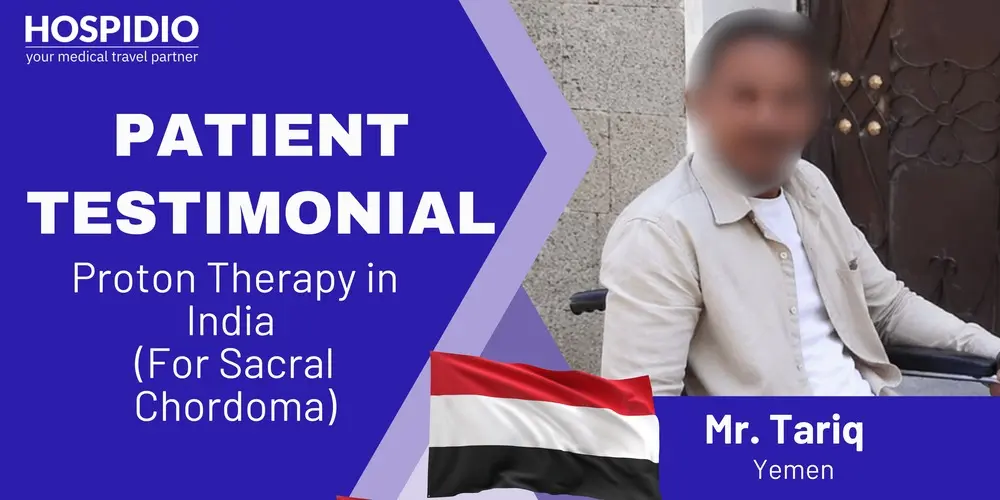
| Patient Characteristic | Details |
| Name | Tariq (Name changed to protect privacy) |
| From | Yemen |
| Diagnosis | Recurrent sacral chordoma (following prior surgery approximately two years earlier) |
| Treatment | Definitive radiotherapy using image-guided intensity-modulated proton therapy (IG-IMPT) |
| Hospital | Apollo Proton Cancer Centre (APCC), Chennai, India |
| Oncologists | Dr. Srinivas Chilukuri and Dr. Sham Sundar C (Radiation Oncology) |
| Stay in India | Approximately two months in Chennai |
| Outcomes | Completed full proton therapy course. Returned home to Yemen. |
Confidentiality note:A pseudonym has been used at the patient's request. All clinical details are accurate and published with consent.
There are conditions where the treatment exists, but the number of places in the world that can deliver it correctly can be counted on one hand. Sacral chordoma is one of them. Proton therapy for sacral chordoma, delivered with image-guided intensity modulation to the precision this tumour demands, is available at only a small number of centres globally. Apollo Proton Cancer Centre in Chennai is one of those centres. For much of the Middle East, Africa, and the developing world, it is the most accessible one.
Tariq from Yemen understood this. He had already been through surgery for a sacral chordoma approximately two years before he contacted HOSPIDIO. When his follow-up imaging showed the tumour had recurred, his treating doctors recommended two things: redo surgery to remove as much of the tumour as possible, followed by proton therapy to address what surgery alone could not.
He arranged the surgery independently. For the proton therapy, he needed assistance from HOSPIDIO.
There are conditions where the treatment exists, but the places that can deliver it correctly can be counted on one hand. For sacral chordoma and proton therapy, Apollo Chennai is one of them.
Sacral Chordoma: A Rare and Technically Demanding Cancer
Chordoma is a rare type of bone cancer that arises from remnants of the notochord, the embryonic structure from which the spine develops. It most commonly occurs at the base of the spine (sacral chordoma) or at the base of the skull. It grows slowly but is locally aggressive, meaning it pushes into and damages the surrounding bone and nerves, and it has a significant tendency to recur after treatment.
Sacral chordoma is one of the most technically demanding tumours to treat. The sacrum sits at the base of the spine surrounded by nerves controlling bladder, bowel, and lower limb function. Treatment must destroy or control the tumour while preserving as much of this critical surrounding tissue as possible. Standard radiation therapy, which delivers high doses but cannot always be shaped with enough precision, carries significant risks of collateral damage in this location.
Proton therapy changes this calculation.
Why chordoma recurs: Even after successful surgery, chordoma cells can remain in surrounding tissue and regrow. Recurrence rates after surgery alone are high. The combination of surgery followed by definitive radiation, particularly proton therapy, is associated with significantly better long-term local control compared to surgery alone. This combined approach is now considered the standard of care at experienced chordoma centres worldwide.
Why Proton Therapy and Why Only India in This Region
Conventional radiation therapy uses X-rays (photons) to deliver energy to a tumour. Proton therapy uses protons instead. The critical physical difference is in how each deposits its energy: photons continue to deliver dose beyond the tumour and into surrounding healthy tissue, while protons have a defined range and release most of their energy at a specific depth known as the Bragg peak, with very little dose deposited beyond it.
For a tumour at the sacrum, this precision matters enormously. Delivering the dose required to control a chordoma while keeping the dose to adjacent bowel, bladder, and sacral nerve roots within safe limits is extremely difficult with photon-based radiation. Proton therapy makes it achievable.
Image-guided intensity-modulated proton therapy (IG-IMPT) takes this further. Intensity modulation allows the dose distribution to be sculpted with great precision around the tumour's three-dimensional shape. Image guidance ensures that each treatment fraction is delivered to exactly the right position, accounting for any day-to-day variation in the patient's anatomy. Together, these capabilities represent the most precise form of radiation delivery currently available for sacral tumours.
Availability of proton therapy: As of 2025, proton therapy is available at a limited number of centres in Asia. In India, Apollo Proton Cancer Centre in Chennai is the leading facility and one of the most technically advanced proton therapy centres in the region. For patients from the Middle East, Africa, and the broader developing world, APCC Chennai represents the most accessible centre offering IG-IMPT for conditions like sacral chordoma. This technology is not available in Yemen, most of the Middle East outside specialist centres, or across sub-Saharan Africa.
How Tariq Reached HOSPIDIO and What Happened Next
Tariq contacted HOSPIDIO after his redo surgery had already been performed. He knew he needed proton therapy. He knew the only facility that could deliver it to the required standard in this part of the world was Apollo Proton Cancer Centre in Chennai. What he needed was a team that could facilitate access to that centre, manage the clinical coordination, and handle the practical reality of spending two months in a foreign city while undergoing daily radiation treatment.
HOSPIDIO reviewed his post-surgical reports and imaging. Before proceeding to treatment planning at APCC, the team identified two additional investigations that were needed to ensure a complete and accurate picture of Tariq's current disease status:
- A repeat MRI to assess the current status of the residual tumour following his redo surgery, providing the treatment planning team with up-to-date anatomical detail
- A CT chest scan to rule out any lung metastasis, confirming that the disease remained localised before committing to a definitive local treatment approach
These additional investigations are an example of HOSPIDIO's clinical review process in action. Proceeding directly to treatment planning without current imaging would have risked building a treatment plan around outdated information. The APCC team needed to see the disease as it was after surgery, not as it had been before.
Pre-treatment assessment: Updated MRI obtained. CT chest clear. No evidence of distant metastasis. Disease confirmed localised to sacral region. Cleared for definitive proton therapy.
Treatment at Apollo Proton Cancer Centre, Chennai
Tariq's care at APCC was led by Dr. Srinivas Chilukuri and Dr. Sham Sundar C, both radiation oncologists specialising in bone and soft tissue cancers. Together they form part of the clinical team at one of Asia's most experienced proton therapy centres, with specific expertise in rare bone tumours including chordoma and chondrosarcoma.
Treatment planning
Before treatment begins, a detailed simulation and treatment planning process is conducted. For IG-IMPT, this involves a dedicated CT simulation scan in the treatment position, fusion with the MRI for detailed tumour delineation, and the design of a treatment plan that optimises dose to the tumour while keeping dose to adjacent critical structures within established tolerance limits. This planning process can take several days and requires close collaboration between the radiation oncologists, medical physicists, and dosimetrists.
Daily treatment fractions
Proton therapy for sacral chordoma is typically delivered over multiple weeks as daily treatment fractions. Each fraction takes a relatively short time to deliver, but the precision required means each session involves careful patient positioning and image verification before the beam is activated. This is what the image-guided component of IG-IMPT means in practice: every day, the team verifies that Tariq was positioned exactly as planned before treatment was delivered.
Tariq remained in Chennai for approximately two months to complete his full course of proton therapy. This is a significant commitment for a patient from Yemen, far from home, in a city he had not previously visited.
Treatment outcome: Full course of IG-IMPT completed at Apollo Proton Cancer Centre. Tariq returned home to Yemen on completion.
What HOSPIDIO Managed During Two Months in Chennai
A two-month stay in Chennai for daily proton therapy requires more than clinical coordination. Tariq needed somewhere to live, a way to get to the hospital each day, support managing the practical details of an extended stay in an unfamiliar city, and the reassurance that someone was available to help if anything went wrong.
- Medical visa facilitation: HOSPIDIO managed the India Medical Visa application from Yemen, including the hospital invitation letter from APCC and all documentation required for entry.
- Airport arrival and departure: a HOSPIDIO representative met Tariq at Chennai International Airport on arrival and arranged his transfer to accommodation. Departure logistics were coordinated on completion of treatment.
- Long-stay accommodation near APCC: HOSPIDIO arranged a furnished apartment close to Apollo Proton Cancer Centre for the duration of the two-month stay, providing a comfortable and stable home environment throughout treatment.
- Daily hospital transfers: transport between his accommodation and APCC for each treatment fraction was arranged and managed by HOSPIDIO throughout the course of treatment.
- Additional investigations coordination: HOSPIDIO arranged the repeat MRI and CT chest investigations required before treatment planning could begin, including sample collection and imaging appointments at appropriate facilities.
- Local support and engagement: during the gaps between treatment fractions and rest days, HOSPIDIO arranged local visits around Chennai to help Tariq remain engaged and connected to life outside the hospital during an extended away-from-home treatment course.
- Case coordination throughout: the HOSPIDIO team maintained regular communication with Tariq and with his family in Yemen, providing updates and managing any day-to-day concerns throughout both months.
On extended treatment stays: Patients undergoing daily radiation therapy typically spend four to eight weeks at the treatment centre. HOSPIDIO provides full coordination for extended stays of this kind, including long-stay apartment arrangement, daily transport, and ongoing case management throughout the treatment course. This is standard for all HOSPIDIO patients on extended programmes.
What This Story Represents
Tariq's case is significant beyond his individual journey. It illustrates something important about the role India now plays for patients from the Middle East, Africa, and the developing world who need treatments that simply do not exist anywhere closer to home.
Proton therapy for sacral chordoma represents the frontier of radiation oncology. It requires a specific machine, a specific technical capability, and a clinical team with specific experience treating rare bone tumours. Yemen does not have this. Most of the Middle East does not have this. India does. And HOSPIDIO's role is to make India accessible to a patient sitting in Sana'a or Aden who has just been told that the treatment they need is thousands of miles away.
The barriers are real: visa, travel, language, logistics, cost, the fear of being alone in an unfamiliar country during intensive medical treatment. HOSPIDIO's role is to remove each of those barriers, one by one, so that the treatment Tariq needed was not theoretical. It was achievable.
He completed his treatment. He went home.
The treatment Tariq needed was not available anywhere closer to home. HOSPIDIO's role was to make India accessible so that it was not theoretical. It was achievable.
For Patients Who Have Been Told They Need Proton Therapy
If you or a family member has been advised that proton therapy is needed for a chordoma, chondrosarcoma, brain tumour, spinal tumour, or paediatric cancer, and you are based in a country where this technology is not available, Apollo Proton Cancer Centre in Chennai is one of the world's leading accessible facilities for patients from outside India.
HOSPIDIO facilitates access to APCC for international patients and manages the full coordination of the visit, from clinical report review and pre-treatment investigation to visa, accommodation, daily transfers, and ongoing support throughout the treatment course.
You can read more about proton therapy availability in India and what conditions it treats most effectively: Is Proton Therapy Available in India? Everything You Need to Know in 2025.
For an overview of how HOSPIDIO manages every step of a patient's journey to India: From WhatsApp to Discharge: How HOSPIDIO Manages Your Entire Medical Journey.
Have you been advised to seek proton therapy for a rare bone or soft tissue tumour? Send HOSPIDIO your reports for a free specialist review at APCC Chennai.
Recent Blogs

Ashutosh heads the Patient Experience Department at HOSPIDIO, ensuring seamless, compassionate support for international patients seeking treatment in India. With deep expertise in medical travel and hospital coordination, he’s dedicated to making every patient feel safe and cared for. Outside work, he enjoys driving and exploring new cuisines.
Guneet Bhatia is the Founder of HOSPIDIO and an accomplished content reviewer with extensive experience in medical content development, instructional design, and blogging. Passionate about creating impactful content, she excels in ensuring accuracy and clarity in every piece. Guneet enjoys engaging in meaningful conversations with people from diverse ethnic and cultural backgrounds, enriching her perspective. When she's not working, she cherishes quality time with her family, enjoys good music, and loves brainstorming innovative ideas with her team.