
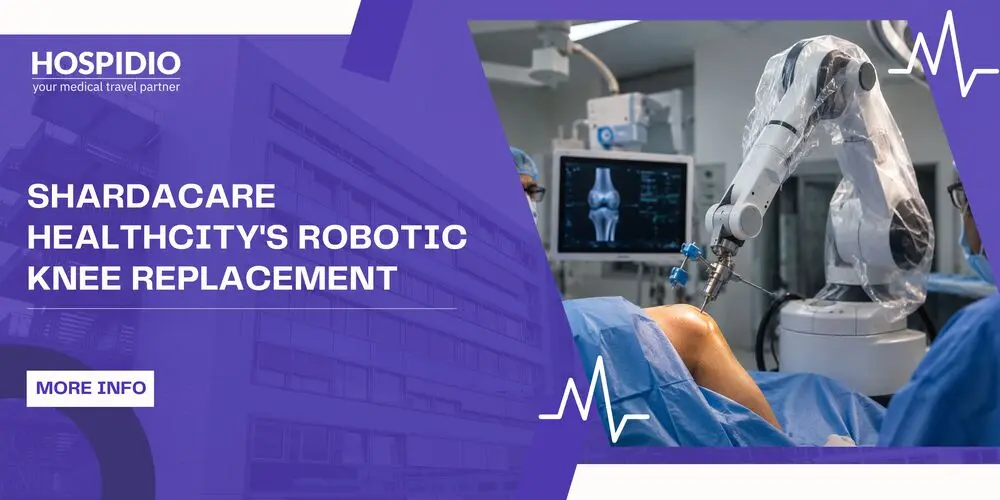
A landmark moment in Indian orthopaedics unfolded at ShardaCare Healthcity when surgeons performed the hospital's first fully automated robotic-assisted knee replacement on a 65-year old patient with severe Grade 4 arthritis and bilateral bowleg deformity. The procedure, led by Senior Orthopaedic Surgeon Dr. Nishith Palo, used an AI-driven robotic platform to deliver CT guided precision beyond what the human hand alone can achieve, restoring full mobility to a patient who had struggled to walk for years. As robotic orthopaedic surgery quietly becomes the new gold standard across India, this case marks a pivotal signal for the millions of arthritis patients across the world who are exploring safe, affordable, and technologically advanced knee care.
What Happened: A Patient's Long Road to Relief
The patient, referred to as Ashok (name changed), had been living with bilateral knee deformity, commonly known as bowlegs for several years, compounded by Grade 4 arthritis in both knees. Grade 4 is the most advanced stage of joint deterioration, where cartilage is almost entirely gone, leaving bone grinding directly against bone. For Ashok, the daily reality was debilitating pain, an inability to walk normally, and a progressive loss of independence.
When he first arrived at Sharda Care Healthcity in Greater Noida, investigations confirmed what he had long feared: both knees required total replacement. The complexity of his case, a severe deformity combined with end stage arthritis, called for a carefully staged surgical plan rather than a single intervention.
The Stepwise Surgical Approach
Dr. Nishith Palo devised a two stage strategy that would prove critical to Ashok's recovery. The first surgery, performed on the left knee using conventional techniques, delivered immediate relief. Impressed by his outcome and the quality of care at Sharda Care Healthcity, Ashok returned six weeks later for his right knee, this time treated with a fully automated, next generation robotic system at the same facility.
Dr. Palo explained the rationale: "This was a very complex case of severe deformity and end stage arthritis affecting both knees. We adopted a stepwise approach, the first knee was treated conventionally, and the second with the latest fully robotic system, a fully automated robotic platform. This technology allowed us to achieve unmatched precision with CT-guided accuracy and minimally invasive techniques, ensuring faster recovery, improved implant longevity, and near natural knee movement."
The outcome was transformative. The patient, who had arrived unable to manage his daily activities, walked out of the hospital with stability and comfort. In his own words: "After the robotic surgery, I feel like I have been given a second chance at mobility."
What Is Fully Automated Robotic Knee Replacement?
For patients unfamiliar with the technology, robotic knee replacement is not science fiction, it is now a clinical reality available in India's leading hospitals.
In a conventional knee replacement, the surgeon uses manual instruments and their own judgement to cut and position the implant. While highly effective, even experienced surgeons face limitations in achieving the sub millimetre accuracy that optimal implant alignment demands.
In a fully automated robotic system, a pre-operative CT scan creates a precise 3D model of the patient's unique anatomy. The robotic arm then executes the surgical plan with accuracy that minimises soft tissue damage, corrects deformity in real time, and places the implant in the exact position mapped out before the procedure even began.
Key advantages over conventional surgery:
- CT-guided precision that accounts for each patient's unique bone structure
- Minimally invasive technique resulting in less blood loss and smaller incisions
- Faster recovery, many patients begin walking within 24 hours
- Improved implant longevity due to near perfect alignment
- Near natural range of motion restored post surgery
- Correction of complex deformities such as bowlegs that are difficult to address manually
Who Is a Candidate for Robotic Knee Replacement?
Not every knee pain patient requires surgery, but robotic knee replacement is particularly suited for:
- Patients with Grade 3 or Grade 4 osteoarthritis where conservative treatments have failed
- Individuals with knee deformity (varus or valgus alignment, including bowlegs)
- Patients who have had previous knee surgeries and require revision
- Younger, active patients who want maximum implant precision and longevity
- Those with rheumatoid arthritis or other inflammatory joint conditions requiring total replacement
As Dr. Palo noted, knee arthritis is no longer an exclusively elderly condition. Approximately 10 percent of knee replacement patients at Sharda Care are in their 30s and 40s, driven by lifestyle factors, obesity, and physical inactivity, trend that is accelerating demand for more durable, precise surgical solutions.
Why This Milestone Matters for International Patients
India has long been a destination of choice for medical travellers seeking high quality orthopaedic care at a fraction of Western costs. This development at Sharda Care Healthcity reinforces what patients from Africa, the Middle East, the UK, and Southeast Asia are increasingly discovering: India's leading hospitals are not simply cost effective alternatives, they are technology forward institutions operating at the cutting edge of global surgical practice.
For context, robotic knee replacement in the United States or United Kingdom typically costs between USD 30,000 and USD 50,000. In India, the same procedure at an accredited hospital is available for a fraction of that cost, often between USD 6,000 and USD 10,000, without any compromise in implant quality or surgical expertise.
Dr. Kousar Shah, Group CEO of ShardaCare Healthcity, underscored the hospital's commitment to accessible advanced care: "By combining cutting edge robotic technology with expert clinical care, we are committed to offering not just treatment, but a pathway to renewed mobility, independence, and a better quality of life."
The Rising Burden of Knee Arthritis in India
The timing of this advancement could not be more important. ShardaCare Healthcity's orthopaedic OPD alone sees over 400 knee arthritis cases every month. Across India, an estimated 180 million people are affected by arthritis in some form, and the number of patients requiring total knee replacement is climbing sharply year on year.
Obesity, sedentary lifestyles, an ageing population, and limited early stage intervention are converging to create a significant demand for joint replacement procedures. Robotic systems offer a way to meet that demand without sacrificing outcomes, making surgeries faster, safer, and more reproducible across a larger patient population.
Conclusion
The successful performance of India's first fully automated robotic knee replacement at Sharda Care Healthcity is more than a hospital milestone, it is a signal that precision orthopaedics is now accessible within India's healthcare ecosystem. For patients living with severe arthritis, deformity, or restricted mobility who have been delaying surgery due to concerns about outcomes, recovery time, or cost, this development offers a compelling reason to act.
If you or a loved one is considering knee replacement surgery and want to explore robotic options at accredited Indian hospitals, HOSPIDIO can connect you with verified orthopaedic specialists and provide a personalised treatment plan, completely free of charge.
References
- Healthcare Radius. (September 23, 2025). ShardaCare Healthcity performs first fully automated robotic knee replacement on a 65 yr old. https://www.healthcareradius.in/features/surgery/robotic-knee-replacement
- Sharda Care Healthcity. Official website. Retrieved from https://www.shardacare.com/
About Hospidio: This blog post is intended to provide factual, evidence-based information to help our community make informed decisions about medical care. Always consult with a qualified healthcare professional before making any treatment decision. HOSPIDIO connects international patients with verified hospitals and doctors across India and Turkey.
Recent Blogs




Frequently Asked Questions
It is a surgical procedure where an AI-driven robotic arm uses a pre-operative CT scan to execute the knee replacement with sub millimetre precision, correcting deformity and placing the implant exactly as planned, beyond what manual surgery alone can achieve.
Conventional surgery relies on the surgeon's manual judgement and instruments. Robotic surgery uses a 3D model of your unique anatomy to guide every cut and implant placement in real time, resulting in better alignment, less tissue damage, and faster recovery.
Patients with Grade 3 or Grade 4 osteoarthritis, knee deformity such as bowlegs, rheumatoid arthritis, or those who have had previous knee surgeries and need revision are strong candidates. Younger active patients also benefit due to improved implant longevity.
Most patients begin walking within 24 hours of surgery. Full recovery typically takes 6 to 12 weeks, though this varies based on age, overall health, and the severity of the original condition.
Yes. Sharda Care Healthcity in Greater Noida recently performed India's first fully automated robotic knee replacement. Several other accredited hospitals across India now offer this technology.
In the United States or United Kingdom, robotic knee replacement can cost between USD 30,000 and USD 50,000. In India, the same procedure at an accredited hospital typically costs between USD 6,000 and USD 10,000, with no compromise in implant quality or surgical expertise.
Yes. Robotic systems are FDA cleared and clinically validated. The added precision of robotic guidance actually reduces the risk of implant misalignment, nerve damage, and post-operative complications compared to conventional techniques.
Absolutely. India is one of the top medical travel destinations for orthopaedic procedures. HOSPIDIO can connect you with verified orthopaedic surgeons and accredited hospitals, and assist with treatment planning, cost estimates, and travel support completely free of charge.
Shruti Verma has completed her M.Tech in Biotechnology with experience in medical writing and scientific content development. She specializes in translating complex biomedical and healthcare information into clear, accurate, and reader-friendly content for diverse audiences. When she is not designing content, probably she is designing graphics.
Guneet Bhatia is the Founder of HOSPIDIO and an accomplished content reviewer with extensive experience in medical content development, instructional design, and blogging. Passionate about creating impactful content, she excels in ensuring accuracy and clarity in every piece. Guneet enjoys engaging in meaningful conversations with people from diverse ethnic and cultural backgrounds, enriching her perspective. When she's not working, she cherishes quality time with her family, enjoys good music, and loves brainstorming innovative ideas with her team.