
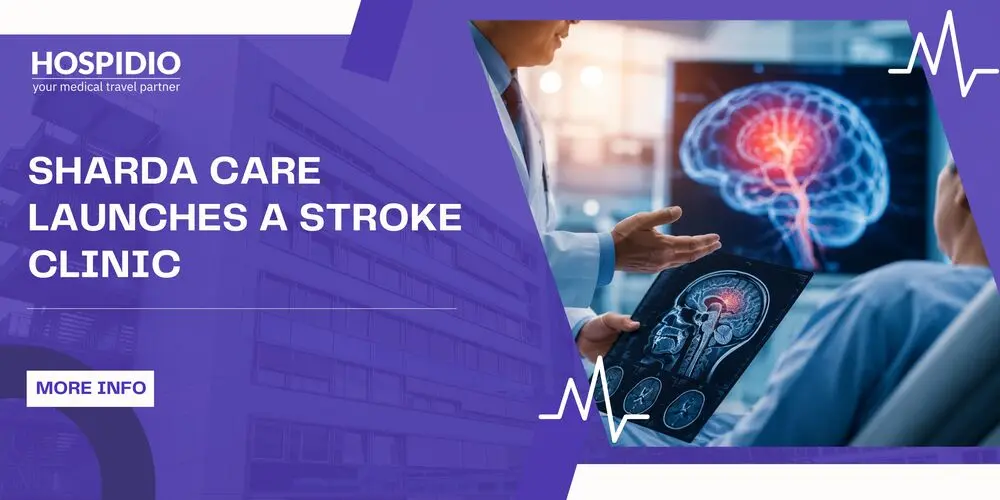
India records a brain stroke every 20 seconds, that is over 18 lakh new cases each year, making stroke one of the country's leading causes of death and long term disability. Yet, public awareness around recognising a stroke and accessing timely care remains alarmingly low. In a significant step toward changing that reality, Sharda Care Healthcity, a leading multispecialty hospital in North India, has launched a dedicated Stroke Clinic and Comprehensive Stroke Rehabilitation Programme on World Stroke Day. The initiative brings specialised neurological care, cutting edge diagnostics, and structured rehabilitation under one roof, and signals a broader shift in how India's healthcare institutions are approaching stroke management.
What's Happening Right Now
On the occasion of World Stroke Day, Sharda Care Healthcity announced the launch of two interconnected programmes: a dedicated Stroke Clinic, operational Monday to Friday from 2 PM to 5 PM with round the clock availability for emergency cases, and a Comprehensive Stroke Rehabilitation Programme integrating the latest in neurological recovery technology.
The initiative is led by Dr. Atampreet Singh, Senior Director and Head of Neurology, supported by a multidisciplinary team of neurologists, psychologists, physiotherapists, and rehabilitation experts. Alongside the launch, the hospital hosted an awareness seminar attended by over 25 doctors, focused on stroke diagnosis, prevention, and post-treatment recovery strategies.
Rishabh Gupta, Managing Director of Sharda Care Healthcity, described the vision clearly: "The Stroke Clinic and Comprehensive Rehabilitation Programme reflect our commitment to holistic, technology enabled recovery. With our multidisciplinary neurorehabilitation team under one roof, we aim to empower stroke survivors to regain mobility, confidence, and quality of life."
The Stroke Crisis in India: Why This Launch Is Significant
The numbers are stark. India accounts for a disproportionate share of global stroke burden, with over 18 lakh new cases reported annually. Stroke is not only a leading cause of death in the country, it is also the number one cause of adult disability, leaving many survivors unable to walk, speak, or care for themselves independently.
What makes this especially troubling is the treatment gap. Despite the proven effectiveness of interventions like IV thrombolysis, a clot dissolving medication that must be administered within four and a half hours of symptom onset, only about 1% of eligible patients in India actually receive it within that window. The reasons are multiple: delayed recognition of stroke symptoms, inadequate transport infrastructure, and a shortage of dedicated stroke care units in many hospitals.
The launch of Sharda Care's Stroke Clinic directly addresses this gap. A dedicated clinical pathway with trained specialists on standby means faster triage, faster imaging, and faster treatment decisions, all of which translate into better outcomes for patients.
Recognising a Stroke: The B.E.F.A.S.T. Framework
The most powerful tool against stroke is public awareness. Dr. Atampreet Singh emphasised that early recognition can be the difference between full recovery and permanent disability: "Every second counts, millions of neurons are lost each minute during a stroke."
The internationally recognised B.E.F.A.S.T. framework offers a simple checklist anyone can use:
- B (Balance): Sudden loss of balance or coordination
- E (Eyes): Sudden vision trouble in one or both eyes
- F (Face): Facial drooping, especially on one side
- A (Arms): Weakness in one or both arms
- S (Speech): Slurred or difficult speech
- T (Time): Time to act immediately, call emergency services
If any of these signs appear, even briefly, it must be treated as a medical emergency. Time lost is brain lost.
Why Younger People are Increasingly at Risk
Stroke is no longer an older person's disease, and this is a global reality, not just an Indian one. Dr. Singh pointed out that over the past two decades, there has been a sharp rise in strokes among younger adults, driven by lifestyle factors that cut across borders: sedentary work habits, obesity, unmanaged hypertension, smoking, and heavy alcohol consumption.
Ischemic stroke, caused by a blood clot blocking a vessel in the brain, remains the most common type worldwide. Hypertension-driven haemorrhagic strokes, where a blood vessel ruptures, are also a growing concern, particularly in populations where blood pressure goes undetected and untreated for years. For international patients travelling from regions where routine preventive care is limited or expensive, the risk is compounded by delayed diagnosis.
The takeaway is the same regardless of where you live: risk factors that were once associated with old age are now appearing in people in their 30s and 40s. Managing blood pressure, maintaining a healthy weight, avoiding tobacco, and getting regular health check ups are no longer optional they are active stroke prevention strategies that every adult should prioritise.
Inside the New Stroke Clinic: Advanced Technology at Every Step
One of the most critical advancements in modern stroke care has been the integration of AI and advanced imaging. Dr. Singh highlighted that new MRI and AI-based diagnostic tools have significantly reduced scan time, allowing neurologists to make faster, more accurate decisions about the appropriate treatment pathway.
For patients with large vessel blockages, where a major artery supplying the brain is completely obstructed, mechanical thrombectomy has been a game changer. In this procedure, a catheter is guided through blood vessels to physically remove the clot, often achieving dramatic neurological recovery in patients who would otherwise face severe disability. Sharda Care's Stroke Clinic is equipped to perform and coordinate this intervention as part of its emergency stroke pathway.
The clinic's round the clock emergency availability ensures that the critical treatment window is never missed due to administrative delays or specialist unavailability.
Rehabilitation: Where True Recovery Begins
Emergency treatment saves lives. But for stroke survivors, the journey to functional independence begins in rehabilitation, and this is where Sharda Care's programme distinguishes itself.
Dr. Dharam Pandey, Director of the Department of Physiotherapy and Rehabilitation Sciences, explained the philosophy underpinning the programme: "Stroke management doesn't end with emergency treatment, it continues through structured rehabilitation."
The Comprehensive Stroke Rehabilitation Programme integrates:
- Robotics assisted therapy: using robotic devices to guide and support limb movement, enabling patients to relearn motor patterns even with significant weakness
- Virtual reality based gamified exercises: immersive, interactive environments that motivate patients and retrain the brain through neuroplasticity
- 3D motion analysis: precise biomechanical assessment of movement to track progress and customise therapy plans
- Functional Electrical Stimulation (FES): using electrical pulses to activate paralysed or weakened muscles, helping restore voluntary movement
This technology forward approach makes recovery measurable and interactive, qualities that are known to improve patient engagement and long term adherence to rehabilitation programmes.
Key Takeaways for Patients and Families
- India records a new stroke case every 20 seconds; awareness and rapid response are lifesaving.
- The B.E.F.A.S.T. framework is a practical, immediate tool for recognising stroke symptoms.
- Treatment within 4.5 hours dramatically improves outcomes, do not wait to seek emergency care.
- Younger adults are increasingly at risk due to lifestyle factors; preventive action matters at every age.
- Structured rehabilitation using robotics, VR, and FES enables meaningful functional recovery beyond the emergency phase.
- Sharda Care's dedicated Stroke Clinic provides both emergency access and scheduled outpatient care for stroke patients in North India.
Conclusion
The launch of ShardaCare Healthcity's dedicated Stroke Clinic and Comprehensive Rehabilitation Programme is a meaningful milestone, not just for India, but for international patients who are increasingly choosing India as a destination for world class neurological care. It reflects a growing recognition that stroke demands a coordinated, technology enabled response, from the first moment a patient presents to the emergency department, through months of rehabilitation that follow.
For international patients and families navigating this difficult journey, India's combination of advanced diagnostics, multidisciplinary expertise, and evidence-based rehabilitation at a fraction of the cost of Western healthcare systems represents exactly the kind of integrated care that transforms outcomes. Whether you are travelling from Africa, the Middle East, or Southeast Asia, facilities like ShardaCare offer a compelling case: specialist stroke care and structured recovery under one roof, without the financial burden that often comes with it elsewhere in the world.
References
- BW Healthcare World. (October 30, 2025). ShardaCare Healthcity Launches Dedicated Stroke Clinic And Comprehensive Rehabilitation Programme On World Stroke Day. https://www.bwhealthcareworld.com/article/shardacare-healthcity-launches-dedicated-stroke-clinic-and-comprehensive-rehabilitation-programme-on-world-stroke-day-577561
- World Stroke Organization. (2024). Global Stroke Fact Sheet. https://www.world-stroke.org
- Indian Council of Medical Research. (2023). India Stroke Statistics. https://www.icmr.gov.in
Recent Blogs
Frequently Asked Questions
Sharda Care Healthcity's dedicated Stroke Clinic offers specialised neurological care for stroke patients, combining emergency treatment, advanced diagnostics, and a comprehensive rehabilitation programme under one roof. The clinic operates Monday to Friday from 2 PM to 5 PM, with round-the-clock availability for emergencies.
Yes. ShardaCare Healthcity welcomes international patients seeking advanced stroke treatment and rehabilitation in India. With a multidisciplinary team of neurologists, physiotherapists, and rehabilitation specialists, the hospital is equipped to manage both acute stroke emergencies and long-term recovery programmes.
The Comprehensive Stroke Rehabilitation Programme includes robotics assisted therapy, virtual reality-based exercises, 3D motion analysis, and Functional Electrical Stimulation (FES) all designed to support meaningful neurological recovery after stroke.
The Comprehensive Stroke Rehabilitation Programme includes robotics assisted therapy, virtual reality-based exercises, 3D motion analysis, and Functional Electrical Stimulation (FES) all designed to support meaningful neurological recovery after stroke.
The Comprehensive Stroke Rehabilitation Programme includes robotics assisted therapy, virtual reality-based exercises, 3D motion analysis, and Functional Electrical Stimulation (FES) all designed to support meaningful neurological recovery after stroke.
Shruti Verma has completed her M.Tech in Biotechnology with experience in medical writing and scientific content development. She specializes in translating complex biomedical and healthcare information into clear, accurate, and reader-friendly content for diverse audiences. When she is not designing content, probably she is designing graphics.
Guneet Bhatia is the Founder of HOSPIDIO and an accomplished content reviewer with extensive experience in medical content development, instructional design, and blogging. Passionate about creating impactful content, she excels in ensuring accuracy and clarity in every piece. Guneet enjoys engaging in meaningful conversations with people from diverse ethnic and cultural backgrounds, enriching her perspective. When she's not working, she cherishes quality time with her family, enjoys good music, and loves brainstorming innovative ideas with her team.