
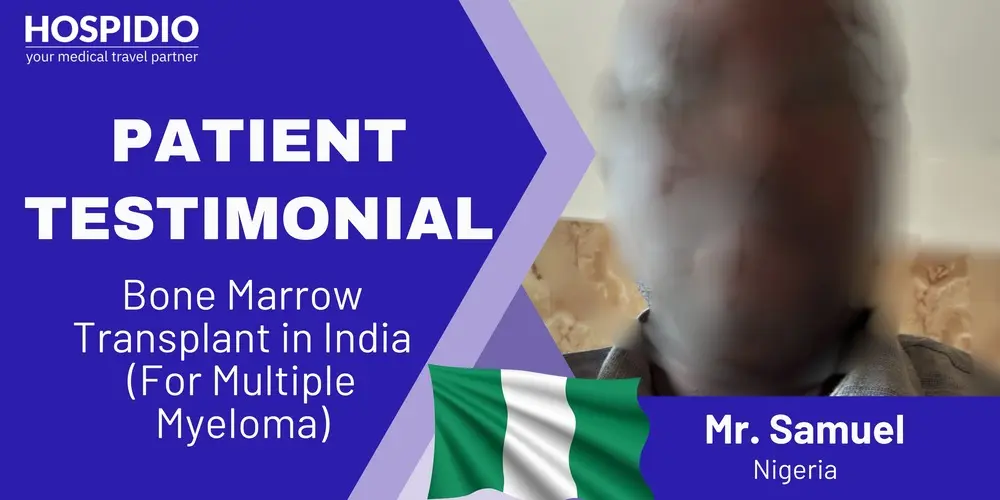
| Patient Characteristic | Details |
| Name | Samuel (name changed to protect privacy) |
| From | Nigeria |
| Diagnosis | Aggressive Multiple Myeloma |
| Treatment | 3 cycles of chemotherapy, followed by autologous bone marrow transplant |
| Hospital | Fortis Hospital, Shalimar Bagh, New Delhi, India |
| Oncologist | Dr. Akash Khandelwal (Hematology & BMT) |
| Hospital Stay | 20 days in hospital for BMT |
| Total Stay in India | Approximately 80 days across two visits to India |
| Outcome | BMT successful. Returned to Nigeria. |
Confidentiality note: A pseudonym has been used at the patient's request. All clinical details are accurate and published with consent.
Multiple Myeloma is not a condition that waits. In its aggressive form, it moves quickly and demands a treatment plan that matches its pace. For patients facing this diagnosis in Nigeria, where access to haematology specialists and bone marrow transplant infrastructure is severely limited, that urgency is compounded by a geography problem: the treatment that gives you the best chance does not exist nearby.
Samuel knew this. When his diagnosis came back as aggressive Multiple Myeloma, he also knew that finding the right specialist and the right facility was not a question he could answer locally. He reached out to HOSPIDIO.
What followed was a 90-day journey spanning two visits to India, three cycles of chemotherapy, and a bone marrow transplant at one of India's leading haematology centres. It was not a straightforward path. The disease was aggressive, and the treatment plan was designed to meet it on those terms. But Samuel completed every stage of the protocol and returned home to Nigeria.
When a disease is aggressive, the treatment plan has to match it. Samuel's journey to India was built around exactly that principle.
Understanding Aggressive Multiple Myeloma
Multiple Myeloma is a cancer of plasma cells in the bone marrow. In most patients it progresses at a moderate pace and can be managed over years with the right treatment. In its aggressive form, the disease behaves differently: it grows faster, responds less readily to standard treatment, and requires a more intensive approach from the outset.
For eligible patients with aggressive or relapsed myeloma, an autologous bone marrow transplant (also called a stem cell transplant) is one of the most effective interventions available. The procedure involves collecting the patient's own stem cells, delivering high-dose chemotherapy to destroy as many myeloma cells as possible, and then reinfusing the stored stem cells to rebuild the patient's bone marrow.
This is a complex, resource-intensive procedure. It requires a specialist BMT unit with cleanroom infrastructure, a haematology team with specific transplant experience, and careful monitoring throughout the engraftment period. It is not available in Nigeria. It is available at Fortis Hospital in New Delhi.
About autologous BMT: In an autologous bone marrow transplant, the patient's own stem cells are collected and stored before high-dose chemotherapy is given. The stored cells are then reinfused to restore the bone marrow. This avoids the rejection risks of donor transplants and is the standard approach for eligible multiple myeloma patients. Success depends on the quality of the BMT unit, the experience of the team, and thorough pre-transplant preparation.
The First Visit: Investigations and Beginning Chemotherapy
Samuel arrived at Fortis Hospital, Shalimar Bagh in New Delhi under the care of Dr. Akash Khandelwal, a haematologist and BMT specialist with extensive experience in myeloma management. Before any treatment began, a thorough investigation workup was conducted to establish the full picture of Samuel's disease.
The investigations included:
- PET CT scan to assess the extent and distribution of myeloma activity throughout the body
- Bone marrow biopsy to characterise the disease at a cellular and molecular level
- Cytogenetics and FISH testing to identify any high-risk chromosomal abnormalities that would influence treatment intensity
- Serum protein electrophoresis and immunofixation to measure -myeloma protein levels
- Full blood panel, kidney function, and bone health assessments
The results confirmed the aggressive nature of the disease. Dr. Khandelwal recommended an induction chemotherapy regimen before proceeding to transplant: standard practice in myeloma management, where chemotherapy is used to reduce the disease burden and bring the patient into the best possible condition before the BMT procedure.
The planned induction was two cycles of chemotherapy. Samuel completed the first cycle in India.
First visit outcome: Investigations completed. Disease profile confirmed. First chemotherapy cycle administered.
Between Visits: Returning Home and Coming Back
After his first cycle of chemotherapy, Samuel returned to Nigeria. This is a recognised part of certain treatment plans for international patients: where the chemotherapy regimen allows for gaps between cycles, a patient can return home between visits and come back to India for the next stage rather than remaining away for the full induction period.
HOSPIDIO maintained communication with Samuel during his time at home, tracking his recovery and coordinating the logistics for his return. When he came back to India, Dr. Khandelwal administered the second chemotherapy cycle.
After two induction cycles, Samuel underwent re-evaluation. This is a critical checkpoint in the myeloma transplant pathway: an assessment of how well the disease has responded to induction chemotherapy before the team commits to proceeding with the BMT.
Post-induction evaluation: Disease response assessed. Samuel cleared for bone marrow transplant.
Clearance for BMT is not automatic. It requires the disease to have responded sufficiently to induction chemotherapy and the patient to be in adequate physical condition to tolerate the high-dose treatment. Samuel met both criteria.
The decision to proceed with BMT after two induction cycles reflects careful clinical judgment by Dr. Khandelwal's team. Transplanting too early risks an inadequate response. Transplanting when the patient is ready maximises the chance of a deep and durable remission.
The Third Cycle and the Transplant
With transplant clearance confirmed, the treatment plan moved into its final phase. Samuel received a third cycle of chemotherapy as part of the conditioning regimen, the high-intensity treatment given immediately before a bone marrow transplant to destroy remaining myeloma cells and create space in the bone marrow for the reinfused stem cells.
The bone marrow transplant procedure
The autologous bone marrow transplant was performed at Fortis Hospital's dedicated BMT unit under Dr. Akash Khandelwal's team. The procedure involved the reinfusion of Samuel's previously collected stem cells following the high-dose conditioning chemotherapy.
Samuel spent 20 days in hospital during the transplant and engraftment phase. This period is the most intensive part of the BMT process: the patient's immune system is at its most vulnerable while waiting for the reinfused stem cells to engraft and begin rebuilding the bone marrow. Close monitoring, infection control, and careful supportive care are essential throughout.
The Fortis BMT unit is specifically designed for this phase of care. The infrastructure, the protocols, and the nursing and medical team all exist to carry patients safely through this window and out the other side. BMT outcome: Procedure successful. Engraftment achieved. Samuel discharged after 20 days in hospital.
What HOSPIDIO Managed Across Both Visits
Samuel's treatment spanned two separate visits to India over approximately 60 days in total. Coordinating a journey of this complexity, for a patient with an aggressive haematological cancer, requires more than booking appointments. HOSPIDIO managed every practical element of both visits.
- Medical visa for both visits: HOSPIDIO managed the India Medical Visa application process, including the hospital invitation letters, all documentation, and coordination with the Indian High Commission in Nigeria.
- Airport arrival and departure transfers: a HOSPIDIO representative met Samuel at the airport on both visits and arranged all arrival and departure logistics.
- Accommodation near Fortis Hospital: suitable accommodation close to Fortis Shalimar Bagh was arranged for both stays, providing a comfortable and convenient base between hospital appointments and during recovery.
- Local transfers throughout both visits: all travel between accommodation and the hospital was managed by HOSPIDIO, removing the logistical burden from a patient receiving intensive treatment. Sample collection and monitoring support: blood tests and required investigations between cycles and during recovery were coordinated by HOSPIDIO, including home sample collection where appropriate. Case coordination and communication: HOSPIDIO maintained regular communication with Samuel's family in Nigeria throughout both visits, ensuring they were informed of his progress at every stage. Return coordination after BMT: following discharge from the BMT unit, HOSPIDIO coordinated Samuel's accommodation during the post-discharge recovery period before he was medically fit to fly home, and arranged his airport transfer for departure.
On BMT aftercare: Patients who have undergone a bone marrow transplant require a period of recovery and monitoring after hospital discharge before they are fit for long-haul travel. HOSPIDIO coordinates this post-discharge stay, including accommodation, daily support, and communication with the medical team, as a standard part of our BMT patient service.
For Nigerian Patients Facing Multiple Myeloma or a Hematological Diagnosis
Samuel's journey represents a path that is becoming more travelled among Nigerian patients with serious haematological cancers. Multiple Myeloma, leukaemia, lymphoma, and related conditions require a level of specialist care and transplant infrastructure that is not yet consistently available in Nigeria. India's leading haematology centres, including Fortis, Medanta, and Apollo, perform high volumes of BMT procedures annually and have strong outcomes data across these conditions.
The practical barriers that once made this journey feel daunting, the visa process, the cost, the logistics of being far from home during intensive treatment, are the barriers that HOSPIDIO exists to remove. Samuel's journey involved two separate visits, a phased treatment plan, and a 20-day hospital stay during the transplant itself. All of it was coordinated.
Nigeria is HOSPIDIO's largest source market for patients from West Africa. We have supported Nigerian patients across cardiac surgery, oncology, neurosurgery, orthopedics, and transplant procedures. If you or a family member has received a diagnosis that requires specialist care beyond what is available locally, reach out to us. We will review the case, identify the right specialist, and build the plan.
For information on the India Medical Visa process from Nigeria and what to expect when travelling with HOSPIDIO, read: From WhatsApp to Discharge: How HOSPIDIO Manages Your Entire Medical Journey.
You can also read about how India compares to other destinations for complex haematological treatment: India vs South Africa for Medical Treatment: What African Patients Need to Know.
Facing a myeloma or blood cancer diagnosis and need specialist care in India? Send HOSPIDIO your reports for a free haematology assessment.
Recent Blogs
Ashutosh heads the Patient Experience Department at HOSPIDIO, ensuring seamless, compassionate support for international patients seeking treatment in India. With deep expertise in medical travel and hospital coordination, he’s dedicated to making every patient feel safe and cared for. Outside work, he enjoys driving and exploring new cuisines.
Guneet Bhatia is the Founder of HOSPIDIO and an accomplished content reviewer with extensive experience in medical content development, instructional design, and blogging. Passionate about creating impactful content, she excels in ensuring accuracy and clarity in every piece. Guneet enjoys engaging in meaningful conversations with people from diverse ethnic and cultural backgrounds, enriching her perspective. When she's not working, she cherishes quality time with her family, enjoys good music, and loves brainstorming innovative ideas with her team.