
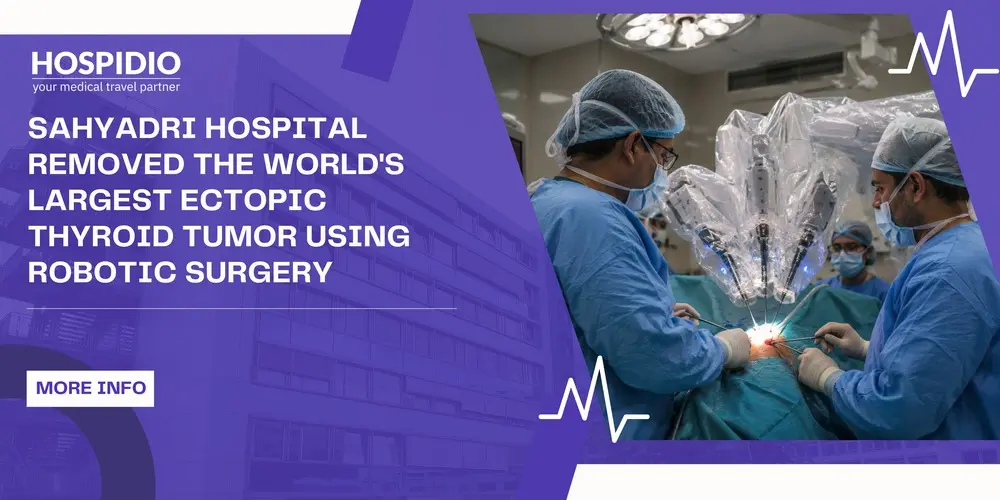
In August 2025, surgeons at Sahyadri Super Speciality Hospital in Pune, India, successfully removed what is believed to be the world's largest reported ectopic thyroid tumor using robotic assisted surgery. For the 62-year old woman at the center of it, this was a second chance at life that multiple hospitals had already told her was not possible.
For international patients weighing their treatment options, this case was a powerful reminder: India's top hospitals are not just affordable. They are among the most advanced in the world.
What was this Case?
The patient was a 62-year old woman who had developed a rare condition called ectopic thyroid goiter, in which thyroid tissue grows outside its normal position in the neck. In her case, this tissue had formed a massive tumor inside her chest, measuring 17 x 12 x 11 cm and weighing 800 grams. That is roughly the weight of two standard cans of soda sitting inside the chest cavity.
Ectopic thyroid tissue is extraordinarily rare, occurring in just 1 in 100,000 to 300,000 people. What made this case even more unusual was that the patient's actual thyroid gland in her neck was completely normal and unaffected. The tumor had grown from thyroid tissue that migrated to the wrong location during development.
Why was this Surgery so Difficult?
The tumor's location turned this into a case that most surgeons would not take on at all. The mass was situated in the chest, lying dangerously close to some of the body's most critical structures, including the heart, the aortic arch, the superior vena cava, the pulmonary arteries, and the pericardium. There was almost no margin for error.
The tumor had also been compressing the trachea, making even placing the patient under anesthesia a significant challenge. Multiple hospitals had reviewed this case and declared it inoperable.
How Robotic Surgery Made the Difference
The multidisciplinary team, led by Dr. Vinod Gore, Surgical Oncologist at Sahyadri Hospital, approached the case using robotic-assisted surgery. Instead of large incisions, the robotic system allowed the team to insert instruments through small cuts between the patient's ribs. The system provided a magnified, high definition 3D view of the chest cavity and gave the surgeons a precision and range of motion that human hands working through a conventional incision cannot replicate. This was critical when working millimeters away from major blood vessels.
Before the procedure could begin, Dr. Vikas Karne, Head of Anesthesiology, performed awake fiber optic intubation. This technique secures the patient's airway while she is still conscious, before general anesthesia is administered. It was necessary because the tumor's pressure on the trachea made conventional intubation too risky.
The surgery proceeded robotically for the majority of the tumor. A small upper portion required a brief mini-sternotomy, which is a limited opening of the breastbone, to access safely. Blood supply feeding the tumor from small vessels near the innominate vein and the carotid arteries was carefully identified and sealed throughout.
The outcome was remarkable. The patient had minimal blood loss, required no blood transfusion, and recovered without the need for ventilator support. She was discharged in good health.
"This case demonstrates the power of robotic surgery in tackling highly complex tumors," said Dr. Gore. "With meticulous planning and teamwork, even rare, high-risk conditions can be treated successfully."
Understanding Ectopic Thyroid
For most readers, ectopic thyroid is an unfamiliar condition. The thyroid gland normally sits at the base of the neck. During fetal development, it migrates from the back of the tongue down to its final position. Occasionally, thyroid tissue fails to complete that journey and cells are left behind along the path. These misplaced cells can, over many years, form a goiter or, in rare cases like this one, a substantial tumor in an unexpected location such as the chest.
Because the condition is so rare and grows slowly, patients often go undiagnosed for years. Symptoms, when they appear, typically relate to compression of nearby structures, such as breathing difficulties, a persistent cough, or a feeling of pressure in the chest.
What this Means for International Patients Seeking Complex Surgery in India
This case was significant for three reasons.
- First, it demonstrated that India's top surgical centers are operating at the frontier of what is technically possible. The level of pre-operative planning, multidisciplinary coordination, and intraoperative precision described here is consistent with what is available at major centers in the United States or Europe.
- Second, it reinforced that India remains a destination where cases deemed inoperable elsewhere can find a second opinion that leads to a very different outcome. For patients who have been turned away or told their condition is too complex, the story of this patient matters.
- Third, this level of care comes at a fraction of the cost of comparable surgery in Western countries. Robotic surgical oncology procedures in India typically cost 60 to 80 percent less than equivalent procedures in the UK, US, or Australia, with no compromise in technology or expertise.
Conclusion
The surgery performed at Sahyadri Hospital in August 2025 was a genuine world first, and it happened in India. A patient told there was no hope found a team willing to approach the problem differently, and walked out of the hospital because of cutting edge technology and exceptional surgical skill working together.
For international patients navigating a complex diagnosis, this is a reminder that the right hospital matters, and that India has hospitals capable of handling cases that other systems have given up on.
If you or someone you know is dealing with a complex surgical condition and looking for a second opinion, HOSPIDIO can help. Our team connects international patients with specialist surgeons at world class hospitals including Fortis and Apollo, with full support from consultation through to recovery.
Get a medical opinion today. Talk to a Hospidio coordinator.
References
BW Healthcare World. (August 12, 2025). Sahyadri Hospital Removes World's Largest Ectopic Thyroid Tumor With Robotic Surgery. https://www.bwhealthcareworld.com/article/sahyadri-hospital-removes-worlds-largest-ectopic-thyroid-tumor-with-robotic-surgery-567215
About HOSPIDIO: This blog post is intended to provide factual, evidence based information to keep our community informed about global medical developments. Always consult with qualified healthcare professionals for personalized medical advice.
Recent Blogs

Shruti Verma has completed her M.Tech in Biotechnology with experience in medical writing and scientific content development. She specializes in translating complex biomedical and healthcare information into clear, accurate, and reader-friendly content for diverse audiences. When she is not designing content, probably she is designing graphics.
Guneet Bhatia is the Founder of HOSPIDIO and an accomplished content reviewer with extensive experience in medical content development, instructional design, and blogging. Passionate about creating impactful content, she excels in ensuring accuracy and clarity in every piece. Guneet enjoys engaging in meaningful conversations with people from diverse ethnic and cultural backgrounds, enriching her perspective. When she's not working, she cherishes quality time with her family, enjoys good music, and loves brainstorming innovative ideas with her team.