
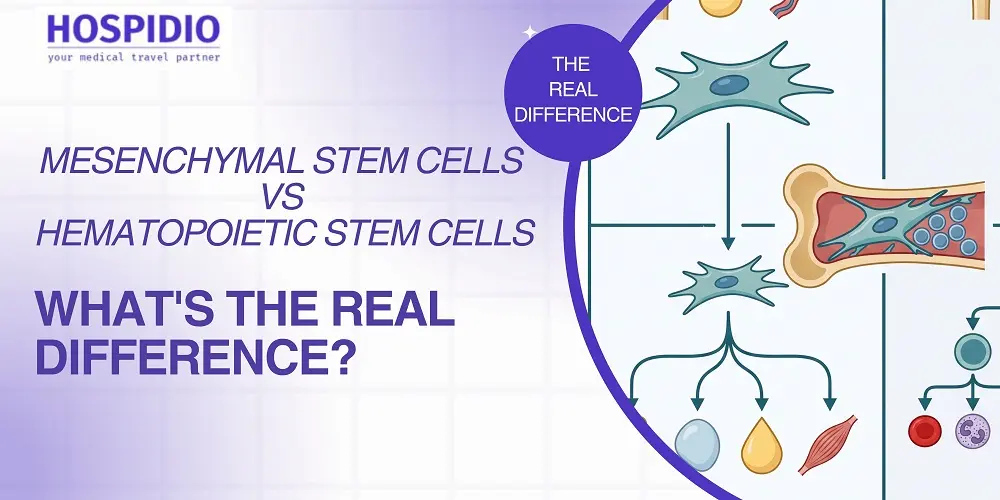
If you have been told you need a "bone marrow transplant" for a blood condition, or you have seen "stem cell therapy" advertised for a bad knee or an autoimmune disease, you have probably run into both of these terms and assumed they are more or less the same thing. They are not. Mesenchymal stem cells (MSCs) and hematopoietic stem cells (HSCs) come from different places in the body, turn into completely different types of tissue, and are used in medicine in very different ways, one of them backed by more than 60 years of established transplant practice, the other still mostly in the research and early clinical stage outside a small number of approved uses.
Quick answer: Hematopoietic stem cells (HSCs) live mainly in bone marrow and give rise to all blood and immune cells; they are used in bone marrow and cord blood transplants for cancers like leukemia and disorders like thalassemia. Mesenchymal stem cells (MSCs) come from bone marrow, fat tissue, or umbilical cord tissue and develop into bone, cartilage, fat, and connective tissue; outside one FDA-approved use for a transplant complication in children, most MSC applications remain experimental.
The Short Differences
| Hematopoietic Stem Cells (HSCs) | Mesenchymal Stem Cells (MSCs) | |
| Main source | Bone marrow, peripheral blood, umbilical cord blood | Bone marrow, adipose (fat) tissue, umbilical cord tissue |
| What they become | Red cells, white cells, platelets, immune cells | Bone, cartilage, fat, muscle, connective tissue |
| Main clinical use | Bone marrow/stem cell transplant for blood cancers and disorders | Orthopedic and regenerative applications, mostly investigational |
| Immune role | Rebuild the entire immune and blood system after transplant | Immune-modulating properties, generally lower rejection risk |
| Regulatory status | Long-established, standard of care for decades | Mostly experimental; one approved pediatric indication (GvHD) as of 2024 |
Where Each One Actually Comes From
HSCs live mainly inside your bone marrow, particularly in the pelvis, breastbone, and hip bones, with a smaller number circulating in peripheral blood. For a transplant, doctors collect them one of three ways: a direct bone marrow harvest from the pelvic bone under anesthesia, a peripheral blood stem cell collection where the donor is given medication to push stem cells into the bloodstream and then undergoes apheresis, or from umbilical cord blood banked at birth.
MSCs, by contrast, are harvested from three main tissue sources: bone marrow (often from the same aspirate used for orthopedic procedures), adipose tissue removed through a small liposuction-style procedure, and umbilical cord or placental tissue collected after a birth with donor consent. Because MSCs are relatively easy to expand in a lab from a small starting sample, a single donation can sometimes be processed into multiple treatment doses, which is part of why they show up so often in the private regenerative medicine market.
Cord blood deserves a special mention because it is a source for both. At birth, the blood left in the umbilical cord and placenta is rich in HSCs and can be banked (privately for family use, or publicly for anyone who needs a match) for a future transplant. Separately, the cord tissue itself, the jelly-like Wharton's jelly, is a distinct and increasingly popular source of MSCs. It is easy for expecting parents to hear "cord blood banking" and "cord tissue banking" and assume they are the same service; they are collecting two different cell types for two different purposes.
Related reading: if you want the full picture on how bone marrow transplants work end to end, our bonemarrow transplant recovery guide walks through the process from donor matching to discharge
What Each One Can Actually Become
This is the core biological difference, and it explains almost everything else on this page. HSCs are multipotent in one specific lane: they can only become blood and immune system cells, red blood cells that carry oxygen, white blood cells that fight infection, and platelets that help clotting. That narrow but critical job is exactly why they are transplanted into patients whose own blood-forming system has been destroyed by disease or by the chemotherapy and radiation used to treat it.
MSCs differentiate along a completely different path. Under laboratory conditions they can be coaxed into becoming osteoblasts (bone-forming cells), chondrocytes (cartilage cells), adipocytes (fat cells), and other connective tissue cell types. They also release growth factors and signaling molecules that appear to reduce inflammation and support tissue repair in the surrounding area, even without fully differentiating into a specific tissue type. That anti-inflammatory, tissue-support behavior is what most current MSC therapy is actually built around, not literal replacement of damaged tissue in the way people often assume.
Clinical Uses Today: Established vs Experimental
This is where the gap between the two is largest, and where a lot of patient confusion (and some misleading marketing) comes from.
Hematopoietic stem cell transplantation has been standard medical practice since the 1960s and is used to treat leukemia, lymphoma, multiple myeloma, aplastic anemia, thalassemia, sickle cell disease, and several inherited immune disorders. It is either autologous (your own stem cells, collected before high-dose chemotherapy and given back afterward) or allogeneic (from a matched donor, sibling, unrelated registry match, or cord blood unit), each with different risk profiles.
Mesenchymal stem cell therapy has exactly one FDA-approved indication as of this writing: remestemcel-L (brand name Ryoncil), approved in December 2024 for children with steroid-refractory acute graft-versus-host disease, a serious complication that can occur after an allogeneic HSC transplant when donor immune cells attack the recipient's tissue. Outside that specific approval, MSC use for osteoarthritis, tendon and cartilage injuries, autoimmune conditions, and other applications remains investigational in most countries, offered through clinical trials or as an off-label procedure, not as an established standard of care with the same evidence base as HSC transplantation.
If you are trying to work out whether your specific diagnosis calls for an established HSC transplant or falls into MSC territory, Our care team can review your reports and point you toward the right specialist before you commit to a treatment path.
How Each Is Collected and Given to the Patient
For an HSC transplant, the process runs on a strict timeline: the recipient often undergoes conditioning chemotherapy or radiation to make room in the bone marrow and, in allogeneic cases, suppress the immune system enough to accept the donor cells. The collected stem cells are then infused intravenously, much like a blood transfusion, and travel to the bone marrow on their own to begin engrafting, typically over two to four weeks.
After an HSC infusion, patients typically stay in or near the hospital for several weeks while doctors monitor blood counts daily, watching for the point of engraftment when the new stem cells begin producing healthy blood cells on their own, and managing infection risk during the window before the immune system has rebuilt itself. This recovery period is usually the longest and most closely supervised part of the entire process.
MSC administration looks different, and considerably shorter. Depending on the intended use, MSCs may be injected directly into a joint or damaged tissue site, given as an intravenous infusion for systemic conditions, or applied locally during a surgical procedure. There is no conditioning regimen and, because MSCs have relatively low immunogenicity, allogeneic (donor-derived) MSC products can often be used without the same tissue-matching requirements that allogeneic HSC transplants require. Most MSC procedures are outpatient, with the patient going home the same day.
Regulatory Status and the "Stem Cell Clinic" Problem
This section matters more than it might seem. Hematopoietic stem cell transplantation is tightly regulated everywhere it is practiced, performed only at accredited transplant centers with defined donor-matching, infection control, and follow-up protocols built over six decades of clinical evidence.
Mesenchymal stem cell therapy sits in a much murkier regulatory space, and that gap has been exploited. The International Society for Stem Cell Research (ISSCR), the leading global body on stem cell science, has repeatedly warned patients about clinics marketing MSC injections for conditions ranging from autism to Parkinson's disease to general anti-aging, claims with little to no supporting clinical trial evidence. Their patient guide recommends checking whether a clinic can point to a registered clinical trial, whether the treatment has been reviewed by a recognized regulatory body, and being skeptical of any provider promising guaranteed results or charging large sums for a treatment not available through mainstream hospitals.
None of this means MSC therapy is fraudulent across the board. Legitimate research programs and hospital-based regenerative medicine departments do offer MSC treatments within proper trial frameworks or narrow approved uses. The difference is asking where a specific clinic's treatment sits on that spectrum before agreeing to anything.
Risks and Safety Compared
HSC transplantation, particularly the allogeneic form, carries the most serious risk profile of the two. Graft-versus-host disease, where donor immune cells attack the recipient's own tissue, affects a substantial share of allogeneic transplant recipients in some form, acute GvHD in roughly a third to half of cases depending on donor match and prevention regimen, with chronic GvHD affecting a meaningful proportion of longer-term survivors. Other risks include infection during the weeks the immune system is rebuilding, and toxicity from the conditioning chemotherapy or radiation itself.
MSC therapy generally carries a lower immediate risk profile, especially when the cells are autologous (the patient's own), since there is minimal rejection risk and no conditioning regimen involved. The bigger concern with MSCs is less about acute danger and more about unproven efficacy: patients may spend significant money on a treatment without solid evidence it will help their specific condition, and unregulated processing or injection technique does carry its own infection and quality-control risks.
Cost Comparison: India, Turkey, US, and UK
Because HSC transplantation is an established procedure, it has a defined, published cost structure. Bone marrow transplant costs in India typically run a fraction of equivalent treatment in the United States, with Turkey offering a comparable savings profile and strong transplant center accreditation. You can see current estimates on our dedicated bonemarrow transplant cost in India and bonemarrow transplant cost in Turkey pages, which break down what is typically included (donor search support, conditioning regimen, transplant procedure, initial hospital stay) versus excluded (extended stay, complications management, travel).
In the US and UK, HSC transplant costs run dramatically higher, often several times the price of the same procedure at an accredited hospital in India or Turkey, even before travel and extended stay are factored in, which is the main reason so many international patients look outside their home country for this specific treatment.
MSC therapy pricing is far less standardized precisely because it is not a single defined procedure. Costs vary enormously by country, clinic, cell source, and number of sessions, and because so much of the market operates outside insurance and standard hospital billing, prices are more a function of what an individual clinic decides to charge than a regulated fee schedule. This is exactly why the clinic-vetting step above matters before comparing any quoted price, a lower price at an unaccredited clinic is not necessarily a better deal.
Questions to Ask Before Choosing a Stem Cell Treatment
Before agreeing to either type of treatment, it is worth asking your specialist: is this treatment approved or is it part of a registered clinical trial, what is the specific evidence for my condition rather than stem cell therapy in general, what are the realistic risks and expected recovery, and who is available if I have a complication after I return home if I am traveling for treatment.
The Bottom Line
Hematopoietic and mesenchymal stem cells are related only in the loosest sense, both are stem cells, but they come from different tissues, become entirely different cell types, and sit at very different points on the evidence and regulation spectrum. If your doctor has mentioned a bone marrow or stem cell transplant for a blood condition, you are in HSC territory, a well-established procedure with decades of outcomes data. If you have seen "stem cell therapy" marketed for joint pain or a chronic condition, you are almost certainly looking at MSC territory, where the science is promising in specific narrow areas but still developing everywhere else. Knowing which conversation you are actually having is the first step to making a safe decision.
We connect patients with accredited hospitals and verified specialists for both established HSC transplants and legitimate, trial-backed MSC programs. Reach out for a free case review before booking anything.
References:Mayo Clinic. Bone Marrow Transplant (Stem Cell Transplant): Overview and Risks. Cleveland Clinic. Hematopoietic Stem Cell Transplant. National Institutes of Health, National Institute of Diabetes and Digestive and Kidney Diseases (NIDDK). Blood and Marrow Stem Cell Transplants. StatPearls (NCBI Bookshelf). Graft-Versus-Host Disease. U.S. Food and Drug Administration. FDA Approves Remestemcel-L-rknd for Steroid-Refractory Acute Graft-Versus-Host Disease, Pediatric (December 2024). International Society for Stem Cell Research (ISSCR). The ISSCR Guide to Stem Cell Treatments (2024 edition).
Recent Blogs

Frequently Asked Questions
Yes, in almost all modern cases. A bone marrow transplant is a type of hematopoietic stem cell transplant, the stem cells just used to be collected only from bone marrow, while today they are more commonly collected from peripheral blood or umbilical cord blood instead. Doctors now use "stem cell transplant" and "bone marrow transplant" fairly interchangeably, even though the collection method has largely shifted away from a direct marrow harvest.
It depends on the condition. Autologous transplants use your own previously collected stem cells and need no donor matching, common for conditions like multiple myeloma. Allogeneic transplants require a donor, ideally a matched sibling or a registry match, since HLA (tissue type) compatibility directly affects the risk of graft-versus-host disease and transplant rejection. Your hematologist decides which type fits your diagnosis.
Current evidence leans more toward pain and inflammation relief than true cartilage regrowth in most patients. MSCs release anti-inflammatory signaling molecules and growth factors that can improve joint comfort and function for some people, but robust proof of new, durable cartilage formation in humans is still limited. Ask any clinic offering this treatment what specific evidence exists for your exact joint condition, not stem cell therapy in general.
Generally no, and this is actually one of MSCs' defining features. MSCs have naturally low immunogenicity and immune-modulating properties, which is part of why remestemcel-L (an MSC product) is now FDA-approved specifically to treat graft-versus-host disease after an HSC transplant, rather than causing it. That said, any injected biological product still carries some infection and quality-control risk depending on how it was processed.
This varies widely and is honestly one of the least settled questions in the field. Some patients report symptom relief lasting months to a couple of years for joint-related uses, while others see minimal or short-lived benefit. Because MSC therapy for most conditions is still investigational, there is no standardized, large-scale data yet on exactly how long effects last, which is worth asking about directly before treatment.
There is no single fixed age cutoff, but transplant centers do assess overall health, organ function, and ability to tolerate the conditioning regimen and recovery period, since these factors matter more than age alone. Older patients or those with significant comorbidities may be offered a lower-intensity ("reduced-intensity") conditioning protocol instead of a full-intensity one. A transplant physician makes this call based on your full medical picture.
No reputable evidence currently supports this for either MSCs or HSCs, and this is exactly the kind of claim the International Society for Stem Cell Research (ISSCR) has publicly warned patients about. Some early-stage research exists for a few of these areas, but nothing has reached the level of proven, approved treatment. Be cautious of any clinic advertising stem cell therapy as a cure for conditions like these outside a registered clinical trial.
Hematopoietic stem cell transplants for approved indications like leukemia or thalassemia are typically covered by insurance in most countries, since they are established standard-of-care treatments. Mesenchymal stem cell therapy for investigational uses like joint pain is usually not covered, since insurers generally require FDA or equivalent regulatory approval for a specific condition before they will reimburse it. Always confirm coverage directly with your insurer before proceeding.
Look for a clinic connected to an accredited hospital, a named specialist with published credentials, and, ideally, a registered clinical trial number if the treatment is investigational. Be wary of guaranteed results, pressure to pay upfront in full, or vague claims of treating unrelated conditions with the same injection. HOSPIDIO only partners with accredited hospitals and verified specialists, so if you are unsure about a specific clinic, our team can help you check it before you commit.
You can reach HOSPIDIO's care team directly at [email protected] or via phone/WhatsApp at +91-9319955321 to share your diagnosis, reports, and location. We will help match you with an accredited hospital and the right specialist, whether that means a hematopoietic stem cell transplant program for a blood condition or a properly vetted, trial-backed mesenchymal stem cell program, and walk you through realistic costs and timelines before you travel.
Dr. Basim Parvez is a licensed physiotherapist and Senior Patient Consultant at HOSPIDIO, holding an MBA in Health Management. With extensive clinical experience and a compassionate approach, he assists patients navigating medical treatments. Dr. Basim also leverages his writing talent to simplify complex healthcare information, empowering patients to make informed decisions and fostering clarity and confidence in their medical journeys.
Sasmita Bal is a Digital Marketing and Content Specialist at HOSPIDIO with expertise in SEO and international healthcare content. She reviews published material to ensure it is optimized for search visibility and relevant to the needs of international patients seeking treatment in India. All content she reviews is authored and clinically approved by the Founder of HOSPIDIO and relevant medical specialists prior to publication.