
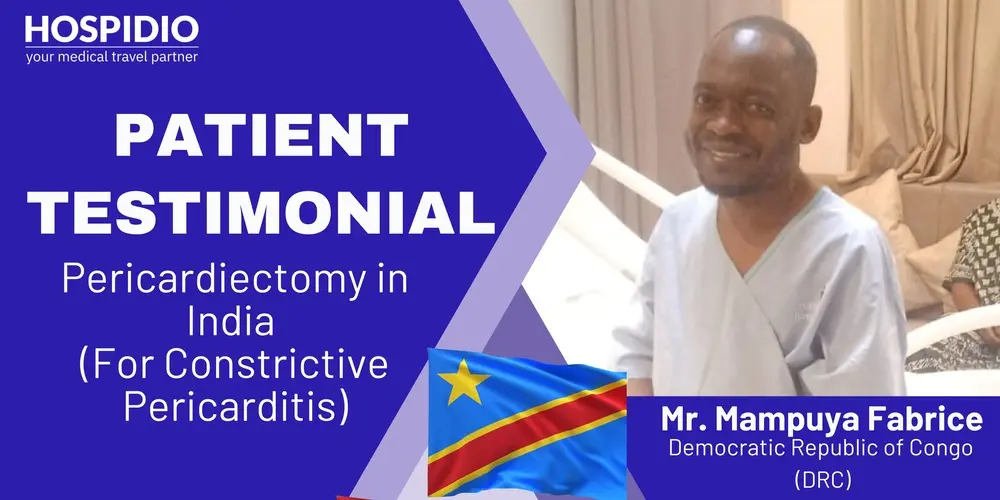
| Patient Characteristic | Details |
| Name | Mampuya Fabrice |
| From | Democratic Republic of Congo (DRC) |
| Diagnosis | Constrictive pericarditis with significant complications |
| Procedure | Pericardiectomy (surgical removal of the pericardium) |
| Hospital | Manipal Hospital, Dwarka, New Delhi, India |
| Cardiac Surgeon | Dr. Yugal Kishore Mishra |
| Hospital Stay | 7 days |
| Total Stay in India | Approximately 3 weeks |
| Outcome | Surgery successful. Returned home to DRC. |
For most people, the word pericarditis conjures an image of inflammation around the heart, something serious but treatable. Constrictive pericarditis is different. Over time, the normally flexible sac around the heart becomes scarred, thickened, and rigid. It constricts. And as it does, it prevents the heart from filling properly with each beat, slowly strangling the organ that keeps everything else alive.
Mampuya Fabrice from the Democratic Republic of Congo had been living with this condition and its complications. He had reached the point where surgery was the only path forward: a pericardiectomy, the removal of the constrictive pericardium to free the heart. It is open heart surgery, and it is not available in the DRC.
He came to India. And when the financial burden of getting that surgery threatened to become an insurmountable obstacle on top of everything else he was already carrying, HOSPIDIO stepped in.
He came to India needing his heart freed. When the cost threatened to become an obstacle, HOSPIDIO made sure it was not.
Constrictive Pericarditis: When the Heart Cannot Breathe
The pericardium is a two-layered fibrous sac surrounding the heart. In healthy tissue, it allows the heart to move freely as it contracts and expands with each beat. In constrictive pericarditis, inflammation that has occurred over time leads to fibrosis and calcification of the pericardium. The sac becomes stiff and inelastic, and it begins to restrict the heart's ability to fill with blood during each cycle.
The consequences are progressive and serious. As the heart struggles to fill adequately, blood backs up into the venous system. Patients develop fluid retention, liver congestion, ascites (fluid in the abdomen), and progressive fatigue. The condition worsens over time without treatment, and without surgery in advanced cases, the prognosis is poor.
Pericardiectomy is the definitive treatment. The surgeon removes the thickened, calcified pericardium, freeing the heart to function normally. It is a technically demanding procedure that requires an experienced cardiac surgical team and full cardiothoracic support. For patients across central and sub-Saharan Africa, India has become one of the most accessible places to have this surgery performed to a world-class standard.
About constrictive pericarditis: Constrictive pericarditis can develop following tuberculosis infection (a common cause in sub-Saharan Africa), previous cardiac surgery, radiation therapy, or other inflammatory conditions. In many parts of Africa, TB-related constrictive pericarditis is the most frequent cause. When medical management no longer controls symptoms, pericardiectomy offers the chance of full or near-full functional recovery.
Arrival in India: Full Evaluation Before Any Decision
Mampuya arrived at Manipal Hospital, Dwarka, in New Delhi under the care of Dr. Yugal Kishore Mishra, one of India's most experienced cardiac surgeons with extensive expertise in complex cardiac procedures including pericardiectomy. Rather than proceeding directly to surgery on the basis of prior reports, the team conducted a thorough evaluation to confirm the diagnosis, assess the full extent of the condition, and ensure Mampuya was properly prepared for surgery.
The workup included:
- Echocardiography to assess pericardial thickness, cardiac filling patterns, and the degree of haemodynamic compromise
- CT scan of the chest to map the extent and distribution of pericardial calcification and thickening
- Cardiac catheterisation where indicated, to measure intracardiac pressures and confirm the haemodynamic features of constrictive physiology
- Liver function tests and abdominal imaging to assess the degree of systemic venous congestion and organ impact
- Full pre-operative blood work, lung function assessment, and anaesthetic review
This comprehensive pre-operative assessment is not a formality. Pericardiectomy carries significant surgical risk, particularly in patients with advanced disease and organ involvement. The quality of pre-operative planning directly influences outcomes. Mampuya was evaluated thoroughly and cleared for surgery.
Pre-operative assessment: Full evaluation completed. Diagnosis confirmed. Mampuya cleared for pericardiectomy.
When the Financial Barrier Threatened Everything
Medical travel is rarely straightforward, and for patients from the DRC, the financial dimension adds a particular layer of difficulty. The cost of cardiac surgery, even in India where prices are far below Western equivalents, can represent a sum that strains or exceeds a family's means.
Mampuya faced exactly this situation. He was in India, he had been assessed, his surgery was planned, but he needed some medical management to remove the ascites befoe surgery. It was an unforeseen situation but had to be managed before the heart surgery. The financial gap threatened to become an obstacle that stood between him and the procedure his heart needed.
This is the moment where HOSPIDIO's role extended beyond coordination into something more personal.
The HOSPIDIO team went back to Dr. Yugal Kishore Mishra and the hospital with an honest account of Mampuya's financial situation. The surgeon, hospital and HOSPIDIO worked together on an arrangement that was less of a financial burden to the patient.
The surgery happened.
On financial support: HOSPIDIO works with its partner hospitals and surgeons to find solutions for patients who face genuine financial hardship. While this is not possible in every case, where the clinical situation is serious and the patient's need is real, HOSPIDIO will always make the attempt. Mampuya's case is an example of what that commitment looks like in practice.The surgery happened because HOSPIDIO asked. That is what having the right partner means.
The Surgery: Freeing the Heart
Dr. Yugal Kishore Mishra performed the pericardiectomy at Manipal Hospital, Dwarka. The procedure involves opening the chest, carefully identifying and removing the thickened, calcified pericardium from the surface of the heart, and freeing the cardiac muscle to contract and expand normally. In cases involving heavy calcification, the surgery requires particular precision to avoid damage to the underlying myocardium.
The surgery was successful.
Mampuya spent seven days in hospital following the procedure. Post-operative care after pericardiectomy involves close monitoring of cardiac function as the freed heart adjusts to operating without the constraint it had been working against, management of fluid balance as the body readjusts, and careful wound care and respiratory physiotherapy.
For Patients from the DRC and Central Africa Facing Cardiac Surgery
Constrictive pericarditis related to tuberculosis is significantly more prevalent in sub-Saharan Africa than in other parts of the world. For patients in the DRC, Congo-Brazzaville, Cameroon, Central African Republic, and neighbouring countries, access to the cardiac surgery needed to treat advanced constrictive pericarditis is severely limited. India is one of the most accessible high-quality options available.
India's leading cardiac surgery centres, including Manipal Hospital Dwarka, perform pericardiectomy and other complex cardiac procedures at costs that, while significant, are far below what equivalent surgery would cost in Europe or South Africa. And HOSPIDIO's role extends beyond logistics to include advocacy on behalf of patients who face genuine financial barriers.
If you or a family member has been diagnosed with constrictive pericarditis or another cardiac condition requiring surgery that is not available locally, reach out to HOSPIDIO. We will review your reports, connect you with the right cardiac surgeon, and work with you on the practical and financial realities of making the journey possible.
To understand how HOSPIDIO manages the full journey from first contact to safe return home, read: From WhatsApp to Discharge: How HOSPIDIO Manages Your Entire Medical Journey.
You can also read how India compares to other destinations for cardiac surgery from Africa: India vs South Africa for Medical Treatment: What African Patients Need to Know.
Facing cardiac surgery and concerned about affordability? Contact HOSPIDIO to discuss your situation openly.
Recent Blogs

Ashutosh heads the Patient Experience Department at HOSPIDIO, ensuring seamless, compassionate support for international patients seeking treatment in India. With deep expertise in medical travel and hospital coordination, he’s dedicated to making every patient feel safe and cared for. Outside work, he enjoys driving and exploring new cuisines.
Guneet Bhatia is the Founder of HOSPIDIO and an accomplished content reviewer with extensive experience in medical content development, instructional design, and blogging. Passionate about creating impactful content, she excels in ensuring accuracy and clarity in every piece. Guneet enjoys engaging in meaningful conversations with people from diverse ethnic and cultural backgrounds, enriching her perspective. When she's not working, she cherishes quality time with her family, enjoys good music, and loves brainstorming innovative ideas with her team.