
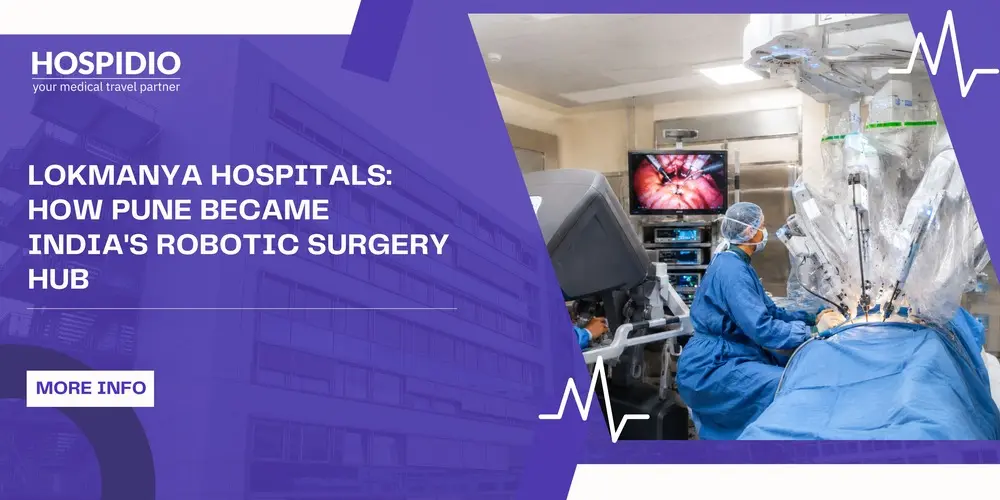
In July 2025, a major development quietly reshaped the healthcare landscape in India. Pune, a city already known for its universities, technology sector, and manufacturing industry, was formally recognized as India's robotic surgery capital following a landmark investment in Lokmanya Hospitals, Asia's pioneering institution in robotic assisted joint replacement surgery.
For international patients weighing where to go for advanced orthopedic care, this was worth paying attention to. It confirmed what many in the medical travel industry had long observed: that India was no longer just a cost-saving alternative. It had become a destination of genuine clinical depth and surgical precision.
What Happened in Pune in July 2025
In July 2025, Unaprime Healthcare LLP acquired approximately 84.5% stake in Lokmanya Hospitals, a Maharashtra based hospital chain with over 50 years of history and a pioneering record in robotic assisted surgery across Asia. The deal included the acquisition of a stake previously held by Tata Healthcare Fund, alongside a fresh injection of capital set aside specifically for expansion.
The transaction was significant for two reasons. First, it brought in substantial institutional investment from backers with deep experience in healthcare transformation. Second, it did not simply fund more of the same. It set the stage for Lokmanya to grow into something far more comprehensive than a specialty orthopedic hospital.
Unaprime Healthcare was backed by prominent domestic investors including Dr. K. Ravindranath of Global Hospitals, the physician widely credited with bringing multi-organ transplantation to India, and healthcare transformation specialist Manpreet Sohal, who took on the role of Managing Director and Group CEO.
What Made Lokmanya Hospitals the Right Foundation
Before this investment, Lokmanya Hospitals had already built one of the most respected orthopedic track records in Asia. By the time the deal was announced, the hospital had treated over 150,000 patients, performed more than 50,000 knee replacements, and completed over 15,000 robotic surgeries. Those are not modest numbers. They represent some of the highest robotic surgery volumes on the continent.
At the center of that record was Dr. Narendra Vaidya, Chairman and Chief Joint Replacement Surgeon, who had spent decades building Lokmanya's reputation as Asia's first institution to pioneer robotic assisted joint replacement. His clinical leadership, combined with the hospital's focused specialization in orthopedics, gave it an identity that general multi specialty hospitals simply could not replicate.
High surgical volume in joint replacement matters. Surgeons who perform hundreds of these procedures a year develop a level of precision and familiarity with complication management that directly influences patient outcomes. For international patients, that volume is a meaningful quality signal.
Share your medical reports with HOSPIDIO and receive a free specialist opinion within 24 hours.
The Expansion Plan: What Was Set in Motion
The 2025 investment did not simply maintain the status quo. It set an ambitious growth plan in motion.
Under Manpreet Sohal's leadership and guided by Dr. Vaidya and Dr. Ravindranath, Lokmanya Hospitals was planned to expand from over 300 beds to over 800 beds within three to four years. That represented a capacity increase of more than 160 percent.
The clinical scope was also set to broaden significantly. New Centers of Excellence were planned in:
- Cardiac sciences
- Neurosciences
- Comprehensive cancer care
- General and GI surgery
- Multi-organ transplantation
The geographic footprint was planned to grow as well, from four hospitals within Pune to additional locations in Mumbai and Kolhapur. By 2029, Lokmanya was expected to become one of Maharashtra's premier quaternary care hospital chains, capable of handling the most complex multi system cases referred from across the region.
Why Robotic Surgery in India is Attracting International Patients
Robotic assisted joint replacement surgery uses a robotic arm, guided in real time by the surgeon, to achieve precisely planned bone cuts and implant positioning. Before a single incision is made, the surgical team uses imaging data to create a digital plan of the procedure that accounts for the individual patient's anatomy. The robotic system then helps execute that plan with accuracy that is difficult to match through conventional techniques alone.
For patients, this translates into several practical advantages:
- More accurate implant alignment, which can reduce wear over time and improve long term function
- Smaller incisions and less disruption to surrounding soft tissue
- Faster return to walking and rehabilitation, often within 24 hours of surgery
- Reduced risk of certain post operative complications
These clinical benefits are available in India at a fraction of what the same procedure costs in Western healthcare systems. Robotic knee replacement in India typically costs between $4,000 and $7,000 USD, depending on the hospital and implant chosen. The same procedure in the United States commonly exceeds $30,000, and in the United Kingdom through private care, it frequently costs between 15,000 and 20,000 pounds.
For international patients, that cost difference, combined with clinically comparable outcomes at accredited hospitals with high surgical volumes, is what makes India a serious option rather than simply a cheaper one.
What International Patients Should Know Before Traveling for Robotic Surgery
If you are considering robotic joint replacement in India, a few things are worth understanding before you decide.
Not every hospital offering robotic surgery has equivalent experience. The number of robotic procedures performed annually, the surgeon's specific training, and the hospital's protocols for international patient support all vary. High surgical volume matters. Surgeons who perform hundreds of these procedures a year develop a precision in complication management that directly influences patient outcomes.
For practical planning, most robotic joint replacement patients need a hospital stay of two to four days, followed by supervised physiotherapy before they are cleared to fly. Patients traveling from abroad typically plan for a total stay of two to three weeks in India.
How HOSPIDIO Supports Patients Considering Surgery in India
HOSPIDIO is a medical travel coordination service for international patients seeking treatment at India's leading hospitals. When you contact us, we review your medical reports and connect you with an appropriate orthopedic specialist at an accredited hospital. We can arrange a video consultation before you commit to traveling, so you can ask questions directly and understand exactly what the surgical plan involves.
Once you are in India, a dedicated case manager stays with you throughout your stay, coordinating hospital admission, accommodation, and daily logistics. When you leave, you take your complete surgical and discharge documentation in a format your doctor at home can use.
We do not recommend travel when it is not the right choice. But if you are facing long waiting times, high private costs, or simply want a specialist opinion before deciding, we are here to help you think it through.
What Pune's Recognition Signals for the Future of Medical Travel
Pune's emergence as India's robotic surgery capital in 2025 was not a sudden development. It was the result of decades of sustained clinical investment, a surgeon who had built a genuine specialty over a career, and institutional confidence from investors who saw a strong enough foundation to build something much larger on top of it.
For international patients, it is one more signal that India's healthcare infrastructure is not competing on cost alone. Hospitals are investing in technology, volume, and specialization in ways that create real clinical differentiation. Robotic surgery is a clear example. Multi-organ transplantation, advanced oncology, and complex cardiac surgery are others.
The question for patients is no longer whether India can offer world class care. It is finding the right hospital, the right surgeon, and the right support for your specific situation.That is what HOSPIDIO is here to help with.
Ready to find out if robotic surgery in India is right for you? Send us your reports and we will come back with a specialist opinion, a hospital recommendation, and a clear next step within 48 hours.
Get a Free Treatment Plan
Sources:Punekar News (July 3, 2025). This post is for general information only and does not constitute medical advice. Always consult a qualified healthcare professional about your condition and treatment options.
Recent Blogs


Shruti Verma has completed her M.Tech in Biotechnology with experience in medical writing and scientific content development. She specializes in translating complex biomedical and healthcare information into clear, accurate, and reader-friendly content for diverse audiences. When she is not designing content, probably she is designing graphics.
Guneet Bhatia is the Founder of HOSPIDIO and an accomplished content reviewer with extensive experience in medical content development, instructional design, and blogging. Passionate about creating impactful content, she excels in ensuring accuracy and clarity in every piece. Guneet enjoys engaging in meaningful conversations with people from diverse ethnic and cultural backgrounds, enriching her perspective. When she's not working, she cherishes quality time with her family, enjoys good music, and loves brainstorming innovative ideas with her team.