
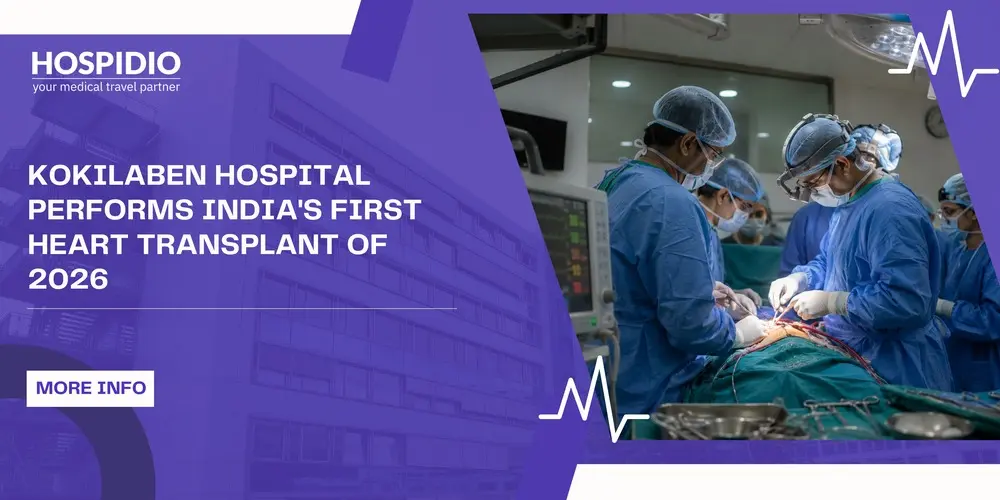
In January 2026, a 10-year old girl was given back her future by a surgical team in Mumbai. Kokilaben Dhirubhai Ambani Hospital performed India's first heart transplant of 2026, pulling a critically ill child back from heart failure through advanced life support, precise surgical coordination, and the generosity of a donor family. This is what happened, and why it matters.
A Sudden Collapse in a Healthy Child
The child had been in good health until a few weeks before her hospitalization. She then rapidly developed severe cardiac symptoms and was diagnosed with dilated cardiomyopathy, a condition where the heart muscle enlarges and weakens, losing its ability to pump blood efficiently to the rest of the body. Genetic testing pointed to a hereditary cause, which likely explained how fast she deteriorated.
As medications failed to stabilize her, she was airlifted from Goa to Mumbai via air ambulance under continuous advanced medical monitoring.
From ECMO to LVAD: Keeping Her Alive While Waiting for a Heart
On arrival at the hospital's Children's Heart Centre, the pediatric cardiology team led by Dr. Prashant Bobhate took over her care. Despite intensive therapy, her heart function continued to decline. The team escalated to Extracorporeal Membrane Oxygenation, or ECMO, a life support system that temporarily takes over the work of the heart and lungs by circulating and oxygenating blood outside the body.
When ECMO related complications arose and she needed longer term support, she was placed on a Left Ventricular Assist Device, or LVAD. The LVAD is a mechanical pump that helps the weakened left ventricle continue circulating blood. It bought the team the time they needed.
Dr. Suresh Rao, Director of the Children's Heart Centre and Consultant Pediatric and Congenital Heart Surgeon, described the situation plainly. The team had to escalate rapidly from medications to ECMO and then to an LVAD. A heart transplant was the only long term solution, but the waiting period is always emotionally challenging for families.
The Donor and the Race Against Time
On January 6, 2026, an organ offer arrived through India's official allocation system. The heart came from a 56-year old woman who had suffered a fatal road accident. Her family's decision to donate gave this child a chance.
A donor heart has a viability window of roughly four to six hours. A retrieval team led by Dr. Hari Bipin Radhakrishnan Kattana traveled to Aurangabad to collect the organ. It was flown back to Mumbai via priority airlift, with a green corridor established to clear the route and minimize transit time. The transplant surgery ran for six hours and concluded successfully, with strong cardiac function confirmed post operatively.
Recovery and the Road Ahead
The child's recovery has been steady. She has been progressively weaned off life support and has begun mobilizing with rehabilitation support. Going forward, she will require lifelong immunosuppressive therapy to prevent organ rejection and close follow up care. Her medical team expects her to regain a near normal quality of life.
Hospital CEO Dr. Santosh Shetty acknowledged the full scope of the effort involved, thanking government authorities, transplant coordinators, and the donor family, calling the transplant a powerful example of how organ donation can give a second chance at life.
What is Dilated Cardiomyopathy?
Dilated cardiomyopathy, or DCM, is one of the leading causes of heart failure in children and the most common reason pediatric patients need a heart transplant worldwide. It can arise from genetic mutations, viral infections, or autoimmune conditions. The heart's left ventricle enlarges and weakens, reducing pumping efficiency. In children, symptoms include fatigue, breathlessness, and reduced tolerance for activity. When DCM stops responding to medication, transplantation is the definitive treatment. Genetic testing, as in this case, can identify hereditary forms and enable early screening of other family members.
Why this Case Reflects a Bigger Shift in Indian Cardiac Care
This transplant is significant beyond the individual outcome. It reflects genuine progress in how India approaches complex pediatric cardiac surgery.
Performing a successful heart transplant in a 10-year old demands a different technical skill set than adult procedures. Pediatric donor hearts are scarcer, margins for error are narrower, and coordination across retrieval, transport, and surgical teams must be flawless. The fact that this was executed successfully at an Indian center signals a level of subspecialty maturity that continues to attract international patients.
The use of ECMO followed by LVAD as a bridge to transplantation reflects a sophisticated approach to end stage pediatric heart failure that is now available at India's leading tertiary hospitals. And with India's organ donation rates still among the lowest globally, this case is also a reminder of how much depends on donor families choosing to act in their most difficult moments.
Considering Cardiac Care in India
India has become a recognized destination for complex cardiac procedures at a fraction of the cost of Western countries. For families evaluating pediatric cardiac surgery, organ transplantation, or advanced heart failure management, India offers experienced surgical teams, accredited facilities, and cost effective pathways that are hard to match elsewhere.
At HOSPIDIO, we connect international patients with India's leading cardiac centers, including the best pediatric cardiac surgeons in India and the best cardiology hospitals in India. We coordinate everything from the first consultation through post operative follow up. Our team can provide a free case review with no obligation.
Get a Free Treatment Plan
Conclusion
India's first heart transplant of 2026 is more than a medical milestone. It is the story of a child who came within weeks of losing her life, and the chain of decisions, technology, expertise, and human generosity that brought her back. As India's transplant infrastructure continues to grow, cases like this one define what is now possible.
References
- Srivastava, A. (January 17, 2026). Mumbai Medical Breakthrough: Kokilaben Dhirubhai Ambani Hospital Performs India's First Heart Transplant of 2026, Saves 10-Year-Old Child. Free Press Journal. https://www.freepressjournal.in/mumbai/mumbai-medical-breakthrough-kokilaben-dhirubhai-ambani-hospital-performs-indias-first-heart-transplant-of-2026-saves-10-year-old-child
- Kokilaben Dhirubhai Ambani Hospital, Mumbai. Children's Heart Centre. https://www.kokilabenhospital.com
About Hospidio: This blog post is intended to provide factual, evidence based information to keep our community informed about global health developments and medical milestones. Always consult with qualified healthcare professionals for medical advice and follow guidance from your treating physicians.
Recent Blogs

Shruti Verma has completed her M.Tech in Biotechnology with experience in medical writing and scientific content development. She specializes in translating complex biomedical and healthcare information into clear, accurate, and reader-friendly content for diverse audiences. When she is not designing content, probably she is designing graphics.
Guneet Bhatia is the Founder of HOSPIDIO and an accomplished content reviewer with extensive experience in medical content development, instructional design, and blogging. Passionate about creating impactful content, she excels in ensuring accuracy and clarity in every piece. Guneet enjoys engaging in meaningful conversations with people from diverse ethnic and cultural backgrounds, enriching her perspective. When she's not working, she cherishes quality time with her family, enjoys good music, and loves brainstorming innovative ideas with her team.