
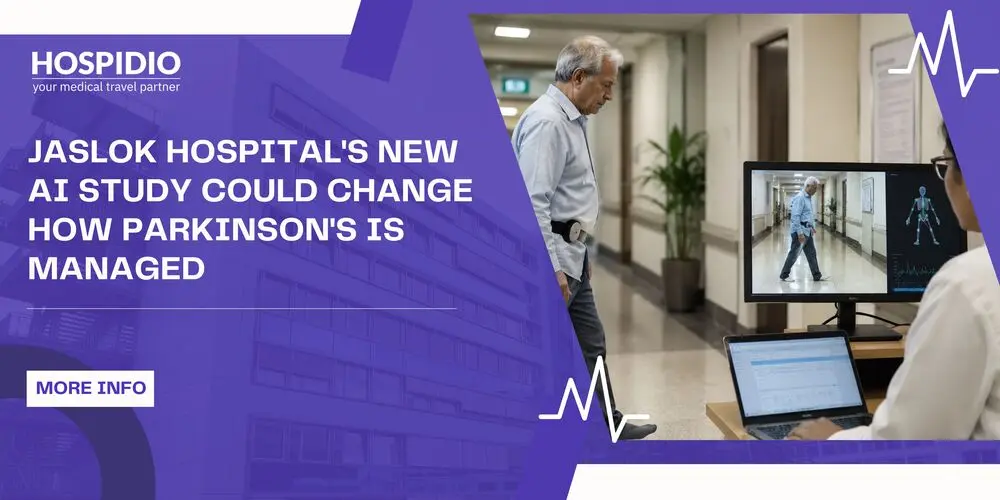
A landmark clinical study launched by Jaslok Hospital & Research Centre in Mumbai could change how doctors predict one of Parkinson's disease's most dangerous complications. The hospital has unveiled an AI-powered initiative to forecast Freezing of Gait (FOG) episodes in Parkinson's patients using nothing more than routine walking videos. Launched formally on World Parkinson's Day, this project represents a meaningful leap toward making neurological care earlier, smarter, and far more accessible across India.
What is Parkinson's Disease, and Why is it Rising in India?
Parkinson's disease is the world's second most common neurodegenerative disorder. It develops when dopamine producing neurons in the brain break down, gradually impairing movement, balance, and coordination. Symptoms include tremors, stiffness, slowed movement, and over time, significant physical disability.
In India, the burden is growing. Neurologists have observed a steady rise in Parkinson's cases linked to an ageing population and increased diagnostic awareness. As Dr. Paresh Doshi, Director of Neurosurgery at Jaslok Hospital, noted at the study launch: "Parkinson's is steadily increasing in India, placing greater pressure on neurological care systems."
Among its most disabling complications is a symptom known as Freezing of Gait.
Understanding Freezing of Gait
Freezing of Gait, or FOG, is one of the most distressing features of advanced Parkinson's disease. Patients describe their feet suddenly feeling "glued to the floor" mid stride, even when they want to keep walking. These episodes can last seconds or minutes and strike without warning, while crossing a road, turning a corner, or passing through a doorway.
FOG affects up to 80% of patients with advanced Parkinson's disease and is a leading cause of falls, fractures, hospitalizations, and loss of independence. Despite its prevalence, predicting when a patient will develop FOG has remained one of the most elusive challenges in Parkinson's care. That is precisely the gap this new AI study aims to close.
How the AI System Works
Jaslok Hospital has designed a two phase clinical study that uses computer vision and machine learning to analyze walking videos and detect early signs of FOG vulnerability, before visible symptoms appear.
The system requires no wearable sensors, no expensive equipment, and no laboratory testing. It analyzes routine walking videos to pick up on subtle gait changes that are invisible to the human eye but recognizable to a trained AI model.
- Phase 1 (Retrospective Training): The AI is trained on historical data and videos from over 150 patients who previously developed FOG, learning the earliest gait signatures of FOG risk.
- Phase 2 (Prospective Validation): The model is then validated across 337 patients tracked over up to three years, testing its ability to predict FOG risk in patients who have not yet experienced an episode.
Underpinning the entire system is a remarkable dataset. Jaslok Hospital has accumulated 25 years of longitudinal data from over 750 Deep Brain Stimulation (DBS) patients, one of the most comprehensive such archives in the world. This depth of real world clinical data gives the AI a foundation that very few institutions globally could provide.
An India-France Collaboration
The study is jointly led by Dr. Paresh Doshi and Dr. Carine Karachi, a globally recognized FOG expert from the Paris Brain Institute in France. Dr. Karachi has described Dr. Doshi's 30-year dataset as unique worldwide, and the collaboration is supported through CEFIPRA funding (currently under review).
Jaslok Hospital CEO Jitendra Haryan framed the hospital's broader ambition clearly: the goal is practical, deployable AI that simplifies neurological detection and improves patient outcomes across India's diverse healthcare landscape, not technology for its own sake.
Why this Matters Beyond Mumbai
The most significant design choice in this project is what the system does not need. Because it is entirely wearable free and video based, it is well suited for settings far beyond well resourced urban hospitals.
A smartphone camera and an internet connection are all that is required. This opens the door to telemedicine applications, remote patient monitoring, and adoption in district clinics and community health programs where specialist equipment is rarely available. The long term goal is an open access app that any clinician can use to identify at risk patients early, predict FOG timelines, and initiate preventive care before disability sets in.
What Early Prediction Makes Possible
Early FOG prediction is not just a diagnostic milestone. It is a clinical opportunity. When a patient is identified as high risk months before their first episode, doctors can act through targeted motor training, gait rehabilitation, DBS programming adjustments, and medication optimization.
For patients and families, the stakes are deeply personal. Falls from FOG episodes are among the most feared events in the Parkinson's journey. They cause injury, erode confidence, and often mark the transition from independent living to full time care. A tool that predicts these episodes early enough to intervene represents a genuine shift in how Parkinson's care is delivered: from reactive symptom management toward proactive prevention.
Key Takeaways
- Jaslok Hospital Mumbai has launched an AI study to predict Freezing of Gait using routine walking videos.
- FOG affects up to 80% of advanced Parkinson's patients and is a leading cause of falls and loss of independence.
- The AI uses computer vision and machine learning with no wearables or specialist equipment required.
- The study draws on 25+ years of longitudinal data from over 750 DBS patients at Jaslok.
- The collaboration between Dr. Paresh Doshi and Dr. Carine Karachi (Paris Brain Institute) is funded through CEFIPRA.
- The long term goal is an open access app for clinicians in telemedicine and resource limited settings.
Conclusion
Jaslok Hospital's AI driven FOG study is a compelling example of what becomes possible when deep clinical expertise, a rare longitudinal dataset, and international collaboration come together. As Parkinson's disease continues to rise in India and globally, accessible and scalable tools like this one will be critical in shifting care from crisis response to early prevention.
Considering Neurological Care in India?
If you or a loved one is living with Parkinson's disease and exploring specialist neurological care, including Deep Brain Stimulation or advanced movement disorder treatment, India's leading hospitals offer world class expertise at significantly lower costs than in Western countries.
At Hospidio, we help international patients connect with top neurologists and neurosurgeons, guiding you through every step of the process with clarity and care.
Get a Free Treatment Plan
No obligation. Our patient consultants typically respond within 15 minutes.
References
IndiaMedToday. (April 13, 2026). Jaslok Hospital Launches AI Study to Predict Parkinson's Freezing of Gait Using Simple Walking Videos. https://indiamedtoday.com/jaslok-hospital-launches-ai-study-to-predict-parkinsons-freezing-of-gait-using-simple-walking-videos/
About Hospidio: This blog post is intended to provide factual, evidence based information to keep our community informed about global health developments and medical innovations. Always consult with a qualified healthcare professional for medical advice, diagnosis, or treatment decisions.
Recent Blogs



Shruti Verma has completed her M.Tech in Biotechnology with experience in medical writing and scientific content development. She specializes in translating complex biomedical and healthcare information into clear, accurate, and reader-friendly content for diverse audiences. When she is not designing content, probably she is designing graphics.
Guneet Bhatia is the Founder of HOSPIDIO and an accomplished content reviewer with extensive experience in medical content development, instructional design, and blogging. Passionate about creating impactful content, she excels in ensuring accuracy and clarity in every piece. Guneet enjoys engaging in meaningful conversations with people from diverse ethnic and cultural backgrounds, enriching her perspective. When she's not working, she cherishes quality time with her family, enjoys good music, and loves brainstorming innovative ideas with her team.