
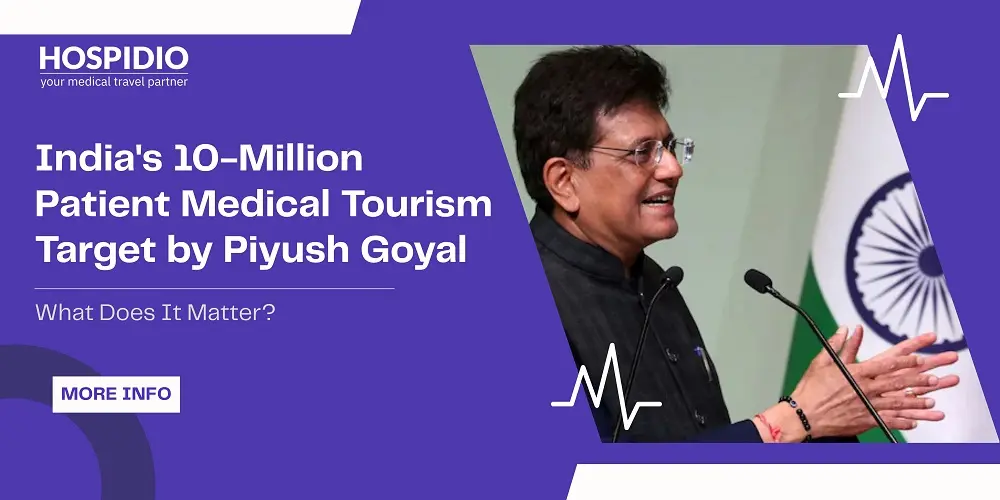
India Just Set an Ambitious Medical Tourism Target. Here's Why It Matters to You
In September 2026, India's Union Commerce and Industry Minister Piyush Goyal announced a transformative vision: India should aim to attract 10 million international medical tourists annually. To put this in perspective, that's nearly three times more than the 3.5 million international patients served over the past seven years.
If you're considering medical travel to India, this announcement is significant. It signals that India is investing in infrastructure, quality assurance, and patient experiences specifically designed for people like you. But what does this mean in practical terms? And how can you benefit from this expansion?
We've broken down the announcement, verified the details, and explained what you need to know before choosing India for your treatment.
The Announcement: India's Medical Tourism Vision for 2026 and Beyond
Minister Goyal's five-point action plan represents a coordinated push across government, hospitals, and healthcare providers to position India as the world's most affordable and accessible destination for quality medical care. The initiative is built on a proven foundation: India already offers clinical excellence and healthcare costs that are 60 to 80 per cent lower than in developed countries.
The roadmap includes training and certifying international-standard caregivers, encouraging hospitals to join the 'Heal in India' gateway with transparent pricing, improving digital health platforms and telemedicine, organising global exhibitions featuring only NABH-accredited hospitals, and expanding services to Tier-2 and Tier-3 cities beyond metropolitan centres.
For international patients, this isn't just rhetoric. It means more hospitals, clearer pricing, better digital coordination, and a government-backed commitment to maintaining quality across all regions.
What This Expansion Means for You as an International Patient
India's 10-million-patient target is ambitious, but it's being backed by concrete investments in three areas that directly benefit you: accessibility, quality assurance, and affordability.
First, accessibility. Right now, most international patients travel to major metros like Delhi, Mumbai, Bangalore, and Chennai. The new initiative aims to decentralise this. Tier-2 and Tier-3 cities like Pune, Ahmedabad, Lucknow, and Chandigarh are expanding their international patient infrastructure, meaning shorter domestic travel times and more treatment options closer to you once you arrive.
Second, quality. Every hospital promoted under this initiative must hold NABH (National Accreditation Board for Hospitals and Healthcare Providers) accreditation. NABH is India's gold standard for quality assurance, aligned with international best practices and recognised by the International Society for Quality in Health Care. This removes guesswork.
Third, affordability with no compromise. The initiative explicitly emphasises maintaining equal quality standards for both domestic and international patients. You're not getting a second-rate version of a procedure because you're an international patient; you're getting world-class care at a fraction of the cost.
Quality First: Understanding the NABH Standard
If you're comparing hospitals or feeling uncertain about quality, NABH accreditation is your anchor. NABH is administered by the Quality Council of India and sets rigorous standards across hospitals, clinics, laboratories, blood banks, and digital health systems.
What does NABH accreditation actually mean? It means the hospital has been independently evaluated and certified to meet benchmarks in patient safety, infection control, clinical governance, staffing qualifications, equipment standards, and patient care protocols. It's not a guarantee of perfection, but it's a strong signal that the hospital takes safety and quality seriously.
The latest edition of NABH Hospital Accreditation Standards is the 6th edition, and it evolves regularly to incorporate international best practices. Over 30,000 healthcare facilities across India hold NABH or related quality certifications.
When you're researching hospitals in India, NABH accreditation should be a priority filter. If a hospital is featured in India's official medical tourism initiatives, NABH accreditation is mandatory.
Affordability Without Compromise: The Cost Reality
The numbers are compelling. A major orthopedic procedure that costs USD 35,000 to 50,000 in the United States might cost USD 8,000 to 12,000 in India at a NABH-accredited hospital. A cardiac bypass surgery that runs USD 100,000 plus in developed nations costs USD 20,000 to 30,000 in India. Fertility treatments, dental work, joint replacements, cancer therapies: the cost difference is consistent and substantial.
This isn't a race to the bottom. The reason costs are lower in India is structural: lower labour costs, efficient hospital operations, high patient volume, government support, and economies of scale. You're not paying for artificial inflation or brand markups. You're paying for genuine value.
India's 10-million-patient initiative doesn't change these economics, but it does cement them. Government backing ensures that cost controls and affordability remain policy priorities, not just market accidents.
Expanding Beyond The Metros: Tier-2 and Tier-3 Growth
Historically, international medical travel to India meant flying into Delhi, Mumbai, Bangalore, or Chennai. These cities have the infrastructure, reputation, and experience managing international patients. But they're also crowded and expensive for accommodation.
The new initiative explicitly targets Tier-2 and Tier-3 cities. This means hospitals in places like Pune, Ahmedabad, Lucknow, Chandigarh, and Indore are now training international patient coordinators, establishing English-language support, and investing in modernisation. For you, this translates to more options, potentially shorter stays, and less travel congestion.
Regional hospitals often have the same technology and surgeon expertise as metros, sometimes with shorter wait times and more personalised attention. As these cities mature their international patient services, expect more competition and better service quality.
Digital Care: Telemedicine and Seamless Coordination
One of the five pillars of the initiative is improving digital health platforms and telemedicine capability. For international patients, this is transformative. It means you can have consultations with Indian specialists before travelling, share imaging and records digitally, and continue follow-up care after you return home without geographical friction.
India's government is promoting hospitals that offer digital payment systems, online appointment booking, telemedicine consultations, and secure patient record management. This modernises the patient experience and removes traditional friction points like visa delays or communication gaps.
The 'Heal in India' gateway, which sits at the centre of this initiative, is being positioned as a transparent, digital-first hub where you can compare hospitals, check pricing, book consultations, and coordinate your entire medical journey online.
What's Happening Now: Timeline and Action Items
The initiative is not a distant promise.
Several components are already in motion: Training and Certification: India is establishing programmes to certify caregivers and patient coordinators to international standards. This means better-trained staff who understand the unique needs of international patients.
Hospital Participation: NABH-accredited hospitals are being invited to join the 'Heal in India' gateway, listing their services, pricing, and international patient facilities. Participation is growing as hospitals recognise the opportunity.
Global Promotion: India is planning international exhibitions and promotional campaigns to raise awareness of medical tourism among patients in key source markets.
Regional Expansion: Tier-2 and Tier-3 hospitals are upgrading infrastructure and staff training to meet international standards and join the gateway.
These changes won't happen overnight, but they're happening now.
How HOSPIDIO Guides You Through This Expansion
India's medical tourism ecosystem is growing, but growth also brings complexity. More hospitals means more choices, but also more research required. Transparent pricing is promised, but comparing offers across regions and specialties requires expertise.
We help international patients navigate this landscape. Our specialists verify hospital credentials, compare procedures and costs, coordinate your logistics (visa, transfers, accommodation, local transport), and stay with you from your first consultation through discharge and follow-up care. As India's infrastructure expands, our guidance becomes even more valuable, not less.
We're not just connecting you to any hospital. We're connecting you to NABH-accredited hospitals where we've verified quality, negotiated transparency, and established relationships. And we're keeping you informed as the market evolves.
Ready to explore your medical travel options in India? Chat with us on WhatsApp or request a free case review to get started.
References
Recent Blogs



Frequently Asked Questions
No. The initiative explicitly states that quality standards remain non-negotiable and apply equally to all patients, domestic and international. NABH accreditation is mandatory for participating hospitals, and quality assurance is built into the five-point plan, not an afterthought.
Potentially in metros, but the Tier-2 and Tier-3 expansion is designed to distribute demand. Also, increased volume often enables hospitals to run more efficiently and offer shorter wait times, not longer. Competition for international patients will likely improve service.
Yes. The initiative is government-backed, NABH accreditation is a legal requirement for featured hospitals, and transparency and ethics are stated priorities. That said, choose your hospital and surgeon carefully, verify credentials, and get a second opinion if uncertain.
Changes are already underway. Expect to see more hospitals joining gateways, improved digital infrastructure, and expanded Tier-2 city options over the next 12 to 24 months.
India's 10-million-patient vision is ambitious, but it's grounded in real investment and real commitment. For you, it means more options, clearer quality assurance, better digital coordination, and a government-backed healthcare system that's modernising in real time.
If you've been considering medical travel to India but were hesitant about quality, logistics, or options, this moment is worth reconsidering. The infrastructure is improving, the quality standards are tightening, and the cost advantage remains dramatic.
The next step? Reach out. We can help you understand your treatment options, compare hospitals, clarify costs, and plan your journey. You don't have to navigate India's expansion alone.
Sasmita Bal is a Digital Marketing and Content Specialist at HOSPIDIO with expertise in SEO and international healthcare content. She reviews published material to ensure it is optimized for search visibility and relevant to the needs of international patients seeking treatment in India. All content she reviews is authored and clinically approved by the Founder of HOSPIDIO and relevant medical specialists prior to publication.
Guneet Bhatia is the Founder of HOSPIDIO and an accomplished content reviewer with extensive experience in medical content development, instructional design, and blogging. Passionate about creating impactful content, she excels in ensuring accuracy and clarity in every piece. Guneet enjoys engaging in meaningful conversations with people from diverse ethnic and cultural backgrounds, enriching her perspective. When she's not working, she cherishes quality time with her family, enjoys good music, and loves brainstorming innovative ideas with her team.