
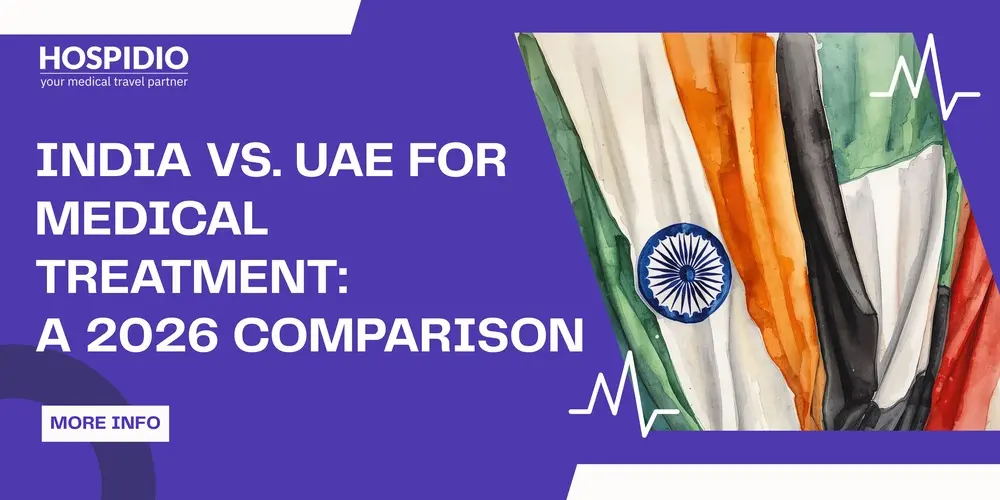
The UAE has spent two decades building itself into one of the most visible medical tourism destinations in the world. Dubai and Abu Dhabi are home to gleaming private hospitals, internationally accredited facilities, and a healthcare sector that actively competes for patients from across Africa, the Middle East, and South Asia. It is polished, convenient, and well-marketed.
India, meanwhile, has been doing something different. It has been quietly building one of the world's deepest concentrations of specialist medical expertise, at a fraction of the cost, treating complex conditions that the UAE's private sector is not always equipped to handle.
Both countries attract international patients. Both have hospitals that meet international standards. But they are not the same proposition, and for many patients, particularly those from East and West Africa, the Caribbean, and the broader developing world, choosing between them without the right information is a significant risk.
This guide cuts through the marketing and gives you an honest, evidence-based comparison. HOSPIDIO facilitates patient journeys to India and has deep familiarity with both markets. We have no incentive to push you toward one destination unless the evidence genuinely supports it for your specific case.
Before we begin: This is not a guide that concludes India is always better. There are situations where the UAE is the right choice, and we will say so clearly. The goal is to help you make the right decision for your specific condition, your budget, and your situation.
The Quick Summary: What Each Country Does Best
Here is the headline comparison before going into detail.
| Category | India | UAE |
| Overall cost | Significantly lower across almost all procedures | Expensive; comparable to Western Europe for complex care |
| Transplants (liver, kidney, BMT) | Available; strong access for foreign nationals | Restricted; organ allocation favors UAE nationals; limited living donor programs |
| Complex oncology | Wide specialist range; proton therapy available | Good for standard protocols; limited depth for rare cancers |
| Cardiac surgery | High volume, excellent outcomes, lower cost | Strong quality; costs 2 to 3 times higher than India |
| Orthopedics | Excellent quality; very competitive cost | Strong quality; significantly higher cost |
| Cosmetic surgery | Available; not a primary focus | Popular destination; competitive for aesthetic procedures |
| Neurosurgery | Exceptional depth in Delhi and Mumbai | Capable for standard cases; less specialist depth |
| Pediatric surgery | Strong dedicated pediatric centres | Limited depth for complex pediatric oncology |
| Proton therapy | Available at Apollo Proton Cancer Centre, Chennai | Not available as of 2025 |
| Language (English) | English at all international patient wards | English widely spoken throughout healthcare system |
| Visa for African patients | Medical visa required; HOSPIDIO manages fully | Visa required for most African nationalities |
| Geographic proximity to Africa | Longer travel (8 to 18 hours from most of Africa) | Shorter travel (4 to 8 hours from East and West Africa) |
The practical summary: For patients needing transplants, complex oncology, neurosurgery, or paediatric procedures, India is consistently the stronger choice on clinical and financial grounds. For patients who need proximity, speed of access from East Africa, or straightforward cardiac and orthopaedic surgery with English-language ease and shorter travel, the UAE deserves serious consideration.
Cost Comparison: India vs UAE Across Key Procedures
Cost is the most common reason patients from Africa, the Caribbean, and the developing world begin researching India in the first place. The UAE's healthcare costs are well-known to be high. Here is the detailed comparison.
| Procedure | Cost in India (USD) | Cost in UAE (USD) |
| Bone Marrow Transplant | $14,000 to $40,000 | $30,000 to $75,000 |
| Liver Transplant | $19,000 to $28,000 | $45,000 to $55,000 |
| Kidney Transplant | $11,000 to $15,500 | $25,000 to $35,000 |
| Heart Bypass (CABG) | $3,800 to $7,500 | $10,000 to $15,000 |
| Hip Replacement | $4,500 to $6,500 | $10,000 to $16,000 |
| Knee Replacement | $3,900 to $5,000 | $9,000 to $14,500 |
| Spine Surgery | $3,000 to $7,500 | $10,000 to $18,000 |
| IVF (Single Cycle) | $3,300 to $4,500 | $8,000 to $11,000 |
| Brain Tumor Surgery | $5,500 to $8,500 | $25,000 to $30,000 |
| Whipple's Surgery | $9,000 to $13,000 | $18,000 to $20,000 |
| Breast Cancer Surgery | $2,800 to $5,500 | $6,500 to $12,500 |
| ASD Device Closure | $6,000 to $7,000 | $12,000 to $18,000 |
| Scoliosis Correction Surgery | $11,500 to $15,500 | $25,000 to $30,000 |
Cost note: All figures are indicative 2025 estimates at accredited private hospitals. UAE costs reflect Dubai and Abu Dhabi private hospital rates. India figures reflect all-inclusive treatment costs at HOSPIDIO partner hospitals. Individual cases vary. HOSPIDIO provides a personalised cost estimate after reviewing your specific reports.
The cost differential between India and the UAE is not marginal. For most complex procedures, India is 50 to 75 percent less expensive. For a family self-funding treatment, that difference is not a preference. It is the difference between treatment being possible or not.
Quality and Accreditation: An Honest Assessment
The UAE's marketing emphasises the premium quality of its healthcare facilities, and that claim is not without foundation. Dubai and Abu Dhabi have invested heavily in private hospital infrastructure, and several leading hospitals in the UAE hold JCI accreditation. For routine procedures in a well-resourced private setting, UAE hospitals perform well.
The question is not whether the UAE has good hospitals. It does. The question is whether the UAE's healthcare system has the same depth of specialist expertise, institutional volume, and breadth of treatment capability as India's for the conditions that bring international patients to travel for care. On that question, the answer varies significantly by specialty.
JCI accreditation
India has more JCI-accredited hospitals than the UAE, and the concentration of accredited facilities in its major medical cities gives patients a wider choice within any given specialty. Both countries have JCI-accredited options available, and HOSPIDIO works only with accredited facilities.
Specialist depth and volume
India's major hospitals perform significantly higher volumes of complex procedures annually than UAE facilities. In transplant medicine, haematology, neurosurgery, and paediatric oncology, volume correlates directly with outcomes. A centre that performs 200 liver transplants a year has institutional experience that a centre performing 20 cannot replicate, regardless of how modern its equipment is.
The UAE's private healthcare system is built primarily to serve its domestic wealthy population and high-income expatriates with straightforward medical needs. It is not structured around the high-volume specialist programmes that make India's leading hospitals world-class for complex cases.
Technology
Both countries have modern hospital technology. One meaningful distinction is proton therapy: as of 2025, India has operational proton therapy facilities at Apollo Proton Cancer Centre in Chennai and other centres, while the UAE does not have proton therapy available. For patients who have been advised to seek proton therapy for brain tumours, spinal tumours, paediatric cancers, or rare bone tumours such as chordoma, India is the only realistic option in the broader region.
Why India costs less without quality suffering
The UAE's high costs are structural. Operating a premium private hospital in Dubai involves very high real estate costs, expatriate staff salaries benchmarked to Western markets, high insurance and liability costs, and a business model calibrated to serve wealthy patients. India's costs reflect a different economy entirely. A senior cardiac surgeon in India earns well by local standards while costing the hospital a fraction of what a comparable UAE or Western salary would. These structural differences explain the price gap without implying any difference in clinical quality.
Transplants: Why India Is the Only Realistic Option
For patients seeking organ transplants or bone marrow procedures, the choice between India and the UAE is not a close comparison. India is the clear choice, for two distinct reasons.
Access for foreign nationals
The UAE's organ transplant system operates under laws that prioritise UAE nationals and long-term residents on transplant waiting lists. Foreign patients face very significant legal and practical barriers to accessing organ transplants in the UAE. For most international patients seeking a liver or kidney transplant, the UAE is not a viable option regardless of cost. Only few hospitals such as Burjeel Medical City, Abu Dhabi, hold the license to run living donor transplant programs and can be considered as an option by an international patient with a legitimate living related donor.
India has a well-established legal framework for international patients accessing living-donor transplants, and HOSPIDIO manages the full documentation and compliance process. India's transplant centres are experienced in working with overseas patients through this pathway.
Transplant volumes and outcomes
India's leading transplant centres perform far higher volumes of liver, kidney, and bone marrow transplants annually than any UAE facility. Medanta in Gurugram, Apollo in Chennai, Kokilaben in Mumbai, and Fortis across Delhi are each among Asia's highest-volume transplant programmes. Outcomes data from high-volume centres is consistently stronger, and India's teams have the institutional experience that complex transplant cases demand.
For patients from East Africa: Many East African patients, particularly from Kenya, Tanzania, Ethiopia, and Uganda, have historically considered the UAE as the nearest option for transplant care. For organ transplants specifically, this is based on a misunderstanding of the access restrictions that apply to foreign nationals in the UAE. India is not only more accessible but significantly more affordable and higher volume for these procedures.
Visa and Flight Connectivity
The UAE has a meaningful visa advantage for East African patients with strong passports, Middle Eastern patients, and Western passport holders. Many of these nationalities can enter the UAE with a visa on arrival or without a visa at all. For patients from the DRC, the Caribbean, and the Pacific Islands, both countries require a visa and the processes are broadly comparable. HOSPIDIO manages the full India medical visa process for all nationalities, reducing this practical burden significantly.
The UAE has a genuine geographic advantage for patients travelling from East Africa, the Middle East, and parts of Europe. Dubai and Abu Dhabi are major international hubs, and Emirates and Etihad together offer among the best route networks in the world. The total travel time from Nairobi to Dubai is approximately 4 hours. From Nairobi to Delhi is 6 to 8 hours via a Gulf connection.
For patients from West Africa, South America, and the Pacific Islands, the travel time difference between the UAE and India is less significant, and HOSPIDIO advises on the best routing based on the specific hospital city in India.
How to Decide: A Practical Framework
Rather than a single answer, here is a straightforward framework for making the right decision for your situation.
Choose India if:
- You need an organ transplant or bone marrow procedure
- You have a complex or rare cancer, or you have been advised to seek proton therapy
- Your procedure is pediatric or involves a rare childhood condition
- Cost is a primary factor and the savings from India are significant to whether treatment is financially possible
- You need neurosurgery or complex spinal surgery
- You are travelling from West Africa, the Caribbean, the Pacific Islands, or anywhere where the travel time difference between the UAE and India is not significant
- You want end-to-end case management by HOSPIDIO throughout your stay
The UAE may be worth considering if:
- You are based in East Africa or the Gulf region and the shorter travel time and visa-free entry significantly reduce the total burden of your journey
- Your procedure is routine cardiac or orthopedic surgery and the cost difference between the two countries does not determine whether treatment is financially feasible
- You hold a Middle Eastern or strong African passport and the UAE's visa-on-arrival access makes it meaningfully more convenient
If you are genuinely uncertain, HOSPIDIO can assess your case and give you a straightforward recommendation based on your specific condition, your passport, your budget, and where you are travelling from. We will tell you which destination makes more sense, including if that destination is the UAE.
The UAE is a legitimate medical destination with quality hospitals, strong English-language support, and excellent connectivity from East Africa and the Gulf. For patients in those regions needing routine procedures and willing to pay a significant premium for proximity and convenience, it deserves serious consideration.
But for patients who need transplants, complex cancer care, neurosurgery, proton therapy, or pediatric procedures, and for patients for whom the cost difference is not a matter of preference but of whether treatment is possible at all, India is the stronger choice. Consistently, substantially, and across the full range of complex conditions that bring international patients to travel for care.
The UAE is closer. India is deeper. For what most international patients actually need, depth wins.
Not sure which destination fits your specific condition and situation?
Send us your reports and we will come back with a recommendation, a cost estimate, and a clear next step.
Recent Blogs


Dr. Basim Parvez is a licensed physiotherapist and Senior Patient Consultant at HOSPIDIO, holding an MBA in Health Management. With extensive clinical experience and a compassionate approach, he assists patients navigating medical treatments. Dr. Basim also leverages his writing talent to simplify complex healthcare information, empowering patients to make informed decisions and fostering clarity and confidence in their medical journeys.
Guneet Bhatia is the Founder of HOSPIDIO and an accomplished content reviewer with extensive experience in medical content development, instructional design, and blogging. Passionate about creating impactful content, she excels in ensuring accuracy and clarity in every piece. Guneet enjoys engaging in meaningful conversations with people from diverse ethnic and cultural backgrounds, enriching her perspective. When she's not working, she cherishes quality time with her family, enjoys good music, and loves brainstorming innovative ideas with her team.