
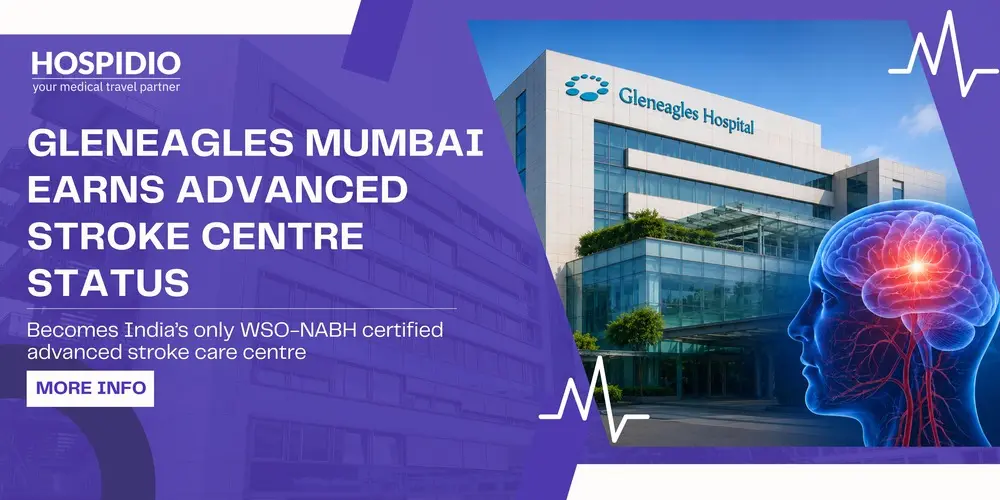
A landmark certification has quietly reshaped the stroke care landscape in India. Gleneagles Hospital in Parel, Mumbai, has become the only hospital in Mumbai and among a select group globally to earn the dual World Stroke Organisation (WSO), National Accreditation Board for Hospitals & Healthcare Providers (NABH) Advanced Stroke Centre Certification. For the millions of patients across South Asia and beyond who travel to India seeking world class neurological care, this milestone is not just a headline. It is a meaningful signal of where some of the most advanced, time-critical treatment in the world is now being delivered.
What is the WSO-NABH Advanced Stroke Centre Certification?
To understand why this matters, it helps to know what the certification actually demands.
The NABH Certification Program for Advanced Stroke Centres is not awarded on the basis of self reporting or infrastructure checklists alone. It follows a rigorous, multi layered assessment that scrutinises a hospital's stroke infrastructure, emergency response systems, clinical protocols, multidisciplinary coordination, and critically real patient outcomes. Gleneagles Hospital is the first institution in Mumbai to clear this bar.
The World Stroke Organisation (WSO) layer adds a further international dimension. The WSO Angels Awards Committee evaluates hospitals on the quality of stroke data reporting, the clinical outcomes they deliver, and whether those standards are maintained consistently across multiple evaluation cycles not just a one-time performance. Gleneagles has now received the WSO-NABH Advanced Stroke Centre Certificate, which represents the highest tier of recognition within this framework.
Together, these two accreditations tell a patient something important: this is not a hospital that treats stroke. This is a hospital that has proven it treats stroke exceptionally well, under internationally standardised conditions, repeatedly.
Why Stroke Care Timing is Everything
Stroke is a medical emergency in which every minute of delay translates directly into irreversible brain damage. The global standard that defines best-in-class stroke care rests on two key metrics:
- Door to Needle Time (DTNT): The time between a patient arriving at the hospital and receiving thrombolysis (clot-dissolving) treatment
- Door to Groin Time (DTGT): The time between arrival and mechanical thrombectomy, a procedure where a clot is physically removed from a blocked artery
Both metrics are central to the NABH and WSO assessment criteria, and both are areas where Gleneagles Hospital has demonstrated consistent performance. The hospital adheres to the internationally recognised "golden window" for thrombolysis, treatment delivered within 4.5 hours of stroke onset, a threshold that is widely associated with significantly reduced brain damage and better functional recovery.
For international patients, these numbers matter. When families are researching hospitals for a loved one who has experienced a stroke, or considering where to seek rehabilitation and follow-up care, the DTNT and DTGT benchmarks offer a concrete, data backed way to compare facilities across borders.
The Team Behind the Certification
Certifications reflect systems, not individuals, but systems are built by people. The stroke programme at Gleneagles Hospital is led by a multidisciplinary team that includes senior neurologists Dr Shirish Hastak, Dr Nitin Dange, and Dr Pankaj Agarwal, alongside interventional specialists, critical care physicians, and rehabilitation experts. This team operates in close coordination from the moment a stroke patient arrives, through acute management and into recovery.
The hospital runs a dedicated Neuro Critical Care Unit built exclusively for patients with acute and complex neurological conditions. This kind of dedicated infrastructure, rather than general ICU beds repurposed for neurological cases, reflects the level of investment that both WSO and NABH assessors look for when evaluating whether a facility can genuinely support the most severe stroke presentations around the clock.
Dr Bipin Chevale, CEO of Gleneagles Hospital Mumbai, explained the continuous improvement culture underpinning the certification: the hospital regularly analyses its stroke data to identify gaps and refine response times, enabling consistent outcomes even in complex and high-risk cases.
What this Means for International Patients Seeking Stroke Care in India
India has long been a destination for medical travellers seeking neurological care particularly from Africa, the Middle East, Bangladesh, and Southeast Asia drawn by the combination of specialised expertise, advanced technology, and significantly lower costs compared to Western healthcare systems.
However, the quality of stroke care varies considerably across Indian hospitals, and for patients and families navigating treatment from abroad, identifying genuinely world-class facilities can be difficult. The WSO-NABH certification now offers a clear, independently verified standard.
For patients considering India for:
- Post-stroke rehabilitation: Gleneagles' integrated pathway from acute care to rehabilitation means patients can access structured recovery within the same certified framework.
- Neurosurgical intervention: The hospital's combined neurology and neurosurgery capabilities, backed by interventional specialists, cover complex presentations beyond standard thrombolysis.
- Second opinions or follow up care: International patients who had initial stroke treatment elsewhere can access evidence-based reassessment from a team whose outcomes are tracked and benchmarked to global standards.
It is also worth noting that the WSO recognition is not domestic. The WSO Angels Awards Committee is an international evaluating body, the same standards applied to Gleneagles Hospital are the same standards applied to leading stroke centres in Europe, North America, and Australia. For patients accustomed to navigating Western healthcare and now exploring treatment in India, this equivalence carries real weight.
Key Takeaways at a Glance
- Gleneagles Hospital, Parel, is Mumbai's first and only hospital to receive WSO-NABH Advanced Stroke Centre Certification
- The certification assessed emergency response systems, clinical protocols, multidisciplinary coordination, and patient outcomes not just infrastructure
- The hospital operates within internationally recognised timelines for thrombolysis and mechanical thrombectomy
- A dedicated Neuro Critical Care Unit and a full multidisciplinary team support patients from acute care through recovery
- The WSO Angels Awards Committee is an international evaluating body, making this recognition globally comparable
Conclusion
The WSO-NABH Advanced Stroke Centre Certification awarded to Gleneagles Hospital Mumbai is a marker of what quality verified neurological care looks like in India today. For patients, families, and medical travel consultants alike, it removes a significant layer of uncertainty from a decision that is already difficult enough to make.
Stroke remains a leading cause of death and disability worldwide, and access to the right care within the right timeframe changes outcomes fundamentally. As India continues to raise the bar on certified, internationally benchmarked healthcare, facilities like Gleneagles Hospital are demonstrating that some of the world's best stroke care is now available, and verifiably so, in Mumbai.
If you or a loved one is exploring stroke care, neurological rehabilitation, or neurosurgery options in India, HOSPIDIO can help you understand your options, connect you with the right specialists, and coordinate your treatment journey from wherever you are in the world.
References
About Hospidio: This blog post is intended to provide factual, evidence-based information to help our community make informed decisions about medical travel. Always consult with qualified healthcare professionals for individual medical advice.
Recent Blogs


Frequently Asked Questions
It is the highest level of recognition jointly awarded by the World Stroke Organisation (WSO) and the National Accreditation Board for Hospitals & Healthcare Providers (NABH) to hospitals that meet global standards in stroke infrastructure, emergency response, clinical protocols, and patient outcomes.
Gleneagles Hospital, Parel, is the first and only hospital in Mumbai to receive this dual certification, placing it among a select group of globally recognised Advanced Stroke Centres that consistently deliver time-critical, evidence-based stroke care.
The golden window refers to the 4.5 hour period after stroke onset during which thrombolysis (clot dissolving treatment) is most effective. Treating a patient within this window significantly reduces brain damage and improves functional recovery.
DTNT is the time between a patient arriving at the hospital and receiving thrombolysis. DTGT is the time between arrival and mechanical thrombectomy. Both are key international benchmarks for measuring stroke care quality.
Yes. Gleneagles Hospital welcomes international patients and offers a full continuum of stroke care from acute emergency treatment to rehabilitation backed by a multidisciplinary team and a dedicated Neuro Critical Care Unit.
Yes. Gleneagles Hospital welcomes international patients and offers a full continuum of stroke care, from acute emergency treatment to rehabilitation, backed by a multidisciplinary team and a dedicated Neuro Critical Care Unit.
HOSPIDIO can help you identify the right specialist, understand your treatment options, and coordinate your full medical travel journey to India, from hospital selection and appointment booking to travel and logistics support, completely free of charge.
Shruti Verma has completed her M.Tech in Biotechnology with experience in medical writing and scientific content development. She specializes in translating complex biomedical and healthcare information into clear, accurate, and reader-friendly content for diverse audiences. When she is not designing content, probably she is designing graphics.
Guneet Bhatia is the Founder of HOSPIDIO and an accomplished content reviewer with extensive experience in medical content development, instructional design, and blogging. Passionate about creating impactful content, she excels in ensuring accuracy and clarity in every piece. Guneet enjoys engaging in meaningful conversations with people from diverse ethnic and cultural backgrounds, enriching her perspective. When she's not working, she cherishes quality time with her family, enjoys good music, and loves brainstorming innovative ideas with her team.