
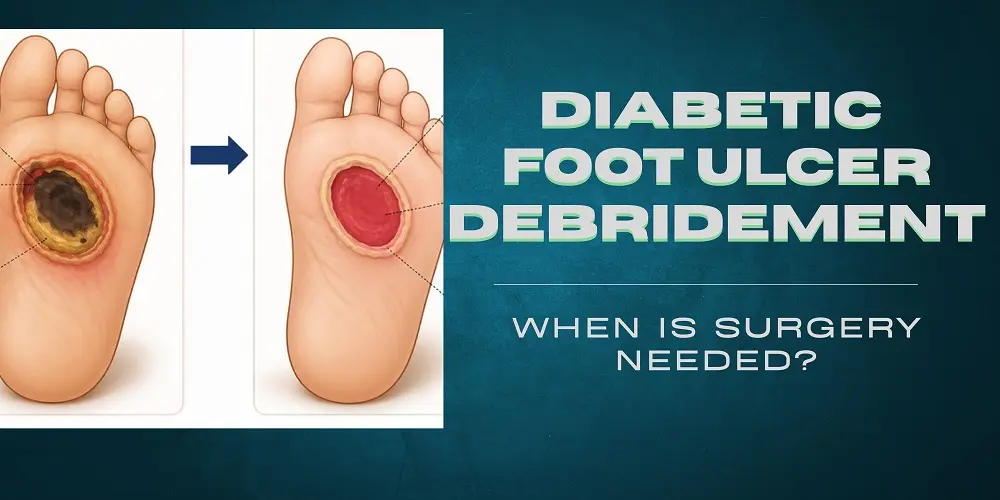
A foot ulcer that will not close is one of the most stressful things a person with diabetes can face. It is easy to assume that any wound will heal on its own with enough time and care, and often that is true. But some diabetic foot ulcers stall, get infected, or reach the point where a doctor uses the word “debridement,” and then “surgery.” That jump can feel sudden and frightening.
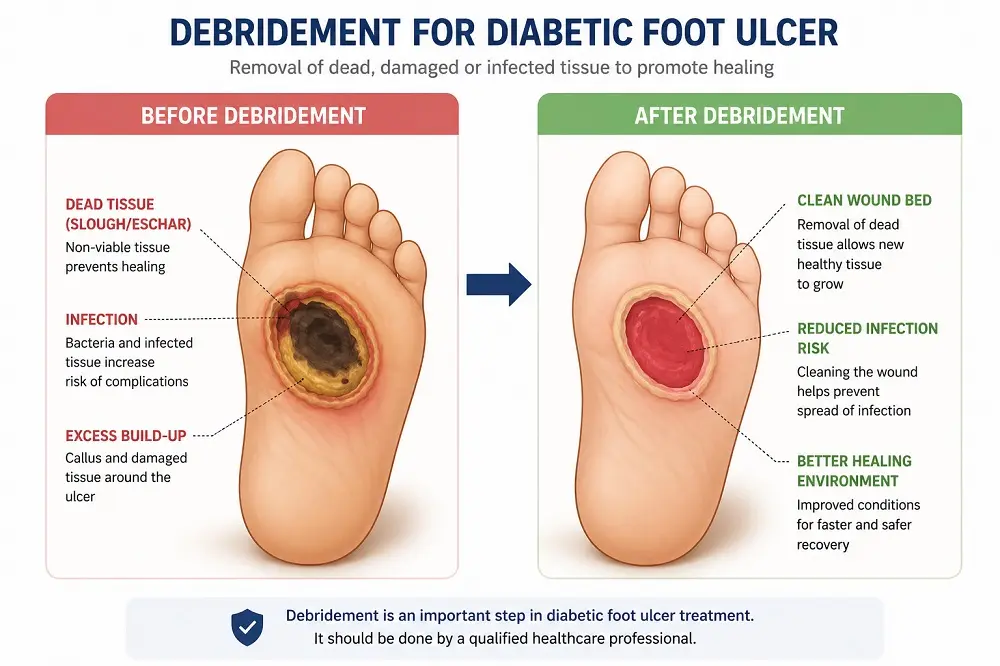
Debridement is the removal of dead, infected, or non healing tissue from a wound so healthy tissue underneath can grow back. It ranges from simple cleaning done at a clinic visit to a surgical procedure done under anesthesia. It becomes surgical debridement when there is infection, dead tissue, exposed bone, or a wound that has not responded to standard care. This article walks through how that decision gets made, what the procedure actually involves, and what recovery looks like.
What Is Diabetic Foot Ulcer Debridement?
Diabetic foot ulcers heal slowly for a few overlapping reasons. Nerve damage (neuropathy) often means a person does not feel the wound forming or worsening. Reduced blood flow can starve the area of the oxygen and nutrients it needs to repair itself. High blood sugar interferes with the normal healing process at a cellular level. Put together, a wound that would close in a couple of weeks for most people can sit open for months in someone with diabetes.
Over time, a layer of dead tissue and bacterial film (called biofilm) builds up over the wound bed. This layer physically blocks new tissue from forming and gives bacteria a place to multiply undisturbed. Debridement clears that layer away. It does not “heal” the wound directly, it resets the wound so the body’s own healing process can restart.
Diabetic foot ulcers are also more common than most people realize. Roughly 1 in 4 people with diabetes will develop a foot ulcer at some point in their life, and once a wound is present, the surrounding skin, nerves, and blood vessels are all already working at a disadvantage. This is part of why doctors treat diabetic wounds differently from an ordinary cut or scrape, and why a wound that would be minor for someone else can require a structured treatment plan.
If a wound near you has stopped changing for more than a couple of weeks, that alone is worth a specialist opinion, not just another dressing change.
Types of Debridement
Doctors use several methods, often more than one over the course of treatment: Surgical or sharp debridement uses a scalpel or surgical instruments to cut away dead tissue, usually in a clinic procedure room or operating theatre. It is the fastest and most thorough option, which is why it is used for infected or deep wounds.
Mechanical debridement includes methods like wet to dry dressings or ultrasound assisted cleaning, which physically lift dead tissue away.
Enzymatic debridement uses a topical medication that chemically breaks down dead tissue over several days.
Autolytic debridement relies on the body’s own moisture and enzymes, supported by specific dressings, to soften and separate dead tissue. It is gentle but slow.
Biological debridement, sometimes called larval therapy, uses medical grade larvae to consume dead tissue while leaving healthy tissue alone. It sounds unusual but is a recognized clinical option in select cases, particularly when surgery needs to be delayed for medical reasons.
For a wound that is infected, deep, or not improving, surgical debridement is generally the recommended path, since it removes the most tissue in a single, controlled session, rather than relying on gradual methods that can take weeks to achieve the same result. Doctors often combine methods over the course of treatment, for example, a first round of surgical debridement to clear the bulk of dead tissue, followed by autolytic dressings to manage the wound as it closes.
How Do Doctors Decide If a Wound Needs Surgery?
This is the question most people actually want answered. Doctors typically use the Wagner classification system to grade a diabetic foot ulcer from 0 to 5:
- Grade 0: Skin is intact, but there is a risk area (bony deformity or prior ulcer site).
- Grade 1: Superficial ulcer involving only the skin surface.
- Grade 2: Deeper ulcer reaching tendon, ligament, or joint capsule.
- Grade 3: Deep ulcer with abscess or bone infection (osteomyelitis).
- Grade 4: Localized gangrene, usually affecting a toe or part of the forefoot.
- Grade 5: Extensive gangrene involving most or all of the foot.
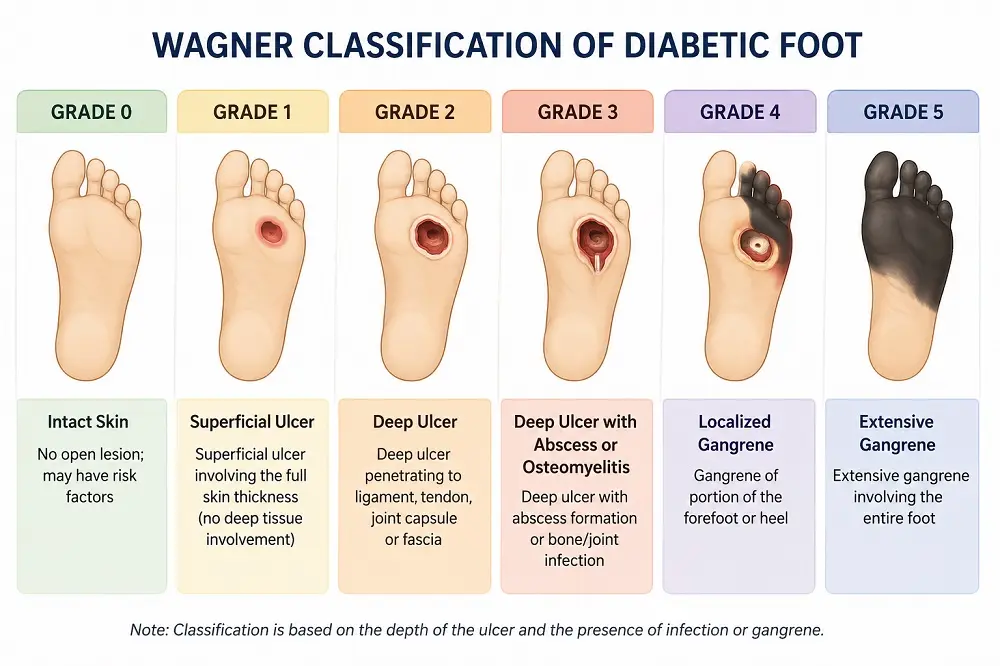
As a general rule, surgical debridement becomes the recommended approach at Wagner grade 2 and above, or sooner if any of the following apply, regardless of grade:
- The wound shows no meaningful improvement after about 30 days of standard wound care, including offloading, dressing changes, and any prescribed antibiotics.
- There is visible dead or blackened tissue in the wound.
- A doctor can touch bone with a sterile probe inserted into the wound (called the probe to bone test), which raises strong suspicion of bone infection.
- There are clear signs of active infection.
Signs Your Foot Ulcer Needs Urgent Surgical Attention
Some signs mean a same day or next day evaluation, not a wait and see approach:
- Redness or warmth spreading outward from the wound edges.
- A red streak moving up the foot or leg.
- Fever, chills, or feeling generally unwell.
- A foul odor from the wound.
- Increasing pus or drainage.
- Black, gray, or dark tissue anywhere in or around the wound.
- A sudden increase in pain, or, just as concerning, a sudden loss of pain in a wound that used to hurt, which can mean nerve damage is progressing.
- Visible bone or tendon at the base of the wound.
Diabetic foot infection is not rare. It is estimated to occur in up to 60 percent of people with diabetic foot ulcers at some point, which is part of why doctors take these signs seriously rather than waiting to see if a wound “turns a corner” on its own.
If you are seeing two or more of these signs right now, treat it as urgent. This is exactly the kind of situation where getting a fast, specialist opinion, including a second opinion from a center abroad if local options are limited, changes the outcome.
What Happens During Surgical Debridement?
Before the procedure, a surgeon typically orders bloodwork, imaging (X-ray or MRI if bone infection is suspected), and often a vascular assessment to check blood flow to the foot, since poor circulation affects both the surgical plan and healing afterward.
Anesthesia depends on how much tissue needs to be removed. Smaller, localized debridement can often be done with local anesthesia in a procedure room. More extensive debridement, especially if infection has spread, is usually done under regional or general anesthesia in an operating theatre.
During the procedure itself, the surgeon removes dead and infected tissue back to a margin of healthy, bleeding tissue. This is a deliberate endpoint, bleeding tissue is a sign that what remains has a working blood supply and a real chance of healing. The surgeon also irrigates the wound thoroughly to reduce the bacterial load, and may take a tissue or bone sample at this point to guide antibiotic choice, rather than treating the infection with a broad, guessed at antibiotic. If bone infection (osteomyelitis) is confirmed, treatment shifts to a combined surgical and antibiotic approach, which is covered in more depth in a companion article on bone infection in diabetic feet.
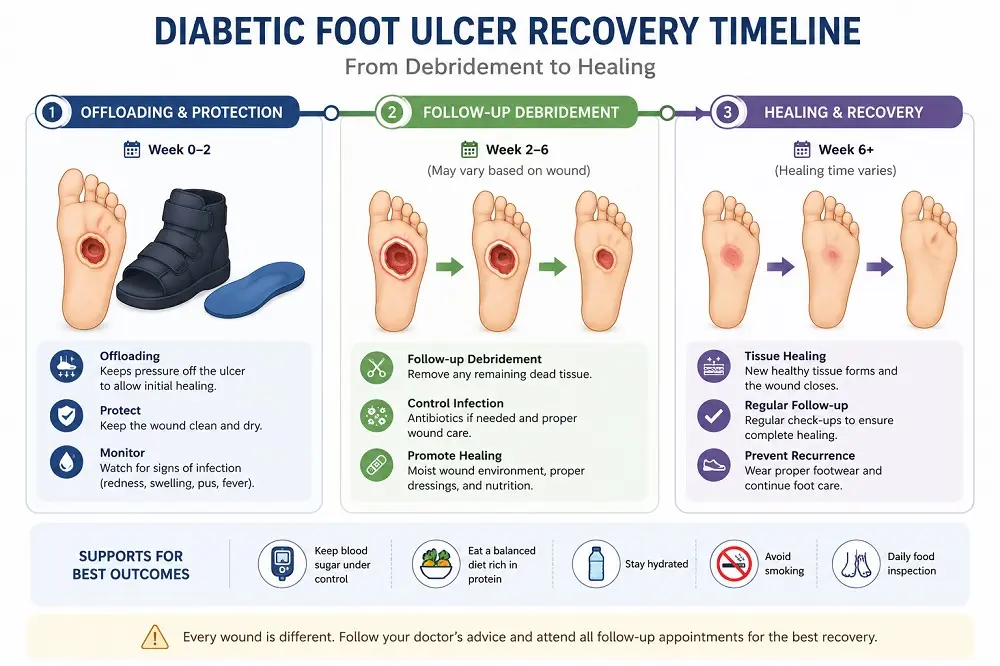
After debridement, the wound is packed or dressed depending on its depth, an offloading plan is set up to keep weight off the area, and antibiotics are started or continued if infection is present. Most patients are seen again within a few days to a week to check how the wound is responding and to plan whether another round of debridement is needed. Pain after the procedure is usually manageable with standard pain relief, and many patients report the area feels less painful once the source of infection has actually been removed, not more.
Is Debridement the Same as Amputation?
No, and this is worth stating plainly because it is one of the most common fears attached to this topic. Debridement removes only tissue that is already dead or infected. Its entire purpose is to preserve as much healthy foot as possible and control infection before it spreads further. In many cases, timely debridement is exactly what prevents an amputation, rather than being a step toward one.
In more advanced cases, removing a single toe alongside debridement is sometimes necessary if that specific tissue cannot be saved. That is a distinct, separate decision made only when there is no realistic path to healing that tissue, and it is not the same as a foot or below knee amputation.
Recovery After Debridement Surgery
Recovery depends heavily on how deep the wound was and how healthy the surrounding tissue is, but a few things are consistent across most cases:
Hospital stay is often short. Smaller procedures can be done as a day case, while deeper or infected wounds may need a few days of monitoring.
Offloading is not optional. Continuing to walk on the healing area, even briefly, can undo progress. Options range from a total contact cast (considered the gold standard, shown to heal 72 to 100 percent of eligible ulcers within 5 to 8 weeks) to a removable offloading boot, depending on the wound location and the person’s situation.
Repeat debridement is common. Many wounds need more than one session as healing progresses and new areas of non viable tissue become visible.
Healing timelines vary widely, from a few weeks for a shallow wound with good blood flow to a few months for a deeper wound, particularly if circulation is compromised.
Watch for the same warning signs listed earlier during recovery. New redness, drainage, odor, or fever after debridement is a reason to call the treating team immediately, not wait for the next scheduled visit.
Nutrition and blood sugar control also play a bigger role in healing than most people expect. Adequate protein intake supports tissue repair, and keeping blood sugar within the range set by your doctor directly affects how quickly the wound closes. Some patients with wounds that are healing slowly despite good wound care are also considered for hyperbaric oxygen therapy, which increases the oxygen available to the healing tissue, though this is used selectively rather than for every case.
Choosing Where to Have Debridement Surgery
For a straightforward, early stage wound, treatment close to home is usually the right call. For a wound that is infected, deep, involves suspected bone infection, or has already failed a round of local treatment, the team and facility matter more than distance.
A few things are worth checking before deciding on a surgeon or hospital, wherever you are:
- Does the team include both a surgeon experienced in diabetic wound care and access to a vascular specialist, in case blood flow needs to be assessed or treated alongside debridement.
- Is there a clear plan for follow up wound care after the initial procedure, not just the surgery itself.
- Does the hospital have experience specifically with diabetic foot cases, rather than general wound care alone.
This is often where international patients start looking beyond their home country, particularly when local wait times are long or specialist diabetic foot teams are limited.
Why Some Diabetic Foot Ulcers Will Not Heal Without Surgery
Two things commonly keep a wound stuck despite good home care. The first is the biofilm and dead tissue layer described earlier, which only debridement clears effectively. The second is peripheral arterial disease, reduced blood flow to the leg and foot, which is common in people with long standing diabetes. If blood flow is significantly reduced, debridement alone may not be enough, since the tissue around the wound will still struggle to heal even after cleaning. In those cases, a vascular procedure to restore blood flow is usually needed alongside or before debridement. This is covered in full in a dedicated article on diabetic foot vascular surgery, part of this same series.
A doctor can usually tell early on whether reduced blood flow is a factor, using a simple pulse check at the foot and ankle, followed by a Doppler ultrasound if there is any concern. This is one reason a full evaluation, not just a look at the wound itself, matters before deciding on a treatment plan. Skipping this step is one of the more common reasons a wound keeps recurring after what looked like successful debridement.
Preventing Future Ulcers After Debridement
Once a wound has healed, preventing the next one matters just as much:
- Check both feet daily, including between the toes and the soles, for any new redness, blister, or break in the skin.
- Wear well fitted, protective footwear at all times, including indoors.
- Keep blood sugar within the range set by your treating doctor.
- Attend regular podiatry or foot clinic follow ups, even after full healing.
- Treat any new skin break as urgent. What starts as a small crack can become a serious ulcer within days in someone with diabetes.
Recurrence is common, not a personal failure. Studies consistently show that a significant number of healed diabetic foot ulcers return within a year, most often at the same site or a nearby pressure point. This is exactly why footwear, offloading habits, and daily checks are treated as ongoing care, not a one time instruction given at discharge. A short, scheduled check in with a podiatrist every few months catches most problems while they are still small and manageable, well before another round of debridement becomes necessary.
Getting the Right Care, Wherever You Are
A diabetic foot ulcer that needs surgical debridement is treatable, and most people go on to heal well with the right team and a realistic recovery plan. The part that matters most is not delaying care while a wound quietly gets worse.
For international patients, Hospidio connects you with experienced diabetic foot care surgeons and accredited hospitals in India and Turkey, for evaluation, treatment planning, travel arrangements, and follow up care after you return home. If a local opinion has left you uncertain, or if surgery has been recommended and you want to understand the cost and process before deciding, that is exactly where a second, specialist opinion helps most.
Every case is different, and the right next step depends on the wound’s depth, whether infection or reduced blood flow is involved, and how it has responded to treatment so far. A short conversation with a specialist team, even before you travel, is usually enough to get a clear picture of what surgery, if any, is actually needed, and what recovery would look like in your specific situation.
Explore diabetic foot surgery cost and care options in India, or connect with orthopedic, general surgery, and vascular specialists in India and Turkey to get a clear treatment plan.
REFERENCES
- The role of surgical debridement in healing of diabetic foot ulcers - PubMed
- Wagner classification system for diabetic foot ulcers
- Understanding Diabetic Foot Ulcer Classification Systems - WoundSource
Recent Blogs



Frequently Asked Questions
Most people feel little to no pain during debridement, largely because diabetic neuropathy reduces sensation in the foot, and local or regional anesthesia is used for anything more than minor bedside cleaning. Some pressure or tugging may be felt, but sharp pain is uncommon during the procedure itself.
Mild soreness for a day or two afterward is normal and usually managed with standard pain relief. If pain is severe or increasing several days after debridement, contact your treating team, since that can be an early sign of infection rather than a normal part of healing.
There is no fixed number. Many diabetic foot ulcers need more than one debridement session as healing progresses and new areas of dead tissue become visible, while a shallow, early stage wound may need only one. Your surgeon will typically plan follow up visits every few days to a week to reassess.
Deeper wounds, infected wounds, and wounds with poor blood supply generally need more sessions and take longer overall. The goal at each visit is a clean, healthy wound bed, not a fixed procedure count.
Yes, milder ulcers, generally Wagner grade 0 or 1 with good blood flow and no infection, often heal with non surgical care alone, including regular dressing changes, offloading, and blood sugar control. Surgery becomes necessary once infection, dead tissue, exposed bone, or a lack of progress after about 30 days enters the picture.
The safest approach is to have any foot ulcer assessed early by a specialist, rather than assuming it will resolve on its own, since the decision depends on factors that are not always visible to the naked eye, such as blood flow and depth.
Delaying recommended debridement allows dead tissue and infection to remain in the wound, which increases the risk of the infection spreading to deeper tissue or bone, a condition called osteomyelitis. Untreated, this significantly raises the risk of eventual amputation, which is the opposite of what most people hope to achieve by avoiding surgery.
This does not mean every recommendation must be accepted without question. It does mean any delay should be an informed decision made with a specialist, including a second opinion if you are uncertain, rather than an indefinite postponement.
No. Debridement removes only tissue that is already dead or infected, and its main purpose is to preserve as much healthy foot as possible while controlling infection. In many cases, timely debridement is what prevents an amputation rather than being a step toward one.
In advanced cases, removing a single toe alongside debridement is sometimes necessary if that specific tissue cannot be saved, but this is a separate, distinct decision made only when there is no realistic path to healing it, not a routine outcome of debridement.
Timelines vary widely depending on wound depth and location, but many patients return to normal walking within a few weeks to a few months, once the wound has closed and any offloading device is no longer needed. Deeper wounds or those involving reduced blood flow take longer.
During the offloading period itself, which can last several weeks, some walking is usually still possible using a boot, cast, or crutches, just not full unprotected weight bearing on the healing area. Your surgical team will guide the exact timeline based on how your specific wound responds.
Coverage and cost vary significantly by country, insurer, and the extent of surgery needed, so there is no single answer. What can be said generally is that earlier treatment, before infection or bone involvement sets in, is almost always less extensive and less costly than delayed treatment.
For patients considering treatment in India, a clear breakdown of diabetic foot surgery costs is available through Hospidio, along with guidance on what typically drives cost up or down for a given case.
No, self debridement is not recommended for diabetic foot ulcers. Reduced sensation from neuropathy means it is easy to cut too deep or damage healthy tissue without feeling it happen, and doing this outside a sterile setting significantly raises infection risk.
Gentle daily wound cleaning as instructed by your care team is different from debridement and is generally safe. Any removal of dead or thickened tissue should be done by a trained clinician who can see and feel the difference between dead and healthy tissue.
Recurrence is common and usually relates to ongoing pressure at the same spot, footwear that does not adequately protect the area, or blood sugar and circulation issues that were present before the first ulcer, rather than a failure of the original treatment. A significant number of healed diabetic foot ulcers return within a year, most often at the same site.
Ongoing prevention, daily foot checks, proper footwear, and regular podiatry follow up, matters as much after healing as the treatment that closed the wound in the first place.
Watch for spreading redness or warmth, a red streak moving up the leg, fever, foul odor, increasing pus or drainage, dark or black tissue, and any visible bone at the base of the wound. Two or more of these signs together generally warrant urgent same day or next day evaluation, not a wait and see approach.
A wound that has also not improved after about 30 days of standard care is another clear signal to seek a surgical opinion, even without obvious infection. When in doubt, a same day assessment is always the safer choice.
Dr. Basim Parvez is a licensed physiotherapist and Senior Patient Consultant at HOSPIDIO, holding an MBA in Health Management. With extensive clinical experience and a compassionate approach, he assists patients navigating medical treatments. Dr. Basim also leverages his writing talent to simplify complex healthcare information, empowering patients to make informed decisions and fostering clarity and confidence in their medical journeys.
Sasmita Bal is a Digital Marketing and Content Specialist at HOSPIDIO with expertise in SEO and international healthcare content. She reviews published material to ensure it is optimized for search visibility and relevant to the needs of international patients seeking treatment in India. All content she reviews is authored and clinically approved by the Founder of HOSPIDIO and relevant medical specialists prior to publication.