
When most people hear developmental dysplasia of the hip, they picture a newborn in a screening clinic. That is one part of the DDH story, but it is not the part this guide is about.
This guide is written for three groups of patients we see regularly at HOSPIDIO: children past infancy whose DDH did not resolve with a harness and now needs surgical correction, pre-teens and teenagers with a confirmed diagnosis facing a hip preservation procedure, and adults whose dysplasia went undetected or resurfaced years after childhood. We are deliberately not covering newborn screening, Pavlik harnesses, or bracing here, since that is routine local pediatric care in almost every country and not something families travel abroad for. What we cover instead is the point at which DDH becomes a surgical decision, at any age, and what that decision looks like in practice.
If your child, your teenager, or you yourself has a confirmed DDH diagnosis and surgery is now part of the conversation, we want to give you a clear and complete picture of the options, and of what treatment in India can look like.
We will cover the clinical picture in full, and we will also be direct about how HOSPIDIO can help. We work with orthopaedic and paediatric orthopaedic hospitals across India that treat DDH regularly, and if treatment abroad turns out to be the right path for your family, our team manages the practical side of the journey alongside the medical care, at no cost to you.
What Is Developmental Dysplasia of the Hip?
Developmental dysplasia of the hip, commonly shortened to DDH, describes a spectrum of conditions in which the hip joint does not form or sit correctly. In a healthy hip, the head of the femur sits deep inside a well formed acetabulum, the socket in the pelvis. In DDH, the acetabulum may be shallower or angled differently than it should be, which means the femoral head is not fully covered or held securely in place.
The condition ranges widely in severity. At the milder end, a hip may simply be loose or slightly underdeveloped, sometimes called instability or mild dysplasia. At the more severe end, the hip can be partially displaced, known as subluxation, or fully out of the socket, known as dislocation.
DDH is most commonly discussed as a newborn condition, and most countries with organised healthcare systems screen infants for it using a physical examination and, where indicated, an ultrasound in the first weeks of life. Caught early, mild DDH often resolves with a harness or brace. What is discussed far less often, and what this guide focuses on, is what happens when DDH is not fully resolved in infancy, when it is diagnosed after a child has started walking, or when a milder form of dysplasia does not become symptomatic until adolescence or adulthood.
Why Surgery Becomes Necessary Beyond Infancy?
In the first few months of life, DDH is usually managed without surgery. A Pavlik harness or similar brace holds the hip in a stable position while the acetabulum continues to develop, and in the large majority of babies treated this way, the hip goes on to develop normally.
Surgery becomes part of the conversation in three situations: when bracing fails to stabilise the hip, when a child is not diagnosed until after they have started walking, typically past twelve to eighteen months, by which point the hip's natural capacity to remodel itself has already begun to decline, or when a hip that responded to early treatment develops residual dysplasia later in childhood. Indian paediatric orthopaedic literature reflects a considerable amount of hands-on experience with exactly this group of patients, since later presentation, where a child is not brought in for evaluation until well past the ideal treatment window, is reported more frequently in India than in countries with universal newborn screening programmes. This is one of the reasons India has developed genuine surgical depth in this specific area.
Surgical Treatment for Children Beyond Infancy
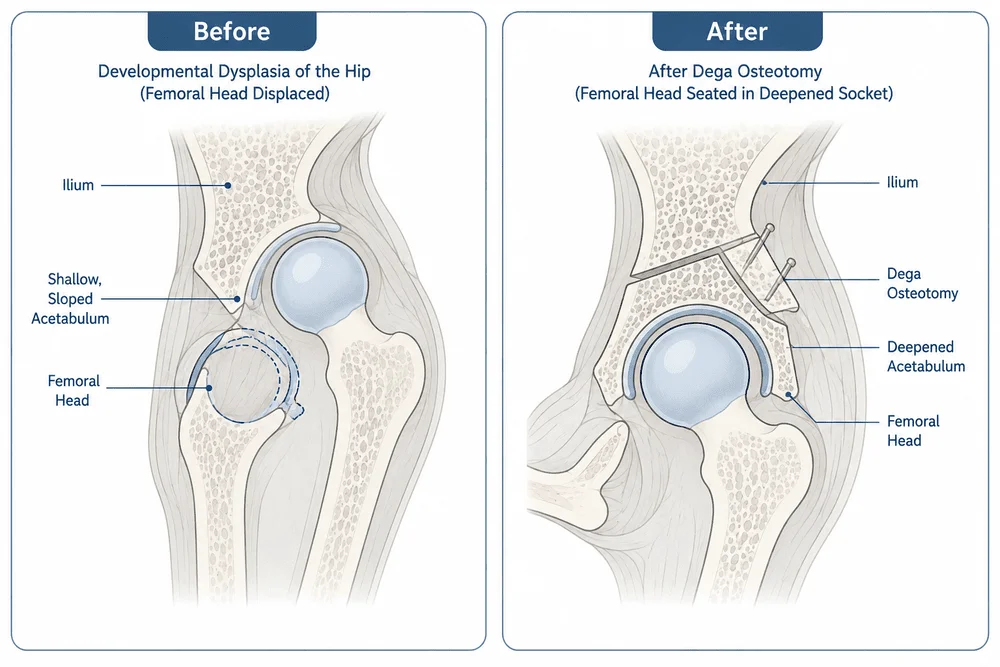
Once a child is at or past walking age, the treatment goal shifts from bracing to physically repositioning the hip and, where needed, reshaping the socket to hold it there. The approach depends heavily on age and on how the hip responds during surgery itself.
| Age Band | Typical Surgical Approach | Notes |
| Roughly 18 months to 4 years | Closed or open reduction, often with femoral shortening | A pelvic osteotomy, most often Dega or Salter, is increasingly added at the same time rather than waiting to see how the socket remodels on its own |
| Roughly 4 to 8 years | Open reduction combined with pelvic osteotomy | The acetabulum's ability to remodel itself declines sharply after around four years of age, so a pelvic osteotomy, typically Salter, Pemberton, or Dega depending on the child's anatomy, is routinely performed alongside reduction |
Recovery for this age group is genuinely a marathon rather than a sprint. Children typically spend around four to seven days in hospital, then wear a spica cast, a cast that immobilises the hip and pelvis, for roughly six to twelve weeks while the bones heal, followed by a gradual return to weight bearing and walking. Most children return to school and ordinary daily activity well before the hip has fully matured, but a normal gait pattern can take the better part of a year to settle in completely.
Older Children, Pre-Teens, and the Bridge to Adolescent Surgery
Once a child is past roughly eight years old, the acetabulum's remodeling potential has largely been used up. Correcting significant residual dysplasia at this stage usually calls for a more extensive pelvic procedure, most often a triple innominate osteotomy, which repositions the socket through cuts in three separate pelvic bones rather than one. This bridges the gap between the childhood pelvic osteotomies described above and periacetabular osteotomy, which cannot be performed until the pelvis has largely stopped growing, usually not before the early teenage years.
For pre-teens and teenagers with a confirmed diagnosis, this is precisely the age band where matching a family with a surgeon who specifically operates on paediatric and adolescent hips, rather than a general adult joint surgeon, matters most. India has a genuinely strong bench of paediatric orthopaedic surgeons with fellowship training and dedicated hip preservation practices.
Dr. Manoj Padman, Director of Pediatric Orthopaedics at Madhukar Rainbow Children's Hospital in New Delhi, has over two decades of experience treating the full range of paediatric musculoskeletal conditions, including hip preservation and deformity correction, following fellowship training at Sheffield Children's Hospital in the UK. Dr. Somesh Virmani, a paediatric orthopaedic surgeon with fellowship training from Christian Medical College, Vellore, one of India's largest paediatric orthopaedic units, has focused his practice specifically on paediatric hip conditions, including DDH and hip preservation surgery, for over a decade, and practises out of Sarvodaya Hospital in Faridabad, part of the HOSPIDIO network. Surgeons like these, who treat DDH in children and teenagers as a core part of their practice rather than as an occasional case, are exactly who we try to match families with.
View Sarvodaya Hospital, Faridabad on HOSPIDIO
View Rainbow Children's Hospital, New Delhi on HOSPIDIO
A confirmed DDH diagnosis in a child or teenager, along with any existing X-rays or scans, is enough for us to begin matching your family with an appropriate paediatric hip preservation specialist and giving you an early sense of what treatment could look like.
Why DDH Often Gets Missed and Resurfaces in Adulthood
The pathway above covers children and teenagers whose DDH is caught, or resurfaces, before adulthood. A second, distinct pattern also exists, and it is why adult DDH surprises so many patients and their families: there are two ways adults end up with symptomatic DDH that was never addressed surgically in childhood at all.
The first is residual dysplasia from childhood. Screening for DDH varies significantly by country, and even within well screened populations, borderline or mild cases can be missed on physical examination, particularly if ultrasound is not routinely used. A hip that looked stable enough in infancy can still be subtly shallow, and that shallowness places extra stress on the joint over decades of use.
The second is adolescent-onset acetabular dysplasia, which is a genuinely separate process. In this pattern, the hip develops normally in early childhood but a growth-related abnormality in the acetabulum emerges during the adolescent growth spurt, between roughly twelve and eighteen years of age. This means a young adult can be diagnosed with dysplasia despite having had an entirely normal newborn hip screen.
Both patterns share the same risk factors: family history of hip problems, breech presentation at birth, and female sex. Dysplasia in adults is meaningfully more common in women than men, though the gap is narrower than in infant DDH. In the general adult population, published estimates put radiographic hip dysplasia at roughly 3.8 percent in women compared with 2.7 percent in men. Among adults specifically diagnosed with acetabular dysplasia, women make up around 88 percent of cases.
The practical weight of this in orthopaedic practice is significant. In some national joint registry data, DDH accounts for over a fifth of all hip replacements performed in adults under fifty, making it one of the leading causes of early hip degeneration in this age group, well behind general wear and tear osteoarthritis in the population as a whole, but disproportionately represented among younger patients.
Have you had long-standing hip or groin pain that has never been properly imaged to rule out dysplasia? Send us your history and any existing scans, and our team can help you understand what imaging and specialist review makes sense next.
How Adult and Adolescent DDH Presents
Unlike infant DDH, which is usually picked up on examination before symptoms exist, adult DDH almost always announces itself through pain. Common symptoms include:
- Groin pain, often the earliest and most consistent symptom, typically worse with activity, prolonged standing, or after exercise
- A mechanical clicking, catching, or locking sensation, which often points to an accompanying labral tear
- A subtle limp, particularly after long periods of walking or standing
- Reduced range of motion, especially with hip flexion and internal rotation
- Stiffness after sitting for extended periods, such as during travel or desk work
- In more advanced cases, symptoms of early osteoarthritis: aching pain at rest, morning stiffness, and progressive loss of function
Because these symptoms overlap heavily with general hip strain, sports injuries, and early arthritis, DDH in adults is frequently misdiagnosed or attributed to overuse for months or years before the underlying dysplasia is identified. A useful rule of thumb: persistent groin pain in an otherwise healthy young or middle aged adult, particularly a woman, that does not resolve with rest and basic physiotherapy, warrants imaging specifically to rule dysplasia in or out.
Diagnosis and the Case for a Second Opinion
Diagnosis starts with a weight-bearing pelvic X-ray, which allows the surgeon to measure the degree of acetabular coverage using standard angles such as the lateral centre-edge angle and the T??nnis angle. These measurements place a hip somewhere on the spectrum from normal, through borderline, to clearly dysplastic.
Where a labral tear or cartilage damage is suspected, which is common alongside dysplasia, an MRI or MR arthrogram gives a much clearer picture of the soft tissue than an X-ray alone.
Here is where we think patients researching this condition are underserved by most information available online: measurement of dysplasia is not always clear cut. Borderline cases, in particular, can be read differently by different radiologists and surgeons, and the treatment implications of a borderline reading are substantial. A hip read as borderline normal might be managed with physiotherapy and monitoring. The same hip read as borderline dysplastic might be a strong candidate for joint preserving surgery. This is not a minor technical detail, it is often the single decision point that determines whether surgery is even on the table.
For this reason, we consistently recommend a second opinion from a surgeon who specifically treats hip dysplasia and performs joint preservation surgery, rather than relying solely on a general orthopaedic assessment, before committing to a treatment plan.
Treatment Options for DDH in Teenagers and Adults: An Overview
For patients at or near skeletal maturity, roughly early teens and older, treatment depends heavily on the severity of the dysplasia, the condition of the cartilage, and the patient's age and activity goals. The table below gives a general framework. For younger children, see the age-banded surgical options covered earlier in this guide.
| Option | Best Suited For | What It Involves |
| Conservative management | Mild dysplasia, early or intermittent symptoms | Physiotherapy, activity and load modification, anti-inflammatory management, monitoring with periodic imaging |
| Hip arthroscopy | Labral tear or impingement alongside mild dysplasia, well preserved cartilage | Keyhole repair of the labrum or removal of impinging bone. Does not correct the underlying dysplasia itself |
| Periacetabular osteotomy (PAO) | Symptomatic moderate to severe dysplasia, roughly ages 12 to 40, cartilage still largely preserved | Repositioning the acetabulum to restore coverage of the femoral head, preserving the native joint |
| Total hip replacement | Advanced joint damage, significant cartilage loss, or failed joint preservation attempts, any age | Replacing the damaged joint surfaces with prosthetic components |
Read our full comparison of physical therapy versus surgery for hip and knee arthritis
Periacetabular Osteotomy: Preserving the Native Hip
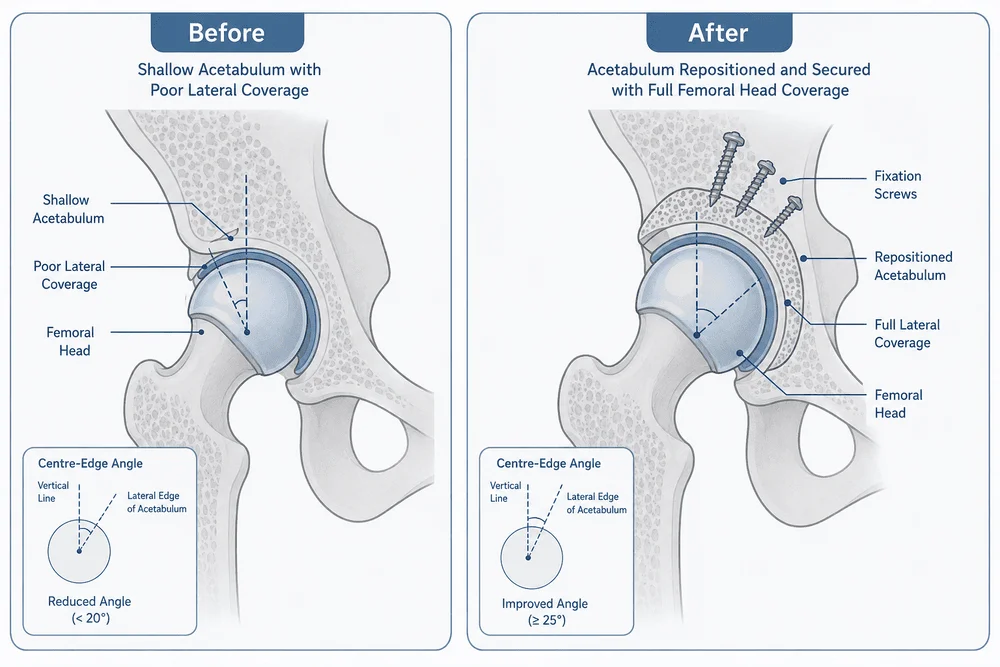
Periacetabular osteotomy, usually shortened to PAO, is the procedure of choice for symptomatic dysplasia in patients who are too young, or whose cartilage is too well preserved, to justify moving straight to a hip replacement. The technique, often referred to as the Bernese PAO after the Swiss centre where it was developed, involves making a series of controlled cuts around the acetabulum, freeing it from the surrounding pelvis, and then reorienting the socket to properly cover the femoral head before securing it in its new position with screws. The femur itself is left untouched.
The goal is to correct the underlying mechanical problem while keeping the patient's own joint. Done successfully, this relieves pain, restores stability, and, most importantly for a younger patient, delays or removes the need for a hip replacement for many years, sometimes for life.
PAO is generally considered for patients roughly between 12 and 40 years old, with symptomatic dysplasia and only minimal to moderate early arthritic change on imaging. Once significant cartilage loss has occurred, PAO is less likely to give a lasting result and hip replacement becomes the more appropriate option.
This is a technically demanding operation performed inside a tight surgical corridor close to major nerves and blood vessels, and outcomes are strongly linked to how frequently the operating surgeon performs it. When you are evaluating hospitals or surgeons for PAO, the single most useful question to ask is how many PAOs that specific surgeon performs each year, rather than the hospital's general orthopaedic reputation.
On recovery: PAO typically involves a hospital stay of three to five days, followed by a period of six to eight weeks using crutches with limited weight bearing while the repositioned bone heals, and a gradual return to full activity over six to nine months. Published long-term outcome studies following PAO patients for fifteen years generally report that most well selected patients retain their native joint over that period without needing conversion to a hip replacement, though the exact proportion varies between studies and depends heavily on how advanced the joint damage was at the time of surgery. This is worth discussing directly with your surgeon in the context of your own imaging, rather than treating any single published figure as a guarantee.
Total Hip Replacement in a Dysplastic Hip
When dysplasia has progressed to significant arthritis, or when a patient is past the age or joint condition where preservation surgery makes sense, total hip replacement becomes the recommended path. It is worth understanding that a hip replacement in a dysplastic hip is a meaningfully different operation from a standard hip replacement performed for ordinary age-related osteoarthritis.
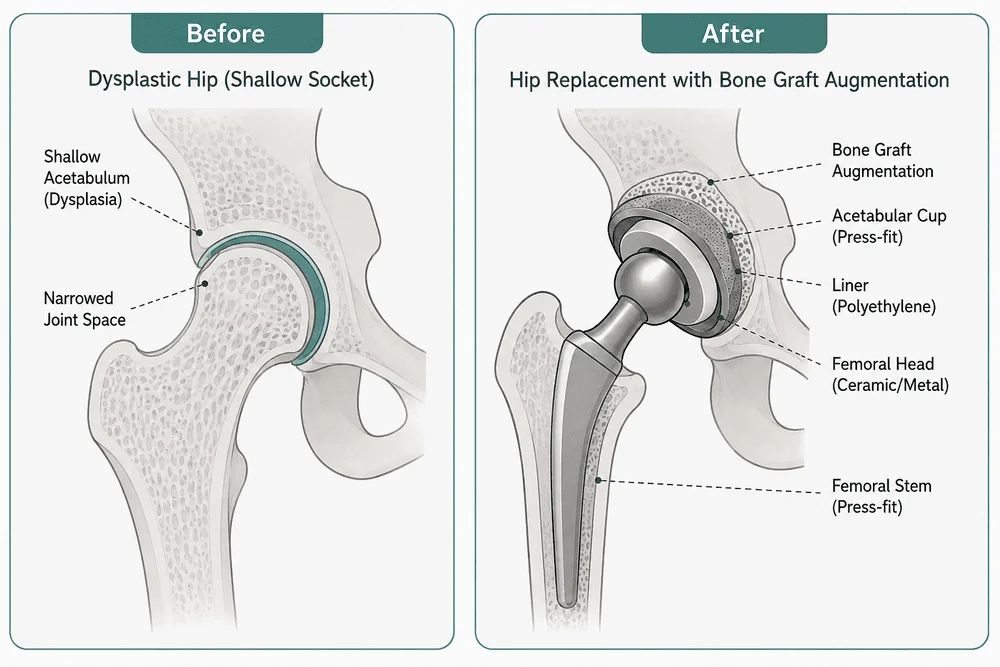
The core difference is anatomy. A dysplastic acetabulum is often shallower, smaller, or oriented differently than a typical socket, which can make it harder to achieve secure, well covered placement of the replacement socket component. Depending on severity, the surgeon may need to use smaller or specially designed implants, augment the socket with bone graft to build up coverage, or plan the procedure around a degree of leg length discrepancy that is common in longstanding dysplasia. None of this is standard in a routine hip replacement for wear and tear arthritis.
The practical implication is that surgeon experience with dysplastic anatomy specifically, not just general hip replacement volume, has a real bearing on how well the implant performs over time. This matters even more for younger patients, who are statistically far more likely to need a revision surgery at some point in their lifetime simply because they are living on the implant for longer and are typically more active than an older patient having the same operation.
A quick note on revision risk: choosing a surgeon and hospital with specific experience in dysplastic hip anatomy is not a minor preference, it materially affects how well a hip replacement holds up over the following fifteen to twenty years, particularly for patients in their twenties, thirties, or forties.
See our detailed cost breakdown for hip replacement in India
Compare with hip replacement cost in Turkey
Surgery Timing and Family Planning
Because dysplasia is significantly more common in women, a real and practical question for many patients in their twenties and thirties is how PAO or hip replacement fits alongside plans to have children. This is a genuine decision point that we rarely see addressed in general information about DDH, yet it comes up regularly in conversations with our patients.
There is no single correct answer, and this is a conversation to have directly with your treating surgeon, but the questions worth raising typically include:
- How long a recovery window is recommended before attempting to conceive, given the bone healing time involved in PAO or the soft tissue healing involved in hip replacement
- Whether a preserved joint following PAO or a replaced joint following hip replacement carries different considerations for pregnancy, weight bearing, and delivery
- Whether it makes more sense, given your specific case, to proceed with surgery before pregnancy or to manage symptoms conservatively and revisit surgery afterwards
Raising this directly and early, ideally at the same consultation where treatment options are first discussed, allows it to be built into the treatment plan rather than treated as an afterthought.
Bilateral DDH and Staged Treatment Planning
Dysplasia is frequently, though not always, present to some degree in both hips, even when only one side is symptomatic at diagnosis. If both hips ultimately need surgical treatment, this is usually staged rather than performed simultaneously, with a recovery period of several months typically recommended between the first and second procedure to allow adequate healing and rehabilitation before placing full demand on the newly operated hip.
For patients travelling internationally for treatment, this has a direct and practical implication: bilateral treatment is not a single trip. It is important to establish early in your planning, ideally during your initial case review, whether your case is likely to require staged bilateral surgery, since this affects total treatment duration, the number of trips required, and overall cost. Our team factors this into your treatment plan from the outset rather than leaving it as a surprise partway through.
What to Check When Choosing a Hospital or Surgeon for DDH Treatment Abroad
DDH sits at the more specialised end of orthopaedic surgery, and general joint replacement credentials do not automatically translate into strong outcomes for dysplasia specifically. When evaluating hospitals and surgeons, we suggest looking for:
- A dedicated hip preservation programme, not just a general joint replacement department
- For a child or pre-teen, a fellowship-trained paediatric orthopaedic surgeon whose practice is centred on children's hip conditions, rather than a general adult joint surgeon who occasionally sees younger patients
- A surgeon with a meaningful annual case volume specifically in PAO or dysplasia-related hip replacement, not only general hip replacement numbers
- Access to both joint preservation and joint replacement expertise within the same centre, so the surgical plan can adapt if intraoperative findings differ from what the imaging suggested
- Availability of specialised implants and bone grafting capability for cases requiring augmented hip replacement
- Internationally recognised accreditation such as JCI or NABH, and an established international patient department
We work with a network of orthopaedic hospitals across India and match each patient to a surgeon based on their specific imaging and case history, rather than defaulting to a single hospital for every DDH case. You are welcome to browse some of our detailed hospital comparisons for context on how leading centres in different cities compare.
- Apollo vs MIOT vs Gleneagles vs MGM vs SIMS: Best Hospital in Chennai
- Apollo vs Manipal vs Fortis vs Aster: Best Hospital in Bangalore
- Top 10 Orthopedic Hospitals in India
Planning Your Treatment Journey to India
Once a treatment plan is confirmed, the practical side of travelling for care matters just as much as the surgery itself. HOSPIDIO manages this end to end, at no cost to you, including:
- Matching you with an appropriate hip preservation or joint replacement specialist based on your case
- Medical visa guidance and documentation support
- Airport pickup, accommodation arrangements, and local transfers
- Coordination with the hospital's international patient team throughout your stay, including for any staged bilateral surgery
- Post-discharge telemedicine follow-up with your treating specialist once you are home
If insurance is part of your financial planning for treatment, coverage for surgery abroad varies significantly by policy and provider, and it is worth understanding what is typically possible before you travel.
- Does Insurance Cover Medical Treatment in India for Foreigners?
- India Medical Visa and Accommodation Support: A Complete Guide for International Patients
- From WhatsApp to Discharge: How HOSPIDIO Manages Your Entire Medical Journey
Recovery and Rehabilitation Timelines
Recovery timelines vary by procedure and by individual case. The ranges below are general guidance rather than a guarantee for any specific patient, and patients travelling internationally should plan around the longer end of each range.
| Procedure | Typical hospital stay | Weight bearing | Return to school or desk work | Return to full activity |
| Pediatric open reduction with pelvic osteotomy | 4 to 7 days | Spica cast, 6 to 12 weeks | Once cast is removed | 6 to 12 months |
| Hip arthroscopy | Day case or 1 night | Partial, 1 to 2 weeks | 1 to 2 weeks | 3 to 4 months |
| Periacetabular osteotomy | 3 to 5 days | Crutches, partial, 6 to 8 weeks | 6 to 8 weeks | 6 to 9 months |
| Total hip replacement | 4 to 6 days | Walking aid, 2 to 4 weeks | 4 to 6 weeks | 3 to 6 months |
Cost of DDH Treatment: India in Context
Cost is one of the clearest reasons international patients choose India for DDH treatment, though the figures below should be read as indicative starting points rather than a fixed quote, since the final cost depends heavily on procedure complexity, whether bone grafting or specialised implants are required, and the hospital tier chosen.
| Procedure | Indication cost in India (USD) |
| Pediatric open reduction with pelvic osteotomy | $5,000 to $7,000 |
| Hip arthroscopy | $1,200 to $3,500 |
| Periacetabular osteotomy (PAO) | $3,500 to $6,000 |
| Total hip replacement | $4,500 to $7,500 |
| Total hip replacement, Turkey for comparison | $10,000 to $15,000 |
For context, a total hip replacement in the United States has historically cost upwards of $40,000, and private treatment in the United Kingdom or Western Europe typically runs into a similar range once surgeon, hospital, and implant fees are combined. This is the core of the cost advantage patients are weighing when they consider treatment in India.
HOSPIDIO provides a personalised cost estimate within 24 to 48 hours based on a review of your reports and imaging, at no cost and with no obligation.
Ready to Begin?
Whether you are exploring joint preservation options or considering hip replacement for DDH, our team can review your imaging and connect you with the right specialist in India. Free case review. Confidential. No obligation.
Recent Blogs



Frequently Asked Questions
It depends on how old the child is when the hip is confirmed to still be unstable or dislocated. Children between roughly 18 months and 4 years usually have a closed or open reduction, sometimes with a pelvic osteotomy added. Children between roughly 4 and 8 years almost always need a pelvic osteotomy alongside reduction, since the socket's ability to reshape itself has declined by that age. Older children and pre-teens, past around 8, more often need a triple innominate osteotomy, and periacetabular osteotomy becomes an option once the pelvis is closer to fully grown, usually in the early teenage years.
A spica cast immobilises the hip and pelvis, and usually one or both legs, to hold the joint in position while the bone heals after reduction or a pelvic osteotomy. Children typically wear one for roughly six to twelve weeks, with the exact duration depending on the procedure and how the hip is healing. It is a significant adjustment for both child and family, and our team can help arrange the practical support needed during this period of the stay in India.
Yes. Mild or borderline dysplasia can go undetected through infancy and childhood and only become symptomatic once the cumulative stress of years of activity begins to cause labral or cartilage damage, typically in the late teens through to the thirties.
Not on its own. Hip arthroscopy treats accompanying problems such as a labral tear or impingement, but it does not correct the underlying shape of the socket. For patients with meaningful dysplasia, arthroscopy alone often gives only temporary relief, which is why it is important to have the degree of dysplasia properly assessed before choosing this route.
PAO repositions your own hip socket to fix the underlying mechanical problem while preserving your natural joint. A hip replacement removes the damaged joint surfaces and replaces them with prosthetic components. PAO is generally considered for younger patients with well preserved cartilage, while hip replacement is used once the joint has significant arthritic damage.
Many patients go on to have children after either procedure. Timing and any specific precautions are individual to your case and should be discussed directly with your treating surgeon as part of your treatment plan.
Not necessarily. Dysplasia is often present to some degree on both sides, but many patients only require surgical treatment on the symptomatic hip. If both hips do need treatment, this is generally staged over two separate procedures rather than done at the same time.
This depends on the procedure. As a general guide, plan for around one to two weeks for hip arthroscopy, three to four weeks for PAO, and two to three weeks for a hip replacement, allowing for pre-operative assessment, the procedure itself, and early recovery before you are fit to fly. Your Patient Consultant will confirm exact timing once your treatment plan is finalised.
This depends entirely on your specific policy. Some international insurance plans offer cashless treatment or reimbursement for care abroad, while others do not cover elective procedures overseas. Our team can help you understand what your policy allows once you share the details with us.
Dr. Basim Parvez is a licensed physiotherapist and Senior Patient Consultant at HOSPIDIO, holding an MBA in Health Management. With extensive clinical experience and a compassionate approach, he assists patients navigating medical treatments. Dr. Basim also leverages his writing talent to simplify complex healthcare information, empowering patients to make informed decisions and fostering clarity and confidence in their medical journeys.
Guneet Bhatia is the Founder of HOSPIDIO and an accomplished content reviewer with extensive experience in medical content development, instructional design, and blogging. Passionate about creating impactful content, she excels in ensuring accuracy and clarity in every piece. Guneet enjoys engaging in meaningful conversations with people from diverse ethnic and cultural backgrounds, enriching her perspective. When she's not working, she cherishes quality time with her family, enjoys good music, and loves brainstorming innovative ideas with her team.