
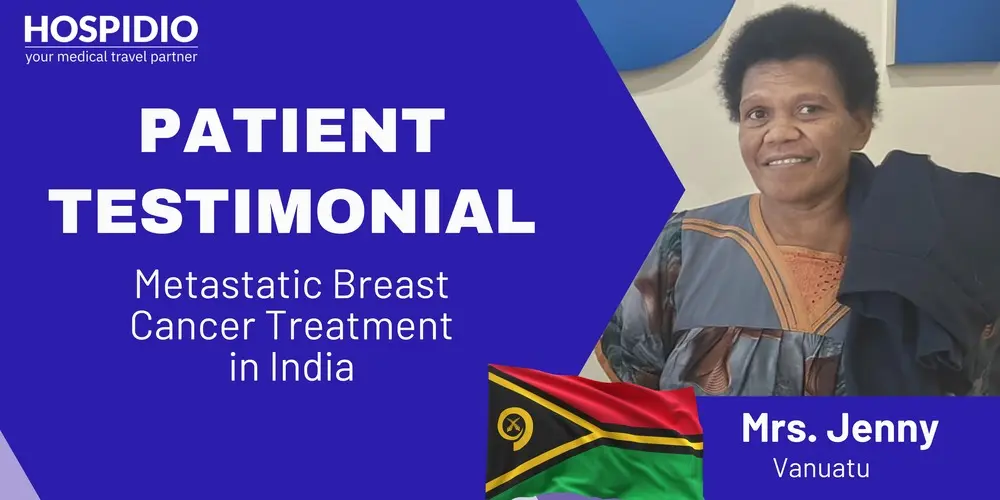
| Patient Characteristic | Details |
| Name | Jenny Narai |
| From | Vanuatu |
| Diagnosis | Stage 4 Breast Cancer with multiple lymph node involvement and sternal mass |
| Procedure | Six cycles of chemotherapy combined with targeted therapy |
| Hospital | Shalby International Hospital, Gurugram, India |
| Oncologist | Dr. Rakesh Kumar Sharma |
| Outcome | Declared cancer free following six treatment cycles |
| Next Step | Follow-up PET CT scan after three months to confirm ongoing remission |
There is a particular kind of courage in a mother who travels thousands of miles for treatment, with her daughter beside her, carrying a Stage 4 cancer diagnosis and no prior treatment history. No previous chemotherapy. No trial medications. Just the disease, at its most advanced stage, and a decision to go to where the best chance of fighting it could be found.
That is where Jenny Narai was when she arrived in India.
From Vanuatu, one of the Pacific Islands where access to advanced cancer treatment simply does not exist, Jenny and her daughter Dalia made the journey to Gurugram with HOSPIDIO's support. What followed over the next several months was one of those stories that reminds you why this work matters.
Jenny came to India with Stage 4 breast cancer. She left declared cancer free.
The Diagnosis: Stage 4, Untreated, and Spreading
Stage 4 breast cancer means the disease has spread beyond the breast to other parts of the body. In Jenny's case, the extent of involvement was significant. Multiple lymph nodes were affected, and there was a mass on the sternum, the bone running down the centre of the chest, indicating the cancer had spread to the chest wall.
She had not received any previous treatment. No chemotherapy, no hormonal therapy, no targeted agents. She arrived at Shalby International Hospital carrying the full burden of an advanced, untreated cancer that had been progressing without intervention.
In Vanuatu, as in many Pacific Island nations, oncology care beyond the most basic level is not available. Patients with serious cancer diagnoses routinely face the same stark reality: the treatment they need does not exist on the island. The choices are to travel, or to go without.
Jenny chose to travel. Her daughter Dalia came with her.
About Stage 4 breast cancer: Stage 4, also called metastatic breast cancer, means the cancer has spread from the breast to other parts of the body such as the bones, lungs, liver, or in Jenny's case the chest wall and lymph nodes. It is the most advanced stage of breast cancer. With the right combination of systemic treatments, including modern chemotherapy and targeted therapy, remission is achievable in a meaningful proportion of patients.
Building the Full Picture: Advanced Investigations at Shalby
Before any treatment began, Dr. Rakesh Kumar Sharma and the oncology team at Shalby International Hospital conducted a comprehensive diagnostic workup. This was essential. To design a treatment protocol that gives a Stage 4 patient the best possible chance, the oncologist needs to understand exactly what type of cancer they are dealing with, how it is behaving biologically, and what treatments it is likely to respond to.
Jenny underwent a full suite of advanced investigations, including:
- PET CT scan: a full-body imaging study that maps the extent and location of cancerous activity throughout the body
- Biopsy: tissue sampling to confirm the cancer type and characteristics at a cellular level
- FISH test (Fluorescence In Situ Hybridisation): a molecular test to determine whether the cancer has a specific gene alteration (HER2 amplification) that makes it eligible for targeted therapy
- IHC markers (Immunohistochemistry): a panel of tests to identify the cancer's hormone receptor status, which determines which treatments will be most effective
- Hormone receptor testing: to assess oestrogen and progesterone receptor positivity
- Full blood panel and supporting investigations
This battery of tests is not routine practice in many parts of the world, and it is certainly not available in Vanuatu. Each test added a layer of precision to the treatment plan that followed. Without them, the team would have been treating a cancer. With them, they were treating Jenny's specific cancer, with a protocol designed around its exact biological profile.
Why these tests matter: Modern breast cancer treatment is not one-size-fits-all. Whether a tumour is HER2-positive, hormone receptor positive, or triple-negative determines which drugs will work and which will not. The FISH test and IHC markers are what allow oncologists to move from general chemotherapy to precisely targeted treatment. This level of diagnostic precision is what India's leading oncology centres offer that most Pacific Island and African healthcare systems currently cannot.
The Treatment: Six Cycles of Chemotherapy and Targeted Therapy
Based on the investigation results, Dr. Rakesh Kumar Sharma designed a treatment protocol combining chemotherapy with targeted therapy. Targeted therapy works alongside chemotherapy to attack specific characteristics of the cancer cells, improving effectiveness while reducing damage to healthy tissue. For patients whose tumours carry certain biological markers, the combination can produce significantly better outcomes than chemotherapy alone.
Jenny began her treatment at Shalby International Hospital. The protocol ran for six cycles, each cycle involving a course of treatment followed by a recovery period. This is demanding. Six cycles of chemotherapy combined with targeted agents is an intensive undertaking, and doing it far from home, in an unfamiliar country, with only her daughter for company, requires a particular kind of resilience.
HOSPIDIO's coordination covered far more than the hospital appointments. For Jenny and Dalia, spending several months in Gurugram as a family from a Pacific Island with no prior experience of India, that support was what made the whole journey possible.
What HOSPIDIO arranged for Jenny and Dalia's stay
- Medical visa applications: HOSPIDIO managed the full India Medical Visa process for both Jenny and Dalia, including the hospital invitation letter, document checklist, and liaison with the Indian High Commission. Read about Medical Visa to India from Vanuatu.
- Airport arrival and departure: a HOSPIDIO representative met them at Indira Gandhi International Airport when they landed in Delhi and arranged the transfer to their accommodation. The same support was provided for their departure.
- Long-stay apartment arrangement: given the extended duration of Jenny's treatment across six chemotherapy cycles, HOSPIDIO arranged a comfortable furnished apartment close to Shalby Hospital, so that the family had a proper home environment rather than a hotel room for the duration of their stay.
- Local transfers: all travel between the apartment, the hospital, and any other required locations was coordinated by HOSPIDIO, so neither Jenny nor Dalia ever had to navigate an unfamiliar city independently.
- Sample collection at the apartment: on days when Jenny needed blood tests or sample collections between treatment cycles, HOSPIDIO arranged for samples to be collected at the apartment rather than requiring an additional hospital trip. This small consideration made a meaningful difference on days when she was not at her strongest.
- Local sightseeing and engagement: the weeks between treatment cycles can be long and isolating for patients and their families. HOSPIDIO organised local sightseeing visits around Gurugram and Delhi, giving Jenny and Dalia the chance to experience India beyond the hospital, rest their minds, and keep their days purposeful during the recovery periods between cycles.
- Ongoing communication and case coordination: the HOSPIDIO team remained the single point of contact throughout, keeping Jenny's family informed, managing any day-to-day concerns that arose, and liaising with the medical team on the family's behalf.
A note on long-stay support: For patients undergoing multi-cycle cancer treatment or other extended procedures in India, HOSPIDIO provides a full long-stay coordination service covering visa, accommodation, local logistics, sample collection, and patient engagement activities. This is part of our standard support for every patient, not an added extra.
The Turning Point: What the Scans Showed
After the fourth cycle of treatment, the team performed a repeat PET CT scan. This is standard oncology practice: to assess mid-treatment how the cancer is responding before committing to the full course. What the scan showed was significant.
After Cycle 4: Complete resolution of the sternal mass. Partial resolution of the breast tumour and affected lymph nodes.
Complete resolution of the sternal mass means the cancer that had spread to Jenny's chest wall was no longer visible on imaging. It had responded fully to treatment. The primary tumour in the breast and the involved lymph nodes had also reduced, though not yet completely.
Dr. Sharma and the team continued with the remaining two cycles of treatment.
After all six cycles were complete, the final PET CT scan was performed.
After Cycle 6: Declared cancer free.
Those three words carry the weight of everything: the journey from Vanuatu, the diagnosis, the months of treatment, the days when treatment made her feel worse before it made her better, the daughter who sat beside her through all of it. The scan said what it said: no evidence of cancer.
The final scan showed what Jenny and her daughter had come all this way to hear. No evidence of cancer.
Going Home
Jenny and Dalia returned to Vanuatu together. They left India with the scan results, the full treatment records, and a plan: return in three months for a follow-up PET CT scan to confirm the remission holds.
Remission is not the same as cure. With Stage 4 breast cancer, the standard of care requires ongoing monitoring to detect any signs of recurrence at the earliest possible stage. The three-month follow-up scan is not a formality. It is part of the treatment plan, and Jenny's team at Shalby, coordinated by HOSPIDIO, will be ready for her when she returns.
But for now, she went home. Cancer free. With her daughter beside her.
In Dalia's Words
It was Dalia, Jenny's daughter, who left the Google review. She was there for every cycle, every scan, every day of this journey. Her words are measured and specific in the way that only someone who has watched something work from close range can be.
★★★★★ Google Review
“We appreciate HOSPIDIO medical travel partner for their reliable support and assistance. Their help has made patient travel and referrals easier, and we thank them for their continued cooperation.” - Dalia Narai, daughter of Jenny, Vanuatu
Dalia says HOSPIDIO made patient travel and referrals easier. That word, easier, is doing a lot of work in that sentence. It is describing what it meant, for a family from a Pacific Island, to navigate an advanced cancer diagnosis, an international medical journey, months of treatment in a foreign country, and the entire logistical reality that surrounds it. That HOSPIDIO made any of that easier is not a small thing.
The review also uses the word reliable. For a family who placed their trust in HOSPIDIO at one of the most frightening moments of their lives, that reliability meant everything.
For Pacific Island Patients Facing a Cancer Diagnosis
Jenny's story speaks directly to a reality that thousands of families across the Pacific Islands live with every year. When a serious cancer diagnosis arrives in Vanuatu, Fiji, Papua New Guinea, Solomon Islands, Kiribati, or Samoa, the local healthcare system simply does not have the oncology infrastructure to treat it. The choice is stark: travel, or go without.
India offers what the Pacific cannot yet provide: advanced cancer diagnostics including PET CT, FISH testing, and IHC profiling; oncology departments running modern treatment protocols; and the specialist depth to manage complex, advanced cases. At a cost that is a fraction of what treatment would cost in Australia or New Zealand, the two other destinations Pacific patients sometimes consider.
HOSPIDIO has supported patients from Vanuatu, Fiji, Papua New Guinea, Kiribati, and other Pacific nations through treatment in India. The journey is long, but it is manageable. And as Jenny's story shows, it can change everything.
For Vanuatu and Pacific Island patients, the medical visa process for India is well supported and HOSPIDIO manages it in full. Read more about how the journey works: From WhatsApp to Discharge: How HOSPIDIO Manages Your Entire Medical Journey.
You can also read other HOSPIDIO patient stories from the Pacific: CABG Success Story from Vanuatu and Mrs. Radhika's Journey from Fiji to India.
Facing a cancer diagnosis and exploring treatment options in India? Send HOSPIDIO your reports for a free specialist assessment.
Recent Blogs

Ashutosh heads the Patient Experience Department at HOSPIDIO, ensuring seamless, compassionate support for international patients seeking treatment in India. With deep expertise in medical travel and hospital coordination, he’s dedicated to making every patient feel safe and cared for. Outside work, he enjoys driving and exploring new cuisines.
Guneet Bhatia is the Founder of HOSPIDIO and an accomplished content reviewer with extensive experience in medical content development, instructional design, and blogging. Passionate about creating impactful content, she excels in ensuring accuracy and clarity in every piece. Guneet enjoys engaging in meaningful conversations with people from diverse ethnic and cultural backgrounds, enriching her perspective. When she's not working, she cherishes quality time with her family, enjoys good music, and loves brainstorming innovative ideas with her team.