
Introduction: Why CAR T-Cell Therapy Matters Today
Over the past decade, hematology has witnessed a shift that few of us anticipated at the turn of the millennium. For patients with relapsed or refractory blood cancers, particularly those who have exhausted chemotherapy, targeted therapy, and even stem cell transplantation, therapeutic options were once extremely limited. CAR T-cell therapy has altered that landscape.
As a hematologist involved in the management of advanced hematologic malignancies, I have seen how this personalized cellular therapy has changed outcomes for carefully selected patients. At the same time, I have also seen the confusion and uncertainty international patients face when exploring CAR T-cell therapy outside their home countries, questions around safety, eligibility, cost, logistics, and long-term outcomes are common and understandable.
This article aims to provide a clear, medically grounded overview of CAR T-cell therapy in India, specifically for international patients. The intent is not to promote a destination, but to explain where India currently stands from a clinical and scientific perspective, and what patients should realistically expect.
We Handle the Planning
You Focus on Recovery
From Medical Visa assistance to airport pick-up and local stay, HOSPIDIO manages your entire medical trip.
Tell Us About Your Need
Free case review. Confidential. No obligation.Understanding CAR T-Cell Therapy
What Is CAR T-Cell Therapy?
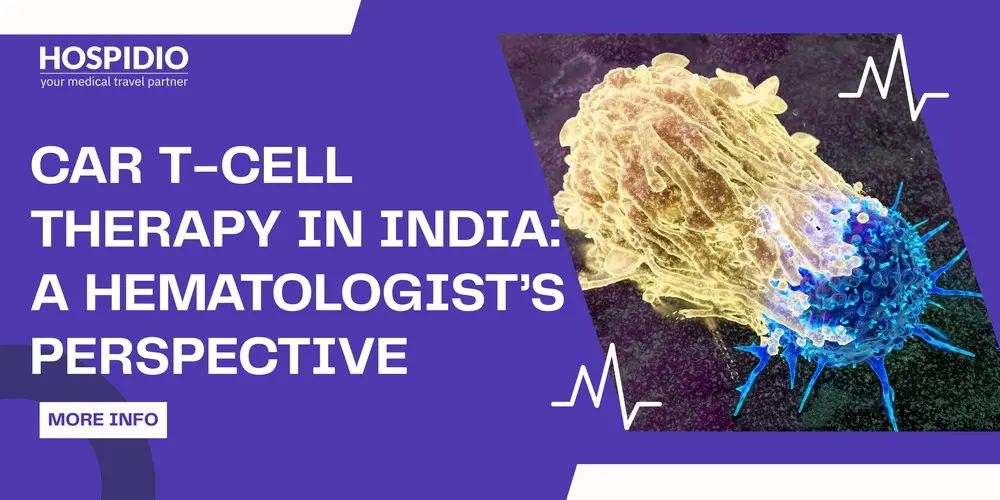
CAR T-cell therapy (short for Chimeric Antigen Receptor T-cell therapy) is a form of adoptive cellular immunotherapy. Unlike chemotherapy, which attacks rapidly dividing cells indiscriminately, CAR T therapy harnesses the patient’s own immune system to identify and destroy malignant cells. The process involves:
- Leukapheresis: T-cells are collected from the patient’s blood.
- Genetic modification: These T-cells are engineered in a laboratory to express a chimeric antigen receptor (CAR) that recognizes a specific antigen on cancer cells (commonly CD19 or BCMA).
- Cell expansion: Modified T-cells are multiplied to reach therapeutic doses.
- Reinfusion: After lymphodepleting chemotherapy, the engineered cells are infused back into the patient.
Once reinfused, these cells can proliferate in vivo and mount a sustained anti-tumor response.
Diseases Currently Treated with CAR T-Cell Therapy
Globally, CAR T-cell therapy has shown the strongest evidence in:
- Relapsed or refractory B-cell acute lymphoblastic leukemia (B-ALL)
- Diffuse large B-cell lymphoma (DLBCL)
- Primary mediastinal B-cell lymphoma
- Mantle cell lymphoma
- Multiple myeloma (BCMA-targeted CAR T)
- Marginal zone lymphoma
- Follicular lymphoma
- Waldernstrom macroglobulinemia
Pivotal trials such as ZUMA-1, JULIET, and ELIANA demonstrated complete remission rates ranging from 60% to over 80% in heavily pre-treated populations. More recently, BCMA-directed CAR T-cell therapies for multiple myeloma have shown deep and durable responses, even in triple-class refractory disease.
CAR T-Cell Therapy vs. Bone Marrow Transplant (BMT): Risk Profiling
From a clinical risk perspective, CAR T-cell therapy is generally considered safer than allogeneic stem cell transplantation, particularly in terms of early treatment-related mortality. Conventional stem cell transplant involves high-dose conditioning chemotherapy and carries a well-documented immediate life risk of approximately 5–10%, driven by complications such as severe infections, graft-versus-host disease, organ toxicity, and prolonged immunosuppression.
In contrast, CAR T-cell therapy does not require myeloablative conditioning or donor stem cells, and early mortality rates are significantly lower, especially when treatment is delivered in experienced centers with standardized toxicity management protocols. While CAR T therapy has its own risks, most notably cytokine release syndrome and transient neurotoxicity, these events are usually reversible with prompt intervention.
As a result, CAR T-cell therapy can often be safely offered to older or frail patients who would otherwise be considered poor candidates for stem cell transplantation, expanding access to potentially curative treatment in populations previously limited by transplant-related risk.
Why India Is Emerging in the CAR T-Cell Therapy Landscape
Clinical Infrastructure and Expertise
CAR T-cell therapy is not simply about access to a product; it requires a highly coordinated clinical ecosystem. This includes:
- Advanced hematology and bone marrow transplant units
- Access to intensive care facilities
- Neurology and infectious disease support
- Transfusion medicine and cell processing laboratories
In India, several tertiary centers now meet these requirements, supported by hematologists trained in cellular therapies and transplant medicine. Importantly, standardized protocols for toxicity grading and management, aligned with ASTCT and EBMT guidelines, are increasingly followed.
Regulatory and Scientific Progress in India
India has traditionally relied on imported CAR T-cell products, which significantly increased costs. Over the last few years, indigenously developed CAR T-cell therapies have entered clinical use under regulatory oversight.
Early Indian trials have demonstrated comparable safety and efficacy profiles to international data, particularly in CD19-positive lymphomas. While long-term follow-up data is still evolving, early remission rates and toxicity profiles are encouraging.
It is important for patients to understand that CAR T therapy in India is not experimental in an uncontrolled sense, it follows structured protocols, ethics committee approvals, and post-treatment surveillance.
Safety Profile: What Patients Should Realistically Expect
Cytokine Release Syndrome (CRS)
CRS is the most common acute toxicity following CAR T-cell infusion. It results from rapid immune activation and cytokine release.
- Symptoms range from fever and fatigue to hypotension and hypoxia
- Most cases are grade 1–2 and manageable
- Severe CRS occurs in a minority of patients
The availability of tocilizumab and corticosteroids has significantly reduced treatment-related mortality.
Neurotoxicity (ICANS)
Immune effector cell-associated neurotoxicity syndrome (ICANS) can present as:
- Confusion or altered consciousness
- Aphasia
- Seizures (rare)
ICANS is usually reversible with prompt intervention, but requires experienced monitoring teams.
Infection and Cytopenias
Prolonged low blood counts and immune suppression may occur, increasing infection risk. Long-term follow-up, vaccination planning, and infection prophylaxis are essential components of post-CAR T care.
Cost of CAR T-Cell Therapy: India vs Other Regions
Cost in India
For international patients, the typical cost of CAR T-cell therapy in India ranges between USD 45,000 and USD 85,000, depending on:
- Type of CAR construct used
- Duration of hospitalization and ICU care
- Complication management
This usually includes cell manufacturing, lymphodepleting chemotherapy, infusion, inpatient monitoring, and early follow-up.
Global Cost Comparison
- United States: USD 400,000–500,000 (excluding hospitalization)
- Australia: USD 250,000–350,000, with limited access and longer wait times
- Latin America: Limited availability; many patients are referred abroad
- Middle East: Variable access, often dependent on government approvals
The cost differential is largely driven by manufacturing economics, healthcare pricing structures, and regulatory overhead, not by dilution of clinical protocols.
Note: Costs vary based on the CAR-T product used, ICU duration, and complication management. For a full breakdown by drug type (Kymriah, Yescarta, NexCAR19) and city, see: CAR T-Cell Therapy Cost in India
Clinical Eligibility Checklist for International Patients
Before planning travel for CAR T-cell therapy, patients should meet most of the following medical criteria. Final eligibility is always determined after detailed case review.
| Type of Criteria | Eligibility |
| Disease-Related Criteria | ✔ Confirmed diagnosis of a CAR T-responsive hematologic malignancy ✔ Relapsed or refractory disease after standard treatments ✔ Antigen expression confirmed (e.g., CD19 or BCMA positivity) ✔ No uncontrolled or rapidly progressing disease beyond eligibility thresholds |
| Patient Health Criteria | ✔ Adequate heart, lung, liver, and kidney function ✔ Acceptable performance status (usually ECOG 0–2) ✔ No uncontrolled active infections ✔ Neurological status suitable for therapy monitoring |
| Prior Treatment History | ✔ Failure or relapse after chemotherapy and/or targeted therapy ✔ Prior stem cell transplant allowed in many cases ✔ Adequate recovery from previous treatments |
| Travel & Logistic Readiness | ✔ Medically fit to travel internationally ✔ Willingness to stay in India for 6–8 weeks ✔ Availability of a caregiver during treatment ✔ Ability to comply with close follow-up after infusion |
| Documentation Required | ✔ Complete medical records and pathology reports ✔ Treatment history and imaging ✔ Molecular and immunophenotyping results ✔ Treating physician’s referral summary |
Patients who do not initially meet criteria may still be eligible after optimization or further evaluation.
Medical Documents to Bring When Travelling to India for CAR T-Cell Therapy
International patients should compile and bring the following documents before travelling. Incomplete records can delay eligibility assessment by days.
Essential:
- Pathology report confirming diagnosis (with immunophenotyping/flow cytometry)
- Bone marrow biopsy report (recent, ideally within 3 months)
- All prior treatment summaries (chemotherapy regimens, dates, response)
- CT/PET scan reports and images (on CD or cloud link)
- Molecular testing results (e.g., FISH, cytogenetics, NGS if available)
- Full blood count, liver function, kidney function, and cardiac workup
- Treating physician's referral letter or case summary
Helpful but not always required:
- Previous bone marrow transplant records (if applicable)
- Echocardiogram or ECHO report (some centers require this upfront)
- List of current medications
- Vaccination history
All documents should ideally be in English or accompanied by a certified translation. Digital copies are accepted for initial review.
Final Thoughts
CAR T-cell therapy represents one of the most significant advances in modern hematology. For international patients, India offers a growing ecosystem where scientific rigor, regulatory oversight, and affordability intersect.
That said, CAR T therapy is not appropriate for everyone. Decisions should always be guided by disease biology, patient fitness, and center expertise, rather than cost alone. When used judiciously, CAR T-cell therapy can offer meaningful, and sometimes life-altering, outcomes.
Note:
At Fortis Super Specialty Hospital, Shalimar Bagh, the hematology department is led by Dr. Akash Khandelwal along with a multidisciplinary team of trained hematologists, transplant physicians, intensivists, and specialized nursing staff. The department follows established national and international clinical guidelines, including evidence-based protocols for advanced therapies such as cellular therapy, bone marrow transplantation, and complex hematologic malignancy management.
Emphasis is placed on patient safety, standardized toxicity monitoring, infection control, and long-term follow-up, ensuring consistency in care delivery. With experience in managing both domestic and international patients, the team maintains structured clinical pathways that support comprehensive evaluation, treatment planning, and post-therapy care, while adhering to ethical practice standards and globally accepted treatment frameworks.
Travel, Visa, and Treatment Logistics for International Patients
For international patients considering CAR T-cell therapy in India, timely coordination and structured planning are essential to ensure both medical suitability and continuity of care. Patients are encouraged to seek expert guidance through HOSPIDIO, which works closely with treating physicians to support pre-treatment evaluation, treatment pathway planning, and post-therapy follow-up. Through HOSPIDIO, patients may arrange a video consultation with Dr. Akash Khandelwal for case review, eligibility assessment, and clinical discussion prior to travel.
In addition to facilitating medical opinions, the team assists with medical visa documentation, travel logistics, accommodation planning near the treatment center, and structured follow-up coordination after discharge, helping international patients navigate the process in a medically informed and organized manner.



Recent Blogs
Dr. Akash Khandelwal is a consultant hematologist with clinical expertise in hematologic malignancies, bone marrow transplantation, and advanced cellular therapies, including CAR T-cell therapy. He is actively involved in the management of complex blood cancers and immune disorders, with a strong focus on evidence-based treatment, patient safety, and long-term outcomes. Dr. Khandelwal works closely with multidisciplinary teams to deliver standardized, guideline-driven care for both domestic and international patients, combining clinical precision with a patient-centered approach.
Guneet Bhatia is the Founder of HOSPIDIO and an accomplished content reviewer with extensive experience in medical content development, instructional design, and blogging. Passionate about creating impactful content, she excels in ensuring accuracy and clarity in every piece. Guneet enjoys engaging in meaningful conversations with people from diverse ethnic and cultural backgrounds, enriching her perspective. When she's not working, she cherishes quality time with her family, enjoys good music, and loves brainstorming innovative ideas with her team.