
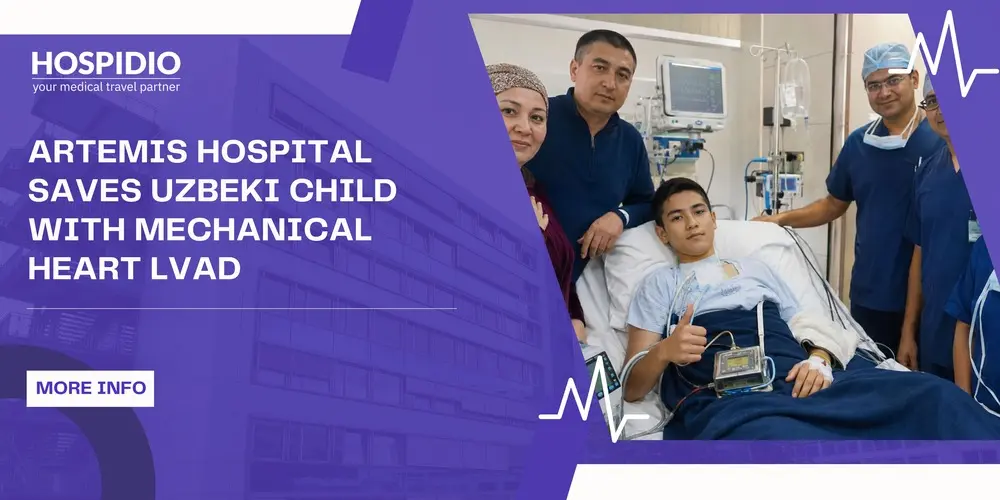
A 14-year old boy from Uzbekistan has made a remarkable recovery after receiving a Left Ventricular Assist Device (LVAD), a mechanical heart pump, at Artemis Hospital in Gurugram, India. Dilshod had been living with dilated cardiomyopathy for nearly a decade, a condition that had progressively robbed his heart of its ability to pump blood effectively. What began as a desperate, last resort intervention has now become a landmark moment in the history of pediatric cardiac surgery in India, marking the first ever discharge of a child in northern India following an LVAD implant.
Who is Dilshod And What is Dilated Cardiomyopathy?
Dilshod is a 14-year old from Uzbekistan who had been living with dilated cardiomyopathy since early childhood, nearly ten years in total. Dilated cardiomyopathy is a condition in which the heart muscle becomes enlarged and weakened, losing its ability to pump blood efficiently to the rest of the body. Over time, this leads to progressive heart failure.
The disease had reached its terminal phase for Dilshod. Simple activities such as moving out of bed or taking a couple of steps made him breathe heavily. He had to be taken to hospital ICU on an emergency basis every now and then to deal with the problem of heart failure. There were no treatments that could treat him at this stage in Uzbekistan, and he had been told by his doctors to take the necessary measures.
The Journey to India
His parents brought him to Artemis Hospital in Gurugram approximately two months before his surgery. Upon arrival, he was placed on the waiting list for a pediatric heart transplant, the definitive treatment for end stage heart failure. But time was not on his side.
During that time period, Dilshod had to be admitted four times into the Pediatric Cardiac ICU because of failing heart. Once, Dilshod was admitted to ICU because of having cardiogenic shock, which is a potentially fatal condition where the heart becomes so weak that it cannot pump enough blood to supply all the organs in the body. There was indication that Dilshod’s liver and kidneys were shutting down. His chances of survival before getting the donor heart were dwindling away.
At this critical juncture, the cardiac surgery team at Artemis Hospital made a bold and precedent setting decision: implant a mechanical heart pump, an LVAD, to keep him alive and allow his organs to recover.
What is an LVAD and How Does it Work?
A Left Ventricular Assist Device (LVAD) is a mechanical pump that supports the heart's left ventricle, the chamber responsible for pumping oxygenated blood to the rest of the body. It does not replace the heart but works alongside it, taking over the workload of pumping blood when the natural heart muscle is too weak to do so on its own.
The device consists of a small pump implanted inside the chest, connected to the left ventricle on one end and the aorta, the body's main artery, on the other. A thin cable exits through the skin and connects to an external computerised controller and battery pack worn by the patient. This allows the person to move freely while the device continues to sustain their circulation.
LVADs are used in two key scenarios:
- Bridge to transplant: To keep a patient alive and stable while awaiting a donor heart.
- Destination therapy: As a long term solution for patients who are not eligible for transplantation.
In Dilshod's case, the LVAD was implanted as a bridge to transplant, giving his failing organs time to recover while he continues to wait for a suitable donor heart.
A Surgery that Made History
The procedure was performed by Dr. Aseem R. Srivastava, Chief of Paediatric Cardiac Surgery at Artemis Hospital, and his multidisciplinary team. Implanting an LVAD in a child is far more complex than in an adult. Challenges include the child's smaller anatomy, the presence of long standing heart disease, and the need for intensive post operative monitoring.
This case represents several firsts for India:
- First child to be discharged in northern India following an LVAD implant
- Youngest ever recipient of an LVAD device in India
Dr. Srivastava described the procedure as one of the most challenging his team had undertaken, and credited the outcome to extraordinary multidisciplinary teamwork, including the Paediatric Cardiac ICU team, pediatric cardiologists, cardiac anaesthesiologists, perfusionists, nurses, physiotherapists, biomedical engineers, and hospital administration staff who worked around the clock.
Recovery: From Bedbound to Climbing Stairs
The results have been nothing short of extraordinary. Within days of the surgery, Dilshod's organ functions began to recover as the LVAD provided the circulation his failing heart could not. The transformation from his pre-surgical state to post surgical recovery is striking.
Before surgery, he was largely confined to bed, too breathless to walk more than a few steps. After surgery, he is now walking independently, climbing stairs, and has been discharged from the hospital, all while carrying the LVAD's external controller and battery pack. He is expected to return to Uzbekistan soon, with plans to attend school and resume a normal childhood.
What this Means for International Patients
This case is a powerful illustration of why India has emerged as one of the world's leading destinations for advanced pediatric cardiac care. For families from countries where complex heart surgeries, particularly in children, are not available, India offers world class expertise at a fraction of the cost compared to the United States, United Kingdom, or Western Europe.
Artemis Hospital in Gurugram is one of India's foremost cardiac centres, equipped with the technology, expertise, and multidisciplinary infrastructure required for procedures of this complexity. Dilshod's story demonstrates that even the most critical, last resort scenarios can be addressed with the right team and the right technology.
For families facing similar circumstances, a child or loved one with end stage heart failure, on a transplant waiting list, or requiring advanced mechanical cardiac support seeking care in India is a viable, credible, and potentially life saving option.
Conclusion
Dilshod's recovery is not just a personal triumph for him and his family, it is a milestone in Indian pediatric cardiac surgery that signals what is now possible for critically ill children from around the world. The successful implantation of an LVAD in the youngest ever recipient in India, followed by discharge and functional recovery, reflects the depth of skill, technology, and team coordination that advanced cardiac centres in India can now reliably deliver.
If your child or a family member is living with heart failure and requires advanced cardiac intervention, HOSPIDIO can help you connect with India's top pediatric cardiac surgeons and hospitals. Share your medical reports with us for a free, confidential case review, our patient consultants typically respond within a few hours.
References
ANI News. (February 13, 2026). Uzbeki child with end-stage heart failure recovers after receiving mechanical heart (LVAD). https://www.aninews.in/news/national/general-news/uzbeki-child-with-end-stage-heart-failure-recovers-after-receiving-mechanical-heart-lvad20260213091740/
About Hospidio: This blog post is intended to provide factual, evidence based information to keep our community informed about global health developments. Always consult with healthcare professionals for medical advice and follow guidance from your local health authorities.
Recent Blogs


Shruti Verma has completed her M.Tech in Biotechnology with experience in medical writing and scientific content development. She specializes in translating complex biomedical and healthcare information into clear, accurate, and reader-friendly content for diverse audiences. When she is not designing content, probably she is designing graphics.
Guneet Bhatia is the Founder of HOSPIDIO and an accomplished content reviewer with extensive experience in medical content development, instructional design, and blogging. Passionate about creating impactful content, she excels in ensuring accuracy and clarity in every piece. Guneet enjoys engaging in meaningful conversations with people from diverse ethnic and cultural backgrounds, enriching her perspective. When she's not working, she cherishes quality time with her family, enjoys good music, and loves brainstorming innovative ideas with her team.