
Imagine waking up not knowing how your body will behave today. Will the medication work this morning? Will you freeze mid-step in a crowded market, or find your hands trembling too much to hold a cup of tea? For millions of people living with advanced Parkinson's disease, this is not imagination, but the Truth.
Managing Parkinson's over time becomes less about treating a condition and more about negotiating with it, hour by hour, dose by dose. Families in the UAE watch their fathers grow dependent. Caregivers in Nigeria exhaust every local option. Patients in the UK sit on waiting lists that stretch far beyond what feels acceptable for a condition that does not pause.
That is precisely why a quiet but landmark moment in Chennai, India on 2 March 2026 matters so much, not just for India, but for every Parkinson's patient and family around the world still searching for better answers.
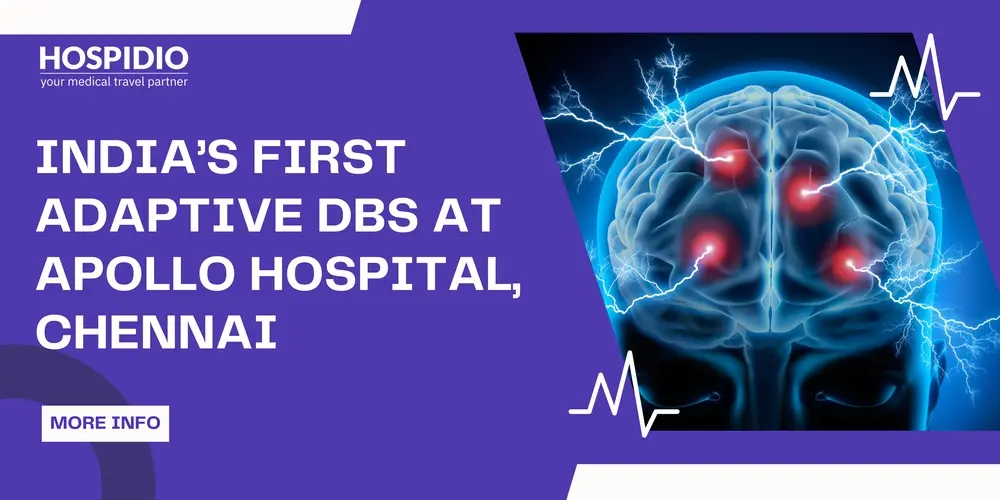
Apollo Hospitals Chennai has performed India's first-ever Adaptive Deep Brain Stimulation (aDBS), a significant leap forward in how Parkinson's disease is treated. And for international patients who have felt that the most advanced care was always just out of reach, this changes the conversation.
What is Parkinson's Disease, and Why Does It Get Harder Over Time?
Parkinson's disease is a progressive neurological condition affecting the brain's ability to control movement, starting with mild tremors or stiffness, and deepening over time to affect balance, speech, and independence.
Most patients manage well on medication for years. But as the disease progresses, that medication becomes unreliable. Patients experience "off" periods where symptoms return in full force, followed by the medication overcorrecting and triggering involuntary movements called dyskinesias. This unpredictable push and pull exhausts both patients and caregivers, and signals that medication alone is no longer enough.
By 2050, an estimated 25.2 million people worldwide will be living with Parkinson's. Across the Middle East, Africa, and Europe, the need for advanced therapies is growing faster than local options can keep up.
From Continuous to Adaptive: What Has Changed With aDBS?
For patients who've exhausted medication options, Deep Brain Stimulation (DBS) has long been one of the most effective advanced therapies available, a surgically implanted device that delivers electrical stimulation to targeted areas of the brain, reducing tremors, stiffness, and motor fluctuations.
Conventional DBS works well, but has one key limitation: the stimulation is continuous and fixed. It delivers the same pulse regardless of what the patient is doing or how their brain signals are changing in that moment.
Adaptive DBS changes this. Using sensing-enabled technology developed by Medtronic, aDBS actively listens to the patient's brain signals in real time and adjusts stimulation automatically, more when needed, less when not. Think of it as the difference between a fixed thermostat and a smart one.
Dr. Vijayashankar Paramanandam, Movement Disorders and DBS Specialist at Apollo Chennai, summed it up: "The system responds instantaneously, delivering the precise amount of stimulation exactly when it is needed, bringing us closer to truly personalised DBS care." The patient himself said it simply after a month of follow-up: "I feel more stable through the day, and that makes a real difference to daily life."
Why Apollo Hospitals Chennai?
This procedure was not a one-off experiment. It is the natural progression of a programme built over years of sustained expertise.
The team at Apollo Hospitals Chennai is led by Dr. Vijayashankar Paramanandam, a movement disorders neurologist, and Dr. Arvind Sukumaran, Senior Consultant Neurosurgeon , both trained through advanced international fellowship programmes in movement disorders neurology and functional neurosurgery. Their expertise is not locally developed in isolation; it has been tested and refined against the best global standards.
Dr. Sukumaran noted the importance of clinical rigour over novelty: "In any new technology, what matters is patient benefit. Following activation, programming and clinical follow-up over a month, we have seen encouraging early response in terms of stability throughout the day. That is a meaningful outcome in Parkinson's, where fluctuation is often the most challenging aspect to manage."
This is a team that measures success in patient outcomes, not press releases.
Apollo Hospitals is one of Asia's largest and most respected hospital networks, with a long-established International Patient Services division designed specifically to support patients travelling from abroad. From pre-arrival medical coordination to post-discharge follow-up, the infrastructure exists to receive international patients with the same standard of care as any local patient, and in many cases, with dedicated support that goes further.
For families in the UAE, Nigeria, Kenya, the UK, or elsewhere who are considering travelling to India for treatment, this is not a leap into the unknown. It is a pathway that thousands of international patients have walked before.
Is Your Loved One a Candidate for Adaptive DBS?
aDBS is not for every Parkinson's patient, and an honest conversation about candidacy is always the right first step. Generally speaking, patients who may benefit from advanced DBS therapy include those who:
- Have been living with Parkinson's disease for several years and are experiencing disease progression
- Are on multiple medications but still experiencing significant "off" periods or dyskinesias
- Find that their quality of life is being increasingly disrupted by motor fluctuations that medication can no longer adequately control
- Have previously been told they may be a candidate for DBS, or have already had conventional DBS and are interested in adaptive therapy
- Are otherwise in reasonable general health and able to undergo a neurosurgical procedure
If this describes someone you love, the next step is not surgery, it is a conversation. A thorough evaluation by the team in Chennai will determine whether aDBS is appropriate, what outcomes might be expected, and what the full treatment journey looks like.
Why Are Patients From the Middle East, Africa, and Europe Choosing India?
The honest answer is a combination of access, quality, and cost, and none of these factors should be considered in isolation.
In the United Kingdom, patients seeking advanced Parkinson's procedures through the NHS face waiting times that can stretch to a year or more. Private care in the UK or Western Europe, while available, comes at a significant financial cost that places it out of reach for many families. In many parts of the Middle East and Africa, aDBS is simply not yet available at all, the technology, the trained specialists, and the established programmes do not yet exist at the level required.
India, and Apollo Chennai specifically, offers something rare:
Internationally trained specialists, world-class infrastructure, and a cost of care that is a fraction of what comparable treatment would cost in the UK or private Gulf hospitals.
This is not about compromising on quality. It is about accessing quality that is genuinely equivalent, without the financial or logistical barriers that make it impossible elsewhere.
Beyond the clinical side, Apollo's International Patient Services team assists with everything from travel and visa documentation to accommodation for accompanying family members. A medical journey abroad, particularly for something as significant as brain surgery, requires more than a flight and a hospital room. It requires coordination, communication, and care at every step.
How HOSPIDIO Supports You Through Every Step
HOSPIDIO exists for exactly this moment, when a family abroad finds a treatment that could change everything, and then wonders: how do we actually make this happen?
As a trusted medical travel facilitator, HOSPIDIO connects international patients with India's leading hospitals and specialists, and manages the entire journey so that patients and families can focus on what matters most: getting better.
When you reach out to HOSPIDIO, here is what happens:
- A dedicated Care Advisor speaks with you to understand your loved one's condition, medical history, and goals
- We handle hospital appointments, documentation, and all pre-travel coordination
- We coordinate with the clinical team at Apollo Chennai to evaluate candidacy and provide a treatment plan
- We support visa applications and assist with accommodation arrangements for patients and accompanying family members
- We remain your point of contact throughout the treatment and during the follow-up period after you return home
- There is no obligation, no fee for the initial consultation, and no pressure. Our role is to give you clear, honest information so that you can make the best decision for your family.
Take the First Step Today
If someone you love has been living with advanced Parkinson's disease, and you have been looking for a treatment that offers more than what is currently available, this is your moment to ask the question.
India's first Adaptive Deep Brain Stimulation has been performed. The team is in place. The outcomes are encouraging. And patients from across the world are already choosing India , and Apollo Chennai, for exactly this kind of care.
You don't have to navigate this alone. HOSPIDIO is here to walk you through the process, answer your questions, and make sure that geography never becomes the reason someone doesn't get the care they deserve.
Early referral for advanced Parkinson's therapies is associated with better outcomes. If your loved one is showing signs that medication is no longer enough, don't wait until options narrow further. Reach out today.
Recent Blogs



Frequently Asked Questions
Apollo’s new Hyderabad hospital is a next-generation smart hospital equipped with AI-driven systems, advanced MRI technology, minimally invasive surgical tools, and integrated digital patient care.
India offers high-quality healthcare, internationally trained specialists, shorter waiting times, and treatment costs that are significantly lower than many Western countries.
The hospital provides advanced care in orthopedics, cardiology, neurology, oncology, joint replacement surgeries, and complex multi-specialty treatments.
HOSPIDIO supports patients with hospital selection, medical opinions, treatment cost estimates, visa assistance, accommodation, airport pickup, and complete treatment coordination.
Yes. Patients can share their medical reports with HOSPIDIO and receive a specialist opinion from top Indian doctors before planning their treatment journey.
Yes. Treatments in India are often 60–90% more affordable than similar procedures in countries like the US and UK, without compromising on quality of care.
Shruti Verma has completed her M.Tech in Biotechnology with experience in medical writing and scientific content development. She specializes in translating complex biomedical and healthcare information into clear, accurate, and reader-friendly content for diverse audiences. When she is not designing content, probably she is designing graphics.
Guneet Bhatia is the Founder of HOSPIDIO and an accomplished content reviewer with extensive experience in medical content development, instructional design, and blogging. Passionate about creating impactful content, she excels in ensuring accuracy and clarity in every piece. Guneet enjoys engaging in meaningful conversations with people from diverse ethnic and cultural backgrounds, enriching her perspective. When she's not working, she cherishes quality time with her family, enjoys good music, and loves brainstorming innovative ideas with her team.