
| Patient Characteristic | Details |
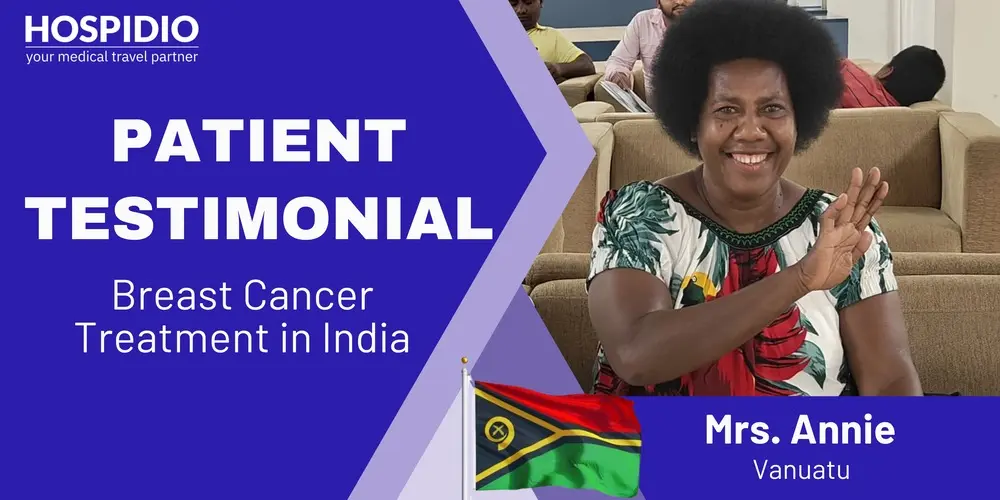
| Name | Annie Kalatei |
| From | Vanuatu |
| Initial Fear | Suspected Stage 4 Breast Cancer |
| Confirmed | Stage 2 Breast Cancer (Localized) |
| Procedures | Breast conservative surgery (removal of lumps) with flap tissue reconstruction, followed by chemotherapy |
| Hospital | Shalby International Hospital, Gurugram, India |
| Oncologists | Dr. Mandeep Singh (Surgical Oncologist) and Dr. Rakesh Kumar Sharma (Medical Oncologist) |
| Outcome | Completed full treatment in India and returned home to Vanuatu |
When a doctor uses the words "suspected Stage 4," the world changes. It does not matter where you are. It does not matter what else is happening in your life. Those two words carry a particular weight, a particular fear, and a particular question that immediately crowds out every other thought: how much time do I have?
That was the weight Annie Kalatei carried with her when she travelled from Vanuatu to India. She had four lumps in her breast. Local assessment had raised the possibility of Stage 4 cancer. She had received no treatment. She came to India not knowing what the full picture would show, but knowing that finding out, and finding the right team to treat whatever was found, was the only path forward.
What the investigations at Shalby International Hospital revealed changed everything.
She arrived carrying the fear of Stage 4. The investigations told a different story. And that different story gave her a different future.
Why Accurate Diagnosis Changes Everything
One of the most important things HOSPIDIO does for patients arriving from countries with limited diagnostic infrastructure is this: it gives them access to the tests that produce a precise, reliable picture of what they are actually dealing with.
In Vanuatu, as in many Pacific Island nations, the diagnostic tools available for complex cancer assessment are limited. A patient can receive a clinical assessment and a working diagnosis, but the kind of detailed molecular and imaging investigation that tells an oncologist exactly what type of cancer they are looking at, what stage it has reached, and how it is likely to behave, is simply not available. Patients arrive at HOSPIDIO with a best estimate of their condition. India provides the certainty.
For Annie, that certainty was not what she had feared. It was better. Significantly better.
The Investigations: Building the True Picture
On arrival at Shalby International Hospital in Gurugram, Dr. Mandeep Singh and Dr. Rakesh Kumar Sharma ordered a full suite of advanced diagnostic investigations before any treatment decision was made. This is the standard approach at HOSPIDIO's partner hospitals: treat first based on what the evidence actually says, not on a working assumption from a setting with fewer diagnostic tools.
Annie underwent a comprehensive workup, including:
- PET CT scan: full-body imaging to map the location and extent of any cancerous activity throughout the body, including whether it had spread beyond the breast
- Biopsy: tissue sampling from the lumps to confirm the nature of the cells
- FISH test: a molecular test to determine HER2 gene status, which directly influences treatment options
- IHC markers: immunohistochemistry panel to identify the cancer's receptor profile
- Hormone receptor testing: oestrogen and progesterone receptor status
- Full blood panel and supporting blood tests
These tests are the difference between treating a suspected cancer and treating a precisely characterised one. Every result narrowed the picture and sharpened the plan.
PET CT result: Cancer localised to the breast. No evidence of spread to distant organs or sites.
Stage confirmed: Stage 2
Stage 2 breast cancer is serious and requires decisive treatment. But the difference between Stage 2 and Stage 4 is not a matter of degree. It is the difference between a condition that is highly treatable with curative intent and a condition that requires a fundamentally different, longer-term management approach. Annie arrived with one of those diagnoses. She left India treated for the other.
Why this matters for Pacific patients: Many patients travelling from Vanuatu, Fiji, Papua New Guinea, and other Pacific nations arrive with diagnoses based on limited local investigations. A significant proportion find that the confirmed diagnosis in India is at a less advanced stage than initially feared. Access to precise diagnostics is itself a form of care, because it determines whether a patient receives the right treatment or an unnecessarily aggressive one.
The Treatment: Surgery First, Then Chemotherapy
Because Annie's cancer was localised and had not spread, the treatment plan recommended by Dr. Mandeep Singh and Dr. Rakesh Kumar Sharma was a curative one: surgery to remove the disease, followed by chemotherapy to eliminate any remaining cancer cells and reduce the risk of recurrence.
Breast conservative surgery with flap reconstruction
Dr. Mandeep Singh performed a breast conservative surgery, removing four lumps from Annie's breast. Conservative surgery aims to remove the cancer while preserving as much of the natural breast tissue as possible, an important consideration for a patient's long-term wellbeing and quality of life.
Following the removal of the tumours, reconstruction was performed using a flap technique, where tissue is used to restore the shape and appearance of the breast. This approach requires surgical skill and experience, and it ensures that the patient's recovery is not only physical but considers the whole person.
Recovery and chemotherapy
After surgery, Annie remained in India to recover before beginning her chemotherapy cycles with Dr. Rakesh Kumar Sharma. Completing both stages of treatment in India, under the same coordinated team, meant continuity of care and consistent monitoring throughout. She did not have to travel back and forth, and her oncology team had full visibility of her progress from surgery through to the end of chemotherapy.
Once her treatment was complete and she had recovered sufficiently to travel, Annie returned home to Vanuatu.
What HOSPIDIO Arranged Throughout Annie's Stay
Annie's treatment spanned multiple stages over an extended period in India. HOSPIDIO's coordination covered every practical aspect of her stay, so that she could focus on her recovery without the added burden of managing logistics in an unfamiliar country.
- Medical visa: HOSPIDIO managed the full Indian Medical Visa application process from Vanuatu to India, including the hospital invitation letter and all documentation required for her entry.
- Airport arrival and departure: a HOSPIDIO representative met Annie at Indira Gandhi International Airport on arrival and arranged her transfer to accommodation. Return transport was coordinated for her departure.
- Accommodation near the hospital: HOSPIDIO arranged suitable accommodation close to Shalby International Hospital, ensuring she had a comfortable and convenient base throughout her treatment and recovery.
- Local transfers: all travel between her accommodation, the hospital, and any other required locations was managed by HOSPIDIO throughout her stay.
- Sample collection: blood tests and samples required between treatment cycles were collected at her accommodation where possible, reducing unnecessary travel on difficult days.
- Sightseeing and engagement: during the recovery periods between treatment stages, HOSPIDIO arranged local visits around Gurugram and Delhi to keep Annie engaged, supported, and connected to life beyond the hospital.
- Case coordination and family communication: the HOSPIDIO team maintained ongoing communication with Annie's family in Vanuatu throughout her stay, ensuring they were kept informed at every stage.
HOSPIDIO long-stay support: For patients undergoing staged treatment combining surgery and chemotherapy, HOSPIDIO provides continuous coordination from arrival through to departure, including all visa, accommodation, transport, sample collection, and family communication. This is standard for every HOSPIDIO patient on an extended treatment programme.
A Message from Annie's Family
Annie rated HOSPIDIO five stars on Google. It was her son-in-law who wrote to the HOSPIDIO team directly, and his words deserve to be read in full.
♥ Message from Annie's Family
“Madame on behalf of my family I wish to again thank you for what you and Hospidio are doing. 2025 has been a challenge for us but we have seen God's hands and care. We believe God has chosen you and your team as an instrument for his greater purpose in this world of sickness and sin. Thank you for your heartfelt and inspirational message to us. We will read in morning worship. I would like to also wish the same for you and your family and its our prayer that God will take you and your family through the challenges of this year 2026. Wishing you and your loved ones a happy new Year. God bless. With love from Family.” - Annie's son-in-law, Vanuatu
This is not a review. It is something rarer: a letter from a family who experienced HOSPIDIO not as a service provider, but as part of the story of their mother's survival.
The phrase "we have seen God's hands and care" speaks to how deeply this journey affected the family. Annie came to India under a cloud of fear. She returned home having been treated, having recovered, and having been supported throughout by a team that her family describes as instruments of a greater purpose. That is not language people use about a transaction. It is language they use about something that changed their lives.
The mention of reading the HOSPIDIO team's message in morning worship is a detail that says everything about the relationship that was built during Annie's time in India. It is the kind of outcome that no marketing can manufacture and no metric can capture. A family in Vanuatu, praying for the people who helped bring their mother home.
For Pacific Island Patients Facing a Cancer Diagnosis
Annie's story carries a specific message for patients across the Pacific who have received a cancer diagnosis and are uncertain about what to do next.
The first message is about diagnosis. What you have been told at home may not be the final word. The diagnostic tools available in Vanuatu, Fiji, Solomon Islands, and similar settings are not the same as those available at accredited oncology hospitals in India. A suspected Stage 4 can become a confirmed Stage 2 once a PET CT scan, FISH test, and IHC panel have been run. That difference is not a detail. It determines the entire treatment path.
The second message is about support. Annie did not navigate India alone. HOSPIDIO was with her from the moment she landed to the moment she departed. Her family at home were kept informed throughout. The logistics of a complex, multi-stage treatment programme in a foreign country were managed so that she could give her full attention to getting better.
HOSPIDIO has now supported multiple patients from Vanuatu through treatment in India. You can read other stories from the Pacific on our testimonials page, including Jenny Narai's cancer story from Vanuatu, Hamish's cardiac surgery story from Vanuatu, and Jenny's orthopaedic journey from Vanuatu.
For information on how to obtain a medical visa from Vanuatu and what to expect when you travel to India with HOSPIDIO, read: From WhatsApp to Discharge: How HOSPIDIO Manages Your Entire Medical Journey.
Facing a breast cancer diagnosis and exploring treatment options in India? Send HOSPIDIO your reports for a free specialist assessment.
Recent Blogs
Ashutosh heads the Patient Experience Department at HOSPIDIO, ensuring seamless, compassionate support for international patients seeking treatment in India. With deep expertise in medical travel and hospital coordination, he’s dedicated to making every patient feel safe and cared for. Outside work, he enjoys driving and exploring new cuisines.
Guneet Bhatia is the Founder of HOSPIDIO and an accomplished content reviewer with extensive experience in medical content development, instructional design, and blogging. Passionate about creating impactful content, she excels in ensuring accuracy and clarity in every piece. Guneet enjoys engaging in meaningful conversations with people from diverse ethnic and cultural backgrounds, enriching her perspective. When she's not working, she cherishes quality time with her family, enjoys good music, and loves brainstorming innovative ideas with her team.