
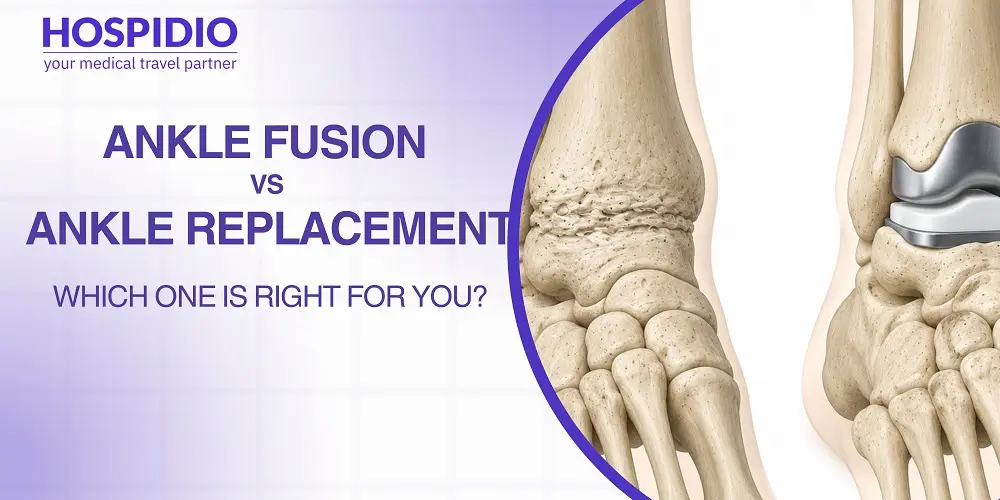
Your surgeon has laid out two paths for your worn out ankle: fusion or replacement. Both promise relief from the pain that’s been slowing you down for years, but they get there in completely different ways, and the choice isn’t as simple as picking the newer sounding option.
Here is the short answer.
Ankle fusion permanently joins the ankle bones into one solid piece, trading away joint motion for a durable, predictable result. Ankle replacement swaps the damaged joint for an artificial one, keeping natural movement but with an implant that has a defined lifespan and a higher chance of needing revision surgery later. The better choice depends on your age, activity level, bone quality, and what you personally value more: durability or motion.
This guide walks through both procedures side by side: who actually qualifies for each, what recovery really looks like, the long term trade-offs nobody mentions upfront, and what each option costs depending on where you have it done.
The 30-Second Difference
Picture your ankle joint as a hinge. Fusion welds the hinge shut so it can never move again, but it also can never wear out the way a moving part does. Replacement keeps the hinge swinging by installing an artificial one, but like any mechanical part, it has a service life.
| Ankle Fusion (Arthrodesis) | Ankle Replacement (Arthroplasty) | |
| What happens to the joint | Bones are fused into one solid piece | Damaged joint replaced with metal and plastic implant |
| Movement after surgery | Ankle no longer bends up or down | Near-natural range of motion in most patients |
| Typical candidate age | Under 50, high activity, heavy labor | Over 55 to 60, lower-impact lifestyle |
| Long-term concern | Arthritis in nearby joints over time | Implant wear and eventual revision |
That table is where most articles stop. Real patients rarely fit either box perfectly, which is why the next section matters more than your age alone.
Who Is Actually a Candidate for Each
Age gets mentioned first in almost every conversation about this choice, but it’s a proxy for the things that actually matter is how hard you plan to use the joint, and how well your bones can support an implant.
Fusion tends to be favored when you’re under 50 and still physically demanding work or sport for years to come, your bone stock is compromised by prior infection or trauma, or you’ve already had a failed replacement and need a reliable fallback. Fusion doesn’t wear out the way a mechanical joint can, so for someone planning decades of heavy use, that durability matters more than motion.
Replacement tends to be favored when you’re older, generally over 55 to 60, with a lower-impact lifestyle, and you want to preserve a natural walking pattern. Replacement is also often the better call if you already have a fused or arthritic hip or knee on the same side, since a stiff ankle forces those joints to absorb motion they weren’t built for.
Either option can be ruled out by poor bone density, uncontrolled diabetes with nerve damage (peripheral neuropathy), active or recent infection in the joint, or significant deformity that hasn’t been corrected first. These factors can eliminate replacement even in an older, low-impact patient who otherwise looks like an ideal candidate, and they can complicate fusion too.
Important: Your surgeon’s recommendation depends on your X-rays, bone density, and the condition of the joints around your ankle, not on age alone. Two patients of the same age can be steered toward opposite procedures based on what the imaging shows.
Not sure which option fits your case? Share your X-rays and history with an orthopedic foot and ankle specialist for a second opinion before you commit to either surgery.
Why This Isn’t Just an Age Question
This is the part that gets glossed over in a rushed consultation, and it’s the most useful thing to understand before you decide.
Fusing a joint in a younger, more active patient often shifts stress onto the joints next door, the subtalar joint below the ankle and the midfoot. Within 10 to 15 years, a meaningful share of fusion patients develop arthritis in those neighboring joints, sometimes severe enough to need further surgery. It’s not a flaw in the surgery; it’s physics. A joint that no longer bends has to send that motion somewhere, and the joints beside it absorb the difference.
Replacement avoids that problem by keeping the ankle mobile, but it introduces a different one: implants wear, loosen, or occasionally fail, particularly in patients with poor bone density, uncontrolled diabetes, or very high activity demands. That’s why the age pattern in real practice runs closer to the opposite of what people assume: replacement is generally steered toward older, lower-demand patients precisely because their implants won’t be asked to survive 40 years of heavy loading.
Myth-bust: “Fusion is only for older patients, and replacement is only for younger, more active ones.” In most modern protocols, it’s closer to the reverse. Younger, high-demand patients are more often guided toward fusion because it can outlast decades of heavy use, while replacement is reserved for patients whose activity level and bone quality suit an implant with a defined lifespan.
Ankle Fusion vs Replacement: The Comparison
| Ankle Fusion | Ankle Replacement | |
| Mobility after surgery | No up-down ankle motion, gait adapts | Near-normal gait in most patients |
| Weight-bearing timeline | Non-weight-bearing 10 to 12 weeks | Partial weight-bearing often at 2 to 4 weeks |
| Revision surgery rate | Low, adjacent-joint arthritis is the main long-term issue | Higher, roughly 10 to 20 percent may need revision by 10 years |
| Effect on nearby joints | Increased stress, arthritis risk over 10 to 15 years | Minimal, since natural motion is preserved |
| Return to sport or heavy work | Good for straight-ahead activity, no restrictions on load | Low-impact activity encouraged, high-impact discouraged |
Two rows are worth sitting with. Weight-bearing starts sooner after replacement, but “sooner” doesn’t automatically mean a shorter total recovery, since replacement rehab focuses on retraining motion, not just letting bone heal. And the revision-rate gap is real, but it has to be weighed against fusion’s own long-term cost: arthritis in the joints it stresses next door.
Recovery Timelines: What Actually Differs
Ankle fusion: expect 10 to 12 weeks of non-weight-bearing while the bones fuse, in a cast or boot, followed by a gradual return to full activity. Total recovery, including the return of strength and confidence in the joint, generally runs 4 to 6 months.
Ankle replacement: partial weight-bearing often begins at 2 to 4 weeks, noticeably sooner than fusion. But total recovery still runs 3 to 6 months, because the rehab goal is different: you’re not just waiting for bone to heal, you’re retraining the muscles and tendons around the ankle to control an artificial joint through a full range of motion.
This is why “replacement recovers faster” is only partly true. Early mobility comes sooner with replacement. Full return to sport, particularly anything involving pivoting or impact, can take just as long either way, and replacement patients are typically advised to stay away from high-impact activity permanently to protect the implant.
Long-Term Outcomes and Revision Risk
Here’s the section most marketing pages skip, and it’s the one that should actually drive your decision.
Modern total ankle replacements show implant survival of roughly 80 to 90 percent at 10 years, meaning most patients are still on their original implant a decade out. Patient satisfaction after replacement is high, often cited around 90 percent, and several studies show patients who’ve experienced both procedures (fusion first, replacement later, or vice versa) tend to prefer the replacement for day-to-day comfort and gait.
Fusion doesn’t “wear out” in the same mechanical sense; a solid fusion, once healed, is permanent. Its long-term risk is different, adjacent-joint arthritis in the subtalar and midfoot joints, which can develop over 10 to 15 years and occasionally requires its own surgery down the line.
What does revision actually involve for each path?
A failed fusion (non-union, where the bones never fully join) may need repeat fixation or bone grafting. A failed or loosened replacement is typically either revised with a new implant or, in more severe cases, converted to a fusion, which is why fusion is sometimes called the fallback option for a replacement that didn’t work out.
What Happens at the Consultation
Knowing what’s coming makes the decision less overwhelming, and helps you ask sharper questions.
First, your surgeon reviews your history and activity level in detail: your job, your sport if you have one, your other joints, and any prior ankle surgeries or infections.
Second, imaging: weight-bearing X-rays at minimum, often a CT scan to assess bone stock and deformity, and sometimes an MRI or bone density scan if there’s a concern about osteoporosis or avascular necrosis.
Third, an honest conversation about both options, including the trade-offs specific to your imaging, not a generic pitch for one procedure. Finally, a shared decision: the best outcomes come from patients who understand exactly what they’re trading away and what they’re gaining, whichever path they choose.
Cost Comparison: India, Turkey, US, and UK
This is the part that barely gets mentioned on clinical blogs, but it’s often the deciding factor once the medical case for either option is genuinely close.
Ankle fusion: In India, the cost typically runs $3,500 to $4,500. In Turkey, it runs $6,000 to $7,000. In the US, the same surgery is commonly quoted at $20,000 to $40,000, and private treatment in the UK generally falls between roughly $10,000 and $13,000 (£8,000 to £10,000).
Ankle replacement: In India, published estimates typically range from $6,000 to $10,000. Turkey doesn’t yet have widely published ankle-specific pricing, but based on comparable joint replacement procedures, a reasonable estimate sits in the $7,000 to $12,000 range. In the US, total ankle replacement is commonly estimated around $40,000, and UK private pricing tends to track close to or above the fusion figures above, given the additional cost of the implant itself. All figures are estimates; confirm current pricing directly with a hospital before booking.
What’s usually included in an all-inclusive medical travel package: surgeon and anesthesia fees, hospital stay, the implant itself (for replacement), routine diagnostic tests, and a structured physiotherapy plan. What’s usually excluded: flights, accommodation beyond the package, extended hospital stay beyond what’s included, and treatment for unrelated conditions discovered during your visit.
Before booking based on price alone, ask how many ankle fusions or replacements (specifically, not joint replacements generally) the surgeon performs each year. Ankle surgery is a narrower specialty than hip or knee replacement, and case volume matters more here than in almost any other joint. For a closer look at fusion pricing specifically, see the ankle fusion surgery cost in India and ankle fusion surgery cost in Turkey breakdowns.
Questions to Ask Your Surgeon Before Choosing
- How many ankle fusions and how many ankle replacements do you perform each year?
- What implant brand would you use, and what’s its published survival data at 10 years?
- If a replacement fails, what’s the plan, revision or conversion to fusion?
- What does my imaging show about the joints next to my ankle, and how might that change over the next 10 to 15 years under each option?
There’s no universally “better” surgery here, only a better fit for your bones, your age, your activity level, and what you’re willing to trade away. Fusion offers durability at the cost of motion. Replacement offers motion at the cost of a defined implant lifespan and a real chance of revision.
Whichever way you’re leaning, a second set of eyes on your imaging is worth having before you commit to either path.
Get a second opinion from HOSPIDIO’s orthopedic foot and ankle specialists before deciding
Disclaimer: This article is for educational purposes and is not a substitute for professional medical diagnosis or treatment. Cost figures are estimates and should be confirmed directly with a hospital before booking
Recent Blogs





Frequently Asked Questions
Fusion doesn’t wear out in the same way a mechanical implant does; once the bones join, that result is permanent. Replacement has a defined lifespan, with roughly 80 to 90 percent of implants still functioning well at 10 years. Fusion’s long-term trade-off is arthritis in the joints next to it, not the fusion itself failing.
So “longer lasting” depends on what you’re measuring. A solid fusion won’t loosen or wear, but the subtalar and midfoot joints beside it can develop arthritis over 10 to 15 years from carrying motion the ankle no longer provides. A replacement’s implant can eventually need revision, but the joint itself keeps moving naturally the entire time it holds up.
Yes, most patients walk without a pronounced limp after ankle fusion, though the gait is slightly stiffer since the ankle no longer bends up and down. The body compensates through the foot and hip, and most people return to normal daily activities, including work and low-impact exercise, without ongoing pain.
The adjustment period varies, but by 4 to 6 months most patients report walking, standing, and climbing stairs comfortably. Athletic or very active patients sometimes notice more limitation with activities that need a lot of ankle flex, like squatting deeply or sprinting, than with regular walking.
A failed or loosened ankle replacement is typically treated with revision surgery, either replacing the worn implant with a new one or, in more severe cases, converting the joint to a fusion. This is one of the most common worries patients raise before choosing replacement over fusion.
Revision rates climb with time and with higher activity levels, which is part of why replacement tends to be steered toward older, lower-demand patients. If your surgeon believes a revision is likely well before it would be needed, that’s worth weighing seriously before committing to replacement in the first place.
No. Age is a rough proxy for the two things that actually matter: activity level and bone quality. A physically active 45-year-old with excellent bone density might be a reasonable replacement candidate, while a sedentary 70-year-old with osteoporosis might not be.
That said, in practice, replacement is more often recommended to patients over 55 to 60 with a lower-impact lifestyle, because their implants are less likely to be pushed to failure by decades of heavy loading. Your surgeon’s imaging and activity assessment matter more than the number on your birth certificate.
Early pain levels are broadly similar for both surgeries in the first one to two weeks. The real difference shows up in the weight-bearing timeline, fusion patients stay non-weight-bearing for 10 to 12 weeks, while replacement patients often begin partial weight-bearing at 2 to 4 weeks.
Total recovery time for both typically runs 3 to 6 months, so a faster start to weight-bearing after replacement doesn’t necessarily mean a shorter overall recovery. Replacement rehab also involves more work retraining motion and control, not just waiting for healing.
Low-impact activities like swimming, cycling, and walking are generally encouraged after ankle replacement. High-impact activities such as running, jumping, or contact sports are typically discouraged, since repeated impact accelerates wear on the implant and raises the chance of needing revision surgery sooner.
If returning to running or competitive sport is a priority, that’s a significant factor pointing toward fusion instead, since fusion carries no long-term activity restriction the way an implant does. This is exactly why activity level, not just age, drives the recommendation.
It can. Fusing the ankle removes its ability to bend, which shifts more motion and stress onto the subtalar joint below it and the midfoot joints nearby. Over 10 to 15 years, a meaningful portion of fusion patients develop arthritis in these adjacent joints, sometimes significant enough to need further treatment.
This isn’t a complication of surgery going wrong; it’s a predictable mechanical consequence of removing motion from one joint in a connected chain. It’s the main long-term trade-off fusion patients should understand going in, and it’s a key reason replacement is often preferred for patients who already have arthritis or fusion in nearby joints.
Your surgeon will assess this through weight-bearing X-rays, sometimes a CT scan for detailed bone stock evaluation, and occasionally a bone density (DEXA) scan if osteoporosis is a concern. Uncontrolled diabetes with nerve damage and poor circulation are also screened for, since both raise the risk of implant complications.
Poor bone density, active infection, or significant uncorrected deformity can rule out replacement even in a patient whose age and activity level otherwise fit the profile well. This is why imaging, not just a conversation about lifestyle, drives the final recommendation.
Generally yes, because the implant itself adds to the cost. In India, published estimates put ankle fusion around $3,500 to $4,500 and ankle replacement around $6,000 to $10,000. The gap exists in most countries, since replacement requires a manufactured prosthesis that fusion doesn’t.
Both procedures still cost significantly less in India or Turkey than in the US or UK, often by 60 to 85 percent. Always confirm current, patient-specific pricing directly with a hospital, since these figures are estimates and vary with the exact surgical technique and implant used.
Dr. Basim Parvez is a licensed physiotherapist and Senior Patient Consultant at HOSPIDIO, holding an MBA in Health Management. With extensive clinical experience and a compassionate approach, he assists patients navigating medical treatments. Dr. Basim also leverages his writing talent to simplify complex healthcare information, empowering patients to make informed decisions and fostering clarity and confidence in their medical journeys.
Sasmita Bal is a Digital Marketing and Content Specialist at HOSPIDIO with expertise in SEO and international healthcare content. She reviews published material to ensure it is optimized for search visibility and relevant to the needs of international patients seeking treatment in India. All content she reviews is authored and clinically approved by the Founder of HOSPIDIO and relevant medical specialists prior to publication.