
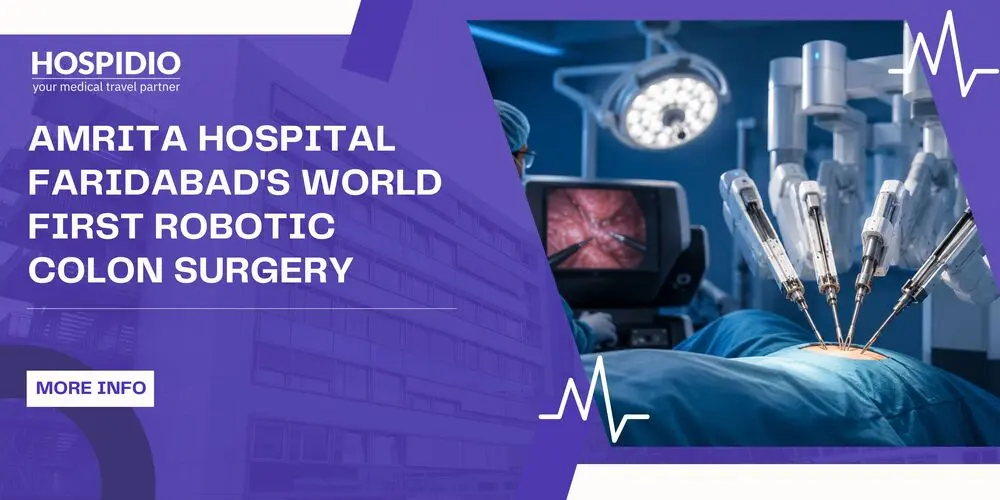
A medical milestone has been quietly achieved in Faridabad, India one that carries major implications for patients with complex gastrointestinal conditions, particularly those travelling internationally for care. The Department of Gastrointestinal Surgery at Amrita Hospital, Faridabad performed what is being recognised as the world's first robotic assisted surgery for a rare colonic tumour complicated by partial situs inversus, a condition in which some internal organs are positioned in a mirror image of their normal anatomical arrangement. The patient, a 67-year old man from Uzbekistan, not only survived a procedure that had no established surgical roadmap, he was eating normally and discharged within a week.
This is the kind of achievement that redefines what advanced surgical care looks like in India, and what international patients can now realistically expect when they choose to travel here for treatment.
What Happened: A Surgery With No Precedent
The patient arrived at Amrita Hospital, Faridabad, having suffered from intestinal obstruction for approximately two months. He had been unable to eat solid foods, had lost significant weight, and was experiencing vomiting, anaemia, and abdominal distension. Investigations revealed a malignant tumour in his colon, but with a critical anatomical twist.
The patient had partial situs inversus, a congenital condition in which some internal organs are mirrored in position. In this case, both his liver and colon were positioned differently from the standard anatomy. Not only was the tumour itself a rare variant of colonic malignancy, but the anatomical environment in which it sat made any surgical approach highly unconventional. There was no existing surgical literature or documented case of robotic-assisted intervention for this specific combination of conditions.
The six hour surgery was led by Dr. Abhishek Agrawal, Robotic GI Oncosurgery Consultant, alongside Prof. Puneet Dhar, Head of Department of Gastrointestinal Surgery, and Dr. Saleem Naik, Senior Consultant of GI Surgery at Amrita Hospital. The team modified both the patient's positioning and the docking of the robotic instruments to successfully access and remove the tumour despite the reversed anatomy.
The patient was moved to intensive care post surgery and shifted to a general ward the very next day. By the third day, he resumed a normal diet. He was discharged just seven days after the procedure.
Why This Surgery Was So Challenging
To understand why this case is medically significant, it helps to understand the two challenges the surgical team faced simultaneously.
The condition: Partial situs inversus occurs in approximately 1 in 10,000 people, encompassing both the total and partial forms. The partial variant, where only some organs are mirrored, is even rarer and less well documented in medical literature. In practical terms, it means the surgeon cannot rely on the anatomical landmarks that all their training has been built around. The appendix may be on the left; the colon may run in a direction that does not match standard surgical maps. In emergencies, this routinely leads to misdiagnosis and dangerous delays.
In this patient, a right sided sigmoid colon, one of the mirrored structures, had developed a malignant obstruction. The tumour was not only rare in its histological type but also located in an area that is difficult to reach even under normal anatomical conditions.
The surgical approach: Robotic assistance was not just a preference here, it was arguably the only tool that made the surgery feasible. Robotic systems like the da Vinci Xi, which Amrita Hospital uses, offer a magnified, high-resolution 3D view of the surgical site with depth perception that conventional laparoscopy cannot match. The robotic instruments are capable of bending and rotating with considerably greater dexterity than the human hand, enabling precise movements in confined or anatomically altered spaces. Critically, the system also incorporates tremor filtration technology that eliminates the natural hand tremors of the surgeon, an especially important feature when operating in an unfamiliar anatomical landscape.
As Dr. Agrawal noted, these capabilities collectively enable more accurate tumour targeting, better preservation of healthy surrounding tissue, and ultimately improved surgical outcomes, particularly in cases where there is no established technique to fall back on.
What is Situs Inversus?
Since this condition sits at the heart of the case, it is worth unpacking for readers who may not have encountered it before.
Situs inversus is a congenital anomaly in which the major visceral organs are mirrored from their normal positions. In situs inversus totalis, all organs, including the heart are on the opposite side. In the partial form (also called situs ambiguus in some classifications), only certain organs are reversed, leading to a more unpredictable and variable anatomy.
The condition is often genetic, associated with mutations or autosomal recessive inheritance patterns. Many people with situs inversus live entirely normal lives and are unaware of the condition until it is discovered incidentally or, as in this case, until an acute illness demands surgical attention.
The real danger of untreated or mismanaged situs inversus lies not in the condition itself, but in the delays it causes. Because symptoms of appendicitis, bowel obstruction, or other acute abdominal emergencies present on the wrong side, they are frequently misinterpreted by physicians who are not alert to the possibility. This can delay diagnosis and push patients toward complications that would have been avoidable with earlier intervention.
The Recovery: A Patient's Perspective
For all the technical complexity of this surgery, the outcome was straightforward in the most meaningful sense: the patient got his life back.
Prior to surgery, he had spent two months unable to eat, growing weaker, and facing the uncertainty of a malignancy for which no surgeon had mapped an operative plan. After the procedure, he described feeling profoundly grateful, noting that the robotic surgery had not just addressed the tumour but had restored his quality of life in a tangible, immediate way. Within days, the pain and constant discomfort that had defined his recent months were gone.
Following discharge, the patient's care path is clear. Based on the final biopsy, he will require a course of chemotherapy. After that, routine blood tests and imaging will be sufficient for surveillance and early detection of any recurrence. No long term medications or lifestyle restrictions are anticipated.
What This Means for International Patients Considering India
Stories like this one matter beyond the individual case. They illustrate the level of surgical capability that now exists in Indian hospitals, capability that is globally competitive and, in some cases, globally leading.
For patients travelling from Central Asia, the Middle East, or Africa for gastrointestinal or oncological care, Amrita Hospital, Faridabad is increasingly relevant as a destination. The hospital operates a 2,600 bed facility equipped with the da Vinci Xi surgical system, one of the most advanced robotic surgical platforms currently available. The team performing this surgery has documented competence not just in standard robotic procedures but in adapting those procedures to anatomically complex, first in world scenarios.
There are several practical points worth noting for prospective patients and their families. Robotic surgery offers shorter hospital stays and faster recovery compared to traditional open surgery. The smaller incisions reduce pain, blood loss, and infection risk. In this particular case, even a six hour surgery involving reversed anatomy resulted in a one week discharge timeline. For patients who have been turned away elsewhere or told their condition is too complex, this kind of outcome deserves attention.
Amrita Hospital has also demonstrated a pattern of surgical firsts beyond this case. The hospital was the first in Faridabad to install the da Vinci Xi system, the first to offer robotic assisted hip and knee replacements using the Mako system, and has previously performed landmark valve replacements using novel transcatheter approaches. This is an institution that appears to actively seek out and manage high complexity, high stakes cases.
A Reassuring Note for Patients With Complex Diagnoses
It is natural for patients with rare anatomical variations or unusual tumour presentations to feel that their cases fall outside the reach of standard care pathways. The anxiety of being told something is rare, or unusual, or unprecedented, can be deeply isolating.
What this case demonstrates is that "unprecedented" does not mean "impossible." It means the surgical team must bring a higher level of preparation, technological support, and adaptability. The team at Amrita Hospital did exactly that, and their patient, who had travelled from Uzbekistan carrying a diagnosis with no clear surgical roadmap, returned home able to eat, recover, and move forward with a defined treatment plan.
For those navigating similarly complex diagnoses, the key takeaway is to seek out centres that have both the technology and the institutional willingness to take on difficult cases. India's top hospitals are increasingly meeting both criteria.
Conclusion
The world's first robotic assisted surgery for a rare colonic tumour in a patient with partial situs inversus is a landmark not just for Amrita Hospital, Faridabad, but for surgical oncology more broadly. It demonstrates what becomes possible when advanced robotic technology is placed in the hands of a team willing to adapt established techniques to entirely new anatomical territory.
For international patients evaluating their options, particularly those with complex GI conditions, rare anatomical presentations, or tumours that have been deemed difficult or risky elsewhere, this development is a meaningful signal. The surgical expertise required to achieve this outcome exists in India. It is accessible. And for the right patient, it can be life changing.
References
- Medical Dialogues. (July 7, 2024). Amrita Hospital Doctors Perform First Robot Assisted Surgery for Rare Colon Tumour in 67-Year Old Uzbekistan Man. https://medicaldialogues.in/news/health/hospital-diagnostics/amrita-hospital-doctors-perform-first-robot-assisted-surgery-for-rare-colon-tumour-in-67-year-old-uzbekistan-man-131164
- Amrita Hospitals, Faridabad. (2024). Amrita Hospital Faridabad Performs World's First Robotic Assisted Surgery for Rare Colonic Tumour. https://www.amritahospitals.org/faridabad/news/amrita-hospital-faridabad-performs-worlds-first-robotic-assisted-surgery-rare
- Amma.org. (2024). Amrita Hospital, Faridabad, Proudly Offers Most Advanced, Cutting Edge Robotic Team. https://amma.org/news/amrita-hospital-faridabad-proudly-offers-a-comprehensive-largest-cutting-edge-robotic-team/
Recent Blogs

Frequently Asked Questions
It is the first documented robotic-assisted surgery performed for a rare colonic tumour in a patient with partial situs inversus, a condition where some internal organs are mirrored from their normal positions. No prior surgical case or established technique existed for this specific anatomical and oncological combination, making the procedure entirely unprecedented.
Partial situs inversus is a congenital condition in which some, but not all, internal organs are positioned as a mirror image of normal anatomy. The overall incidence of situs inversus (including both total and partial forms) is approximately 1 in 10,000 people. The partial variant is even rarer and less well-documented, as it varies considerably from person to person.
The reversed anatomy made standard surgical navigation extremely difficult. The da Vinci Xi robotic system provided a magnified, high resolution 3D view of the surgical site, instruments capable of bending and rotating beyond the range of the human hand, and tremor filtration technology for steadier movements. These features were critical in safely accessing and removing a tumour located in an anatomically unfamiliar environment.
The surgery lasted approximately six hours. The patient was shifted from intensive care to a general ward the day after surgery, resumed a normal diet by the third day, and was discharged just one week after the procedure, a notably fast recovery given the complexity of the case.
Shruti Verma has completed her M.Tech in Biotechnology with experience in medical writing and scientific content development. She specializes in translating complex biomedical and healthcare information into clear, accurate, and reader-friendly content for diverse audiences. When she is not designing content, probably she is designing graphics.
Guneet Bhatia is the Founder of HOSPIDIO and an accomplished content reviewer with extensive experience in medical content development, instructional design, and blogging. Passionate about creating impactful content, she excels in ensuring accuracy and clarity in every piece. Guneet enjoys engaging in meaningful conversations with people from diverse ethnic and cultural backgrounds, enriching her perspective. When she's not working, she cherishes quality time with her family, enjoys good music, and loves brainstorming innovative ideas with her team.