
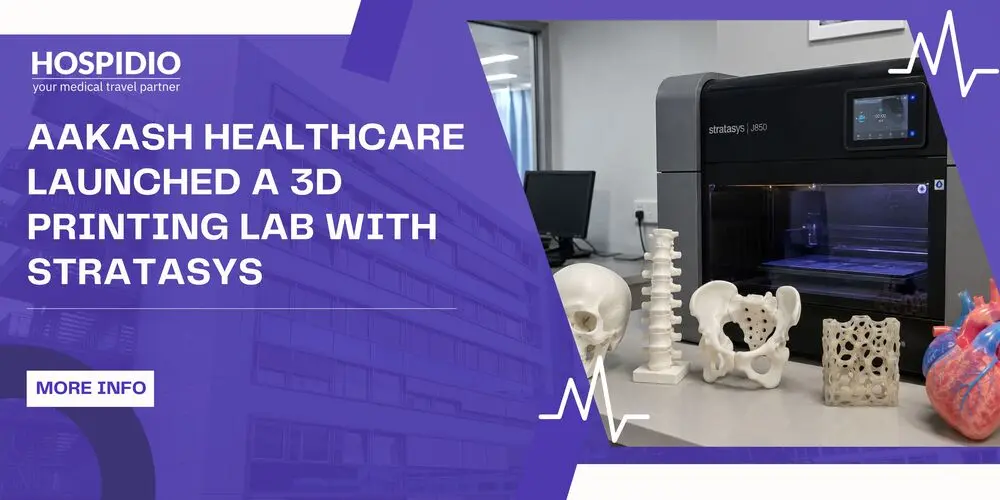
In September 2024, Aakash Healthcare Super Speciality Hospital in Dwarka, New Delhi, took a landmark step in personalised surgical care by launching an Advanced 3D Printing Lab in collaboration with Stratasys, the American-Israeli global leader in polymer 3D printing. The initiative marked one of the most significant milestones in the adoption of additive manufacturing technology within an Indian hospital setting, positioning Aakash Healthcare at the forefront of precision driven orthopaedic care in the National Capital Region (NCR).
What Was Launched and Why It Mattered
The centrepiece of the new facility was the Stratasys Digital Anatomy 3D Printer, a specialised system designed to produce highly accurate and realistic anatomical models that replicated each patient's unique physiology. The lab, formally known as Cure c 3D, was established with a clear clinical mission: to give surgeons and clinicians a powerful pre-operative tool that went beyond imaging data and into the physical, tangible world.
Before this lab existed, orthopaedic surgeons planning complex interventions relied primarily on 2D imaging scans and digital modelling software. These tools, while valuable, did not offer the tactile dimension of holding an exact replica of a patient's spine, joint, or bone structure in hand before making any incision. The 3D printing lab changed that.
Surgeons at Aakash Healthcare were now able to:
- Create patient specific anatomical models that matched the individual's exact bone structure, curvature, or deformity
- Plan surgical approaches in detail before entering the operating theatre
- Design and print customised surgical jigs, precision guides used to position instruments accurately during procedures
- Educate patients by showing them physical models of their own anatomy and proposed interventions
The result was not just a technological upgrade. It was a structural improvement in how surgical decisions were made, how patients were informed, and how outcomes were achieved.
Voices Behind the Launch
The launch brought together key leadership from both organisations, and the statements they offered reflected the broader significance of the collaboration.
Andreas Langfeld, President of Stratasys EMEA and APAC, described the launch as a significant milestone in the company's mission to improve patient care through 3D printing technology. He emphasised that the introduction of the Digital Anatomy 3D Printer at Aakash Healthcare represented far more than a product placement, it was a demonstration of what the technology could accomplish when deployed within a hospital that had both the clinical expertise and the institutional will to integrate it meaningfully.
Rajiv Bajaj, Managing Director of Stratasys India, highlighted that the collaboration was intended to demonstrate the true capabilities of 3D printing in delivering personalised healthcare solutions. He noted that by equipping surgeons with precise and functional anatomical models, the partnership was not only improving surgical preparation but also advancing the overall standard of patient care.
Dr. Aashish Chaudhry, Managing Director of Aakash Healthcare Super Specialty Hospital, framed the integration of Stratasys technology as a major advancement in the hospital's orthopaedic practice.
His remarks underscored that Aakash Healthcare had not simply acquired a piece of equipment, it had made a strategic commitment to personalised medicine and surgical precision as defining values of the institution.
The Clinical Case That Illustrated the Lab's Potential
Perhaps no case made the case for the Cure c 3D lab more powerfully than a documented treatment involving a 12-year old girl from Kyrgyzstan who had been diagnosed with Progressive Scoliosis Dorsolumbar, a rare condition affecting approximately three children in every hundred thousand. The condition caused a severe curvature of the dorsolumbar spine, a notoriously complex region to operate on.
Using the Stratasys J5 MediJet, the hospital's clinical team created 3D-printed models of the patient's spine that showed the abnormal curvature at multiple stages of care: before surgery, after the first surgical intervention, and after the second surgery in which customised 3D-printed jigs and titanium screws were used to reposition the spine.
The jigs themselves fabricated from MED-610 biocompatible material, a Stratasys certified surgical grade resin served as precise physical guides during the operation, reducing the margin for error in an area of the body where precision was not optional but essential.
The outcome of this case demonstrated what the lab was built to achieve. The combination of patient specific modelling and jig based surgical guidance allowed the clinical team to approach an extraordinarily complex case with a level of preparation and confidence that would have been difficult, if not impossible, with conventional methods alone.
What is the Stratasys Digital Anatomy Printer?
For readers unfamiliar with how these printers function, the Stratasys Digital Anatomy range represented a class of medical grade 3D printing technology designed specifically to replicate the mechanical and textural properties of human tissue, not just its shape.
Unlike standard 3D printers that produced rigid plastic models, the Digital Anatomy systems used multi-material PolyJet printing to produce models that could mimic the feel of cartilage, bone density variation, soft tissue resistance, and ligament flexibility. This meant a surgeon could not only see a patient's anatomy in three dimensions but also interact with it in a way that approximated the physical experience of surgery.
The J5 MediJet, the specific system at the heart of the Aakash Healthcare lab, offered a compact, all in one format suitable for point of care hospital environments. It was capable of printing in multiple materials simultaneously, enabling complex multi-tissue models to be produced in a single print run.
3D Printing in Indian Healthcare: A Growing Frontier
The launch of the Aakash Healthcare lab did not take place in isolation. It was part of a broader wave of medical 3D printing adoption that gained significant momentum across India through 2024.
Institutions including AIIMS New Delhi had begun incorporating Stratasys FDM and PolyJet solutions into neurosurgical training programmes, allowing trainees to practise on lifelike anatomical models before performing procedures on actual patients. In December 2024, AIIMS and the Indian Council of Medical Research co-hosted a 3D Printing Summit for Medical Devices, Simulation and Innovation, which brought together over 150 attendees from across the country to discuss the expanding role of additive manufacturing in clinical settings.
Stratasys India's Rajiv Bajaj captured the sentiment of that moment at the AIIMS summit: 3D printing was no longer a vision of the future, it had become a tool that was actively reshaping surgical practice, patient education, and medical device development across India's healthcare ecosystem.Aakash Healthcare's Cure c 3D lab stood as one of the most visible and clinically integrated expressions of that shift.
What This Meant for Patients
For patients, particularly those facing complex orthopaedic procedures, the existence of a dedicated 3D printing lab within the hospital carried practical implications.
Pre-surgical consultations became more visual and comprehensible. A patient could be shown a physical model of their own spine or joint, understand the nature of their condition in three dimensions, and see exactly where and how a surgeon intended to intervene. This improved informed consent, reduced pre-operative anxiety, and helped set realistic expectations for recovery.
Surgically, the availability of patient specific jigs and planning models reduced operative time, minimised the risk of instrument malpositioning, and supported better alignment outcomes in procedures such as spinal corrections and joint replacements, categories of surgery where Aakash Healthcare already held strong institutional expertise.
Reference
About Hospidio: This blog post is intended to provide factual, evidence based information to keep our community informed about developments in medical technology and hospital innovation. Always consult with healthcare professionals for medical advice.
Recent Blogs


Shruti Verma has completed her M.Tech in Biotechnology with experience in medical writing and scientific content development. She specializes in translating complex biomedical and healthcare information into clear, accurate, and reader-friendly content for diverse audiences. When she is not designing content, probably she is designing graphics.
Guneet Bhatia is the Founder of HOSPIDIO and an accomplished content reviewer with extensive experience in medical content development, instructional design, and blogging. Passionate about creating impactful content, she excels in ensuring accuracy and clarity in every piece. Guneet enjoys engaging in meaningful conversations with people from diverse ethnic and cultural backgrounds, enriching her perspective. When she's not working, she cherishes quality time with her family, enjoys good music, and loves brainstorming innovative ideas with her team.