
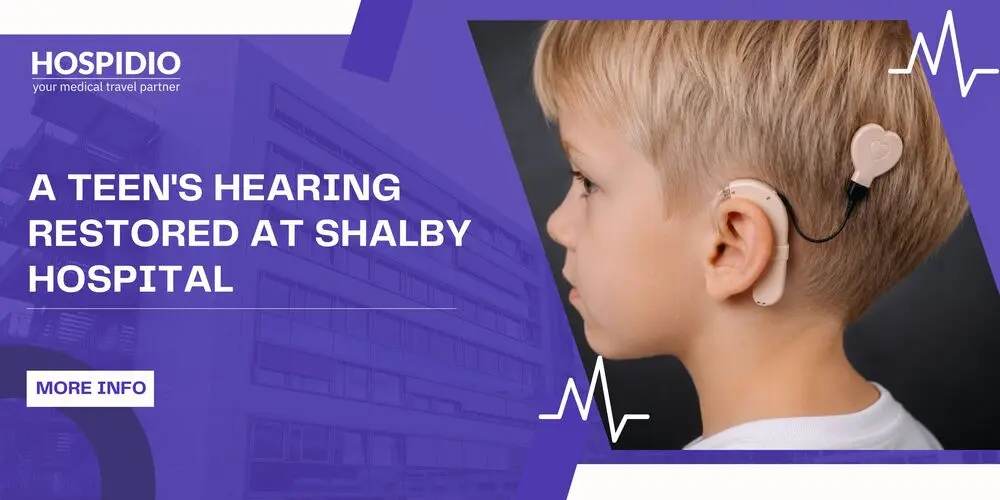
A 14 year-old patient from Iraq arrived at Shalby International Hospital in Gurugram unable to respond to sound, struggling with speech delay, and facing a future of worsening communication barriers. He had post lingual deafness meaning he had once heard the world and then lost it, and no hearing aid had been able to bring it back. Within weeks of surgery, that story changed.
His right ear was fitted with the Cochlear Nucleus Nexa System using the Kanso 3 Nexa Sound Processor, the world's first and only smart cochlear implant system, and one of the most recently launched hearing restoration devices globally. The procedure was led by Dr. Kunal Nigam and his ENT team at Shalby International Hospital, Gurugram. This case places Shalby among a select group of centres worldwide to have used this next generation technology, and it signals an important moment for international patients seeking cochlear implant care in India.
Here is what this surgery means, what the technology involves, and what it tells us about the future of hearing restoration for adolescents and adults.
Understanding Post Lingual Deafness: Why This Case Is Clinically Significant
Post lingual deafness refers to hearing loss that develops after a person has already acquired spoken language, typically after the age of six. In the case of this 14 year old patient, he had lived with language and speech already in place, which means the neural pathways for sound processing were established. This distinction matters enormously when it comes to cochlear implant outcomes.
Clinical research consistently shows that patients with post lingual deafness tend to achieve better speech recognition results following cochlear implantation compared to pre lingual patients, because the brain retains memory of how to interpret sound. A systematic review published in the Brazilian Journal of Otorhinolaryngology confirmed that cochlear implants deliver superior outcomes over conventional hearing aids in post lingual patients, with meaningful improvements in speech understanding, quality of life, and social participation.
A study published in Scientific Reports found that cochlear implantation in post lingually deaf patients is time sensitive, the longer the duration of deafness before surgery, the greater the risk of auditory pathway changes that affect outcomes. For a 14 year-old, intervening now rather than delaying into adulthood represents a critical window for maximising rehabilitation potential. Further research published in PubMed found that in individuals aged 10 to 39 with post lingual hearing loss, cochlear implantation is recommended irrespective of the duration of deafness, with post-operative sentence recognition scores averaging 80% across study populations.
This case at Shalby is not just a surgical success story, it is a timely clinical decision.
What Is the Cochlear Nucleus Nexa System with Kanso 3?
The device used in this surgery is the Cochlear Nucleus Nexa System specifically with the Kanso 3 Nexa Sound Processor. Launched in July 2025 following FDA approval, it is the world's first cochlear implant system featuring upgradeable firmware on the internal implant itself, an industry first that changes what it means to "future proof" a patient's hearing.
Here is what makes this system clinically and technologically distinct:
- Upgradeable Implant Firmware: Unlike all previous cochlear implant systems, the Nucleus Nexa allows the implant not just the external processor to receive firmware updates. This means the patient can benefit from future innovations without requiring revision surgery.
- Internal Memory: The implant stores the patient's unique hearing settings (called MAPs) directly inside the device. If the external sound processor is ever lost or damaged, those personalised settings can be instantly transferred to a replacement processor, eliminating the distress of reprogramming from scratch.
- Kanso 3 Nexa Sound Processor: The world's smallest and lightest rechargeable off the ear sound processor. It sits discreetly behind the ear and connects wirelessly, offering the patient a clean, socially comfortable profile, a consideration that matters deeply to an adolescent navigating school and social life.
- SmartNav Surgical Guidance: The system is supported by Nucleus SmartNav, which provides real time wireless feedback during surgery to confirm electrode placement and cochlear coverage, enhancing surgical precision and reducing operative risk.
- SmartSound IQ 2 with SCAN2: Automated environmental scene analysis that adapts the sound processing strategy in real time, in quiet rooms, noisy classrooms, or outdoor settings, without the user having to manually adjust anything.
For a teenage patient from a different country, beginning an entirely new chapter with hearing, this combination of reliability, discretion, and future adaptability is not a luxury, it is exactly what the clinical picture demands.
The Surgical Team and Why It Matters
The procedure was performed by Dr. Kunal Nigam leading the ENT team at Shalby International Hospital, Gurugram. Cochlear implant surgery is a technically demanding procedure that requires not only surgical precision but a coordinated multidisciplinary approach, including audiologists for pre-operative assessment, an experienced operating team for electrode insertion, and a dedicated rehabilitation team for the months that follow.
Shalby International Hospital, Gurugram operates as a centre for international patients from across the Middle East, Africa, and South Asia. The fact that this team is among the very few worldwide to have performed surgery with the Nucleus Nexa System at this stage of the device's availability reflects both the hospital's access to cutting edge technology and its ENT team's capacity to adopt new systems safely and effectively.
What Happens After the Surgery: The Rehabilitation Journey
For this 14 year old patient, surgery was the beginning, not the end. Cochlear implant rehabilitation is a structured, ongoing process that determines how well the brain adapts to the new signals it is receiving.
In the weeks following device activation, which typically occurs three to four weeks after surgery, the patient's audiologist programs the sound processor in a series of mapping sessions, gradually tuning the electrical stimulation to match the patient's individual auditory nerve response. For a post lingual patient, the brain has existing templates for sound that help accelerate this adaptation.
Speech therapy and auditory training run in parallel, targeting the specific speech delays present in this case. Research confirms that regular auditory rehabilitation is particularly significant for patients with longer durations of deafness, helping to restore the central auditory pathway's ability to decode speech signals. The structured rehabilitation pathway at Shalby is designed to bring this young patient progressively from sound awareness through to sentence recognition and natural conversation.
Progress in the first year is typically the most rapid, with meaningful improvements in speech understanding continuing for 18 to 24 months post activation.
What This Case Means for International Patients
For families in Iraq, the Gulf, East Africa, and across the developing world, accessing the latest cochlear implant technology has often meant travelling to Western Europe or North America, at significant cost and often after long waits. This case demonstrates that India's leading ENT centres are now implanting the same next generation devices as any world class facility, in some cases earlier in the global adoption curve.
The combination of clinical expertise, early access to advanced devices such as the Nucleus Nexa System, and India's established strength in post operative audiology and speech rehabilitation makes centres like Shalby International Hospital, Gurugram a genuinely competitive destination for cochlear implant surgery, at a fraction of the cost of comparable procedures in the United Kingdom or United States.
If you have a family member with severe sensorineural hearing loss who has not found adequate benefit from hearing aids, this milestone in Gurugram is a compelling reason to pursue a formal cochlear implant evaluation now.
Conclusion
A teenager from Iraq came to Gurugram with silence where language should have been. He left with one of the most advanced hearing devices on the planet, a personalised rehabilitation plan, and a pathway back toward communication, education, and a fuller life. The Shalby International Hospital ENT team, led by Dr. Kunal Nigam, has delivered not just a surgical procedure but a clinical milestone for their patient, for their institution, and for the broader community of international patients who need to know that world-class cochlear implant care is available in India today.
HOSPIDIO works with top ENT and cochlear implant specialists across India, including centres with access to the latest Nucleus Nexa technology. If you or a family member is considering cochlear implant surgery, share your audiological reports with us for a free, personalised treatment plan and cost estimate.
References
- Cochlear Limited. (July 8, 2025). Cochlear launches world's first and only smart cochlear implant system. PR Newswire.
- Cochlear ProNews. (July 8, 2025). Cochlear Nucleus Nexa System, the future of hearing. Available now.
- The Hearing Review. (July 9, 2025). Cochlear launches Nucleus Nexa smart cochlear implant system. Brazilian Journal of Otorhinolaryngology. Post lingual deafness: benefits of cochlear implants vs. conventional hearing aids. PMC.
- Scientific Reports. (December 20, 2018). Cochlear implantation in postlingually deaf adults is time sensitive towards positive outcome.
- PubMed / PMC. Clinical characteristics and hearing loss etiology of cochlear implantees undergoing surgery in their teens, 20s, and 30s.
- Shalby International Hospitals. (2026). LinkedIn: Cochlear implant using KONSO 3 with NEXA electrode, performed by Dr. Kunal Nigam.
Recent Blogs

Shruti Verma has completed her M.Tech in Biotechnology with experience in medical writing and scientific content development. She specializes in translating complex biomedical and healthcare information into clear, accurate, and reader-friendly content for diverse audiences. When she is not designing content, probably she is designing graphics.
Guneet Bhatia is the Founder of HOSPIDIO and an accomplished content reviewer with extensive experience in medical content development, instructional design, and blogging. Passionate about creating impactful content, she excels in ensuring accuracy and clarity in every piece. Guneet enjoys engaging in meaningful conversations with people from diverse ethnic and cultural backgrounds, enriching her perspective. When she's not working, she cherishes quality time with her family, enjoys good music, and loves brainstorming innovative ideas with her team.